49 works in this view — arrow keys or swipe to move between them.
Dance in Art
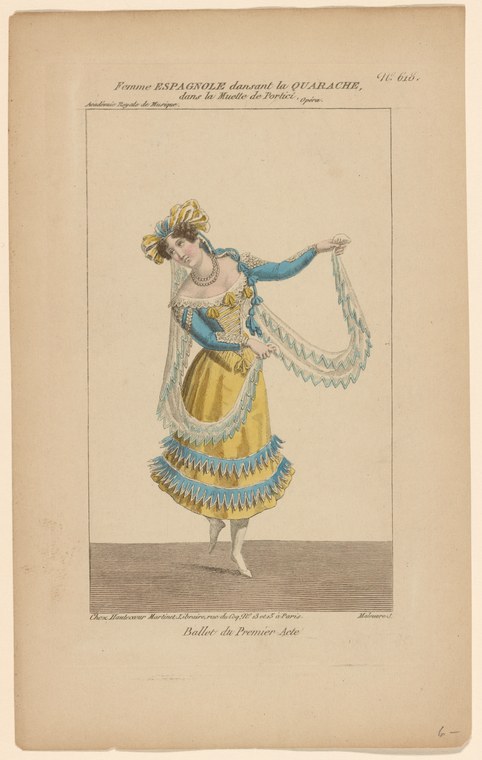
Femme espagnole dansant la quarache, dans la Muette de Portici. Opéra, Académie Royale de Musique. Ballet du premier acte
Unknown artist
- Collection:
- Prints depicting dance
- Source:
- New York Public Library
- Rights:
- Public domain — free to use, share and adapt.
- Recorded as:
- Public Domain
The quarache represents a crucial moment in the history of ballet and opera: the integration of national and exotic dance styles into classical technique as both a narrative device and a vehicle for prima ballerina display. Understanding how the quarache was performed, costumed, and marketed in prints like this one reveals how European theaters used dance to construct and consume ideas of otherness and spectacle. For historians of dance notation and theatrical practice, such prints are among the few visual records of choreography and performance before photography.
What you are looking at
A single female dancer occupies the center of a spare, neutral composition against a pale background. She stands in a classical contrapposto pose, her weight on one leg, the other extended lightly behind. She wears a yellow skirt with blue scalloped trim at the hem and a matching blue-trimmed bodice; her torso is bare above the waist, with jewelry at her neck and arms. A voluminous blue drapery—perhaps a shawl or theatrical prop—sweeps across her body from one arm, creating a dynamic diagonal line that contrasts with her composed stance. Her hair is styled up with ornament, and her expression is serene, gazing away from the viewer. The figure is rendered with hand-coloring over an engraved base, creating a delicate wash of watercolor in the flesh tones and fabric. The composition is formal and frontal, like a costume plate for a theatrical role.
The dancing
The dancer's weight distribution is controlled and aristocratic: one leg bears the weight while the other remains extended or relaxed, a pose suggesting classical training and refinement rather than vigorous movement. Her arms are extended but not rigid; the drapery flows from one arm, suggesting a moment of gentle articulation rather than full extension. Her torso is upright and elongated, the head held high. The single figure fills most of the frame vertically, emphasizing the elegance of her stance and costume rather than ensemble geometry.
The dance depicted
This is a quarache (or cuaracha), a Spanish-American theatrical dance that became a signature piece in grand opera during the early 19th century, particularly after its use in Auber's *La Muette de Portici* (The Dumb Girl of Portici), which premiered in 1828. The quarache was a lively, rhythmic dance, often performed as a solo or feature number by a prima ballerina within a dramatic opera. This print documents the first-act ballet from a Parisian production at the Académie Royale de Musique (the Opéra). The choreography and execution of the quarache in professional ballet emphasized dramatic posture, pointed feet, and Spanish-inflected arm gestures combined with classical technique. The costume—bare midriff, high waistline, and flowing drapery—reflects the theatrical exoticism associated with Spanish and South American settings in 19th-century Parisian opera.
How it was made
This is a hand-colored engraving, likely aquatinted, from the early 19th century. The image combines precise line work in the drapery and form with soft watercolor washes in the flesh, fabric, and background. This technique was standard for costume plates and theatrical documentation of the period, allowing for rapid dissemination to audiences, dancers, and theater practitioners. The hand coloring suggests an original or early impression, as later printings would have been less carefully finished. The small scale and portable format indicate this was a souvenir or reference document for those attending the opera or interested in theatrical fashion.
About this work
This print documents a moment in early 19th-century Parisian operatic spectacle: a solo quarache, a Spanish-inflected theatrical dance that had become a fashionable vehicle for leading dancers in grand opera. The Muette de Portici, which premiered in 1828, became one of the most performed operas of the century in Europe, and images of its celebrated dancers and choreography circulated widely as hand-colored engravings. The quarache itself occupied an interesting position between balletic classicism (pointed feet, upright carriage, academic arm positions) and exoticized Spanish or Latin American style (the drapery, the bare midriff, the dramatic posture). This print preserves not only the costume and setting of a specific theatrical production but also the aesthetic conventions by which early 19th-century audiences understood and consumed representations of non-European dance.
How to look at it
Look first at the stillness and poise of the figure. Despite the caption identifying a lively dance, the artist has chosen a moment of repose or preparation—a display of the dancer's carriage and costume rather than kinetic action. This reflects the convention of theatrical costume plates, which prioritized visibility and identification over the capture of movement. The drapery, however, is caught in motion, sweeping diagonally across the body, suggesting a recent turn or gesture. The contrast between the dancer's composed upright stance and the flowing, dynamic drapery is deliberate: it suggests a moment of suspended grace within choreography, the kind of instant a dancer might strike to display both technical control and dramatic presence.
The artist
The artist is not recorded. However, the print is clearly a professional theater documentation produced under the auspices of the Académie Royale de Musique (the Paris Opéra) during the 1820s or 1830s. Such prints were created by specialized theatrical engravers and colorists who worked in concert with the institution to capture celebrated dancers and roles. The hand-coloring and quality of the engraving suggest a skilled and established workshop rather than an amateur production.
The period
The early 19th century saw the triumph of Romantic ballet and the integration of operatic ballet into the grand opéra genre. *La Muette de Portici* (1828) was one of the foundational works of grand opéra and had enormous influence on European theater. Dance at the Paris Opéra was at the height of its prestige and technical refinement, with dancers like Marie Taglioni beginning to reshape the aesthetic toward ethereal, ethereal movement. Yet spectacle, national costume, and exotic dances remained essential features of operatic production. The quarache, borrowed from Spanish and Latin American performance traditions, allowed composers and choreographers to add color and rhythm to their narratives while keeping the dancer within the frame of classical technique. Printed costume and character documentation was a major industry in Paris during this period, both for theatrical archives and for public consumption as souvenirs and fashion references.
Where it lives
This hand-colored engraving is held in the New York Public Library's collection of prints depicting dance. Such objects were produced in Paris as part of the standard documentation and publicity apparatus of the Opéra, and they circulated as theatrical souvenirs and prints for collectors and practitioners.
Dance in this work
Questions about this work
What is a quarache?
The quarache (also cuaracha) was a lively, rhythmic Spanish or Spanish-American dance that became fashionable in Parisian grand opéra during the 1820s-1830s. It was typically performed as a solo or feature dance for a prima ballerina, combining Spanish-inflected arm and upper-body movement with classical ballet technique, pointe work, and academic carriage. The quarache appears in *La Muette de Portici* and other operas of the period.
Why is the dancer barefoot or bare-legged?
The dancer is wearing shoes (likely soft ballet slippers or heeled slippers), but the bare midriff and arms are part of the exotic theatrical costume associated with Spanish and Latin American characters in early 19th-century opera. This exposed, semi-classical costume was part of how European theaters signaled non-European or exotic identity while maintaining the refinement of the operatic stage.
What does the drapery show about the dance?
The flowing drapery suggests a moment of upper-body rotation or arm gesture within the quarache. The sweep of fabric across the torso indicates a recent turn or a held arm position; it is a visual cue that the dancer is in the midst of choreographic action, not static. This was a common feature of Spanish and Latin American dance styles in European theatrical representation.
Was this a real dance or theatrical invention?
The quarache had roots in Spanish and Latin American folk and popular dance, but by the time it appeared in Parisian opera, it was a theatrical genre with its own conventions and repertory. European choreographers adapted the style, blending it with classical ballet vocabulary. Like much 19th-century exotica, it was both inspired by and distinct from its sources.
More dance artwork





