49 works in this view — arrow keys or swipe to move between them.
Dance in Art
Vaslav Nijinsky in Schéhérazade
Unknown artist
- Collection:
- Prints depicting dance
- Source:
- New York Public Library
- Rights:
- Public domain — free to use, share and adapt.
- Recorded as:
- Public Domain
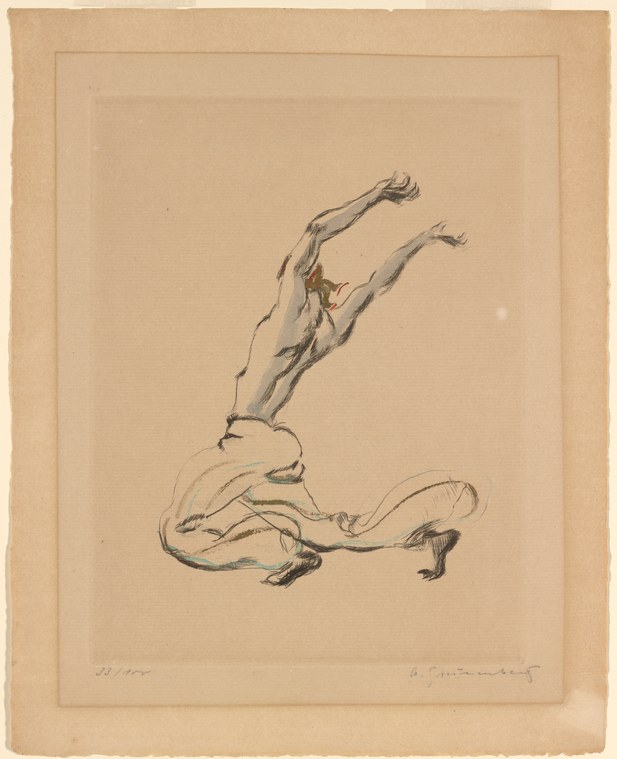
Nijinsky's performances revolutionized male ballet technique and presence, and contemporary drawings are rare primary evidence of how he actually moved. This image captures the explosive, weightless quality that made him legendary, freezing a moment of the flying jumps and extensions that defined his stage power. For historians and dancers, such studies are invaluable records of a performance tradition that exists now only in written accounts, photographs, and reconstructions.
What you are looking at
A single male dancer is captured in a moment of explosive, dynamic movement against a plain background. His body is stretched almost horizontally, legs extended behind him in a powerful leap or flying movement, arms reaching upward and forward. His musculature is rendered with careful anatomical attention, emphasizing the tension and control required for the pose. Below him, a crouching or reclining figure—possibly another dancer or a supporting form—provides compositional balance. The sketch is executed in pen or pencil with confident, economical line work; the artist has used subtle shading to define the body's form and the strain of the movement. The pose suggests a climactic moment of elevation and extension, frozen mid-air.
The dancing
The primary figure is a male dancer in a fully extended, near-horizontal flying position, with legs straight and parallel behind, torso lifted, and both arms raised. The musculature of the legs, back, and shoulders is anatomically precise and conveys considerable strength and control. A secondary figure below, rendered more lightly, appears to be in a supporting or grounded position. The relationship between the figures suggests either a lift preparation, a solo moment framed against a compositional counterweight, or a theatrical staging where the upper figure dominates the visual field through elevation and extension.
The dance depicted
This appears to be a study for or document of classical ballet, most likely from the early 20th-century Russian Imperial Ballet tradition. The extended, weightless flying position, the emphasis on balletic line and turnout, and the male dancer's musculature all align with the heroic male vocabulary of Romantic and early classical ballet. The catalogue identifies this as Vaslav Nijinsky in *Schéhérazade*, the 1910 Ballets Russes production choreographed by Michel Fokine. If correct, this would be a record of the male soloist's vocabulary in that work—a production famous for its sensuality and exotic Orientalism. The flying pose shown here is consistent with the dramatic, leaping vocabulary Nijinsky would have performed, though without the original production context or costume visible, the identification rests primarily on the catalogue attribution.
How it was made
The work appears to be a pen or ink drawing on paper, possibly with light wash or pencil underdrawing. The line is fluid and confident, with the artist using minimal shading to suggest form and musculature rather than modeling with tone. This technique—economical, gestural, anatomically engaged—is typical of rehearsal or study drawings made from live observation or memory by artists close to the dance world. The small scale and informal presentation suggest this was a working document or studio sketch rather than a finished exhibition piece, which would have given it considerable circulation within theatrical and artistic circles of the period.
About this work
This is a study drawing of a male dancer in a moment of balletic elevation and extension, attributed to Vaslav Nijinsky performing in Michel Fokine's *Schéhérazade* (1910). The work documents the heroic vocabulary of early 20th-century Russian Imperial Ballet through an image of extraordinary physical intensity. The drawing captures not narrative or character, but pure movement—the moment of peak extension in a leap, rendered with anatomical precision and an understanding of how balletic line and muscularity work together.
The image belongs to a small body of documentary evidence about Nijinsky's performing style and the Ballets Russes aesthetic. While photographs exist from the period, drawings like this offer a different kind of witness: the artist's selection of which moment to freeze, how to emphasize balletic line over photographic detail, and how to convey the energy and control of the movement. It is both a historical record and an artistic interpretation.
How to look at it
Look at the precision of the extended position: the straight line from the dancer's fingertips through his torso to his heels, the turnout in the supporting hip, the tension in the arch of the foot. The artist has chosen the moment of maximum extension—not the preparation, not the landing, but the instant of peak elevation. Notice how little of the figure is shaded; the artist relies on line and anatomical knowledge to convey the strain and control. The secondary figure below is rendered sketchily, as a foil to the sharp focus above—a compositional choice that emphasizes the upper figure's lightness and power.
The artist
The artist is not recorded in the catalogue. The drawing's style, subject matter, and handling are consistent with the circle of artists and illustrators documenting the Ballets Russes in its early years—a period when theatrical design, costume, and movement documentation attracted serious visual artists. Without signature or attribution, the identity cannot be established from the image alone, though the confident anatomical knowledge and proximity to the subject suggest a trained artist with access to rehearsal or performance.
The period
This drawing was made during the first flourishing of the Ballets Russes (1909–1929), a period when Russian Imperial Ballet vocabulary and aesthetics were being introduced to Western Europe with revolutionary impact. *Schéhérazade*, with its exotic subject matter and sensual, grounded movement vocabulary (in contrast to the ethereal style of earlier Romantic ballet), premiered in 1910 and was one of the company's most celebrated productions. Male dancers like Nijinsky were elevated to a new prominence; the virtuosity and physical presence of the male soloist became as central to the art form as the ballerina had been. This drawing documents that shift, capturing the explosive, athletic quality of Nijinsky's performing style.
Where it lives
This drawing is held by the New York Public Library in its collection of prints depicting dance. It survives as a small sketch on paper, catalogued without a recorded artist, date, or medium, suggesting it may have entered the collection as part of a larger archive or donation related to theatrical history.
Dance in this work
Questions about this work
Is this actually Nijinsky?
The catalogue attributes it to Nijinsky in *Schéhérazade*, but the artist is not recorded and there is no visible signature. The style and subject matter are consistent with early 20th-century Ballets Russes documentation. Without archival evidence or a signed inscription, the attribution rests on the catalogue record rather than definitive proof in the image itself.
What is *Schéhérazade*?
*Schéhérazade* was a 1910 ballet choreographed by Michel Fokine for the Ballets Russes, set to Rimsky-Korsakov's orchestral suite. It was celebrated for its exotic Orientalist subject matter and sensual, grounded movement vocabulary, a departure from the ethereal style of 19th-century Romantic ballet. Nijinsky danced a male slave role in the original production.
Why is the figure below there?
The secondary figure may represent a partner or supporting dancer, or it may be a compositional device—a grounded, reclining form that throws the upper figure's elevation and extension into sharp relief. Without knowledge of the original choreography or the drawing's context, its precise function cannot be determined.
How was this drawing made?
The technique appears to be pen or ink on paper, possibly with pencil underdrawing. The artist used confident, economical line work and minimal shading to suggest form. This approach is typical of rehearsal or study drawings made by observant artists close to the theater world, rather than finished exhibition pieces.
More dance artwork





