49 works in this view — arrow keys or swipe to move between them.
Dance in Art
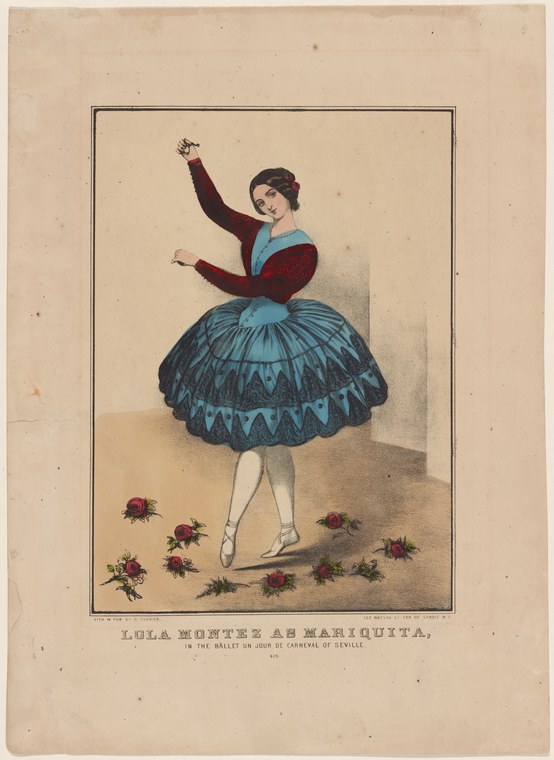
Lola Montez as Mariquita, in the ballet Un jour de carneval of Seville
Unknown artist
- Collection:
- Prints depicting dance
- Source:
- New York Public Library
- Rights:
- Public domain — free to use, share and adapt.
- Recorded as:
- Public Domain
Lola Montez was one of the first modern celebrities, and this print is a primary document of how she was visually marketed and remembered. For historians of Romantic ballet and theatrical practice, the image records an alternative lineage of 19th-century dance—not the canonical classical ballet of Paris, but the spectacular, star-driven performance economy that ran parallel to it. The print's circulation as a souvenir reveals how dance history was made public: not through notation or formal reviews, but through images sold in theatres and on the street.
What you are looking at
A solo female dancer in mid-performance strikes a theatrical pose against a plain, subtly shaded backdrop. She stands en pointe on her right leg, her left leg raised in a high développé or attitude position, while her right arm is lifted triumphantly overhead and her left arm extends to the side for balance. She wears a voluminous turquoise tutu with dark blue underskirts, a burgundy velvet bolero or jacket, and a blue corsage at her waist. Scattered across the stage floor around her feet are scattered flowers—dark red roses and smaller blooms—suggesting applause and triumph. Her pose conveys classical theatrical elegance combined with a moment of personal exuberance: the raised arm and upright carriage suggest both discipline and joy. The hand-coloured engraving technique creates soft shadows beneath her figure and behind her body, emphasizing the stage space.
The dancing
A single female dancer positioned en pointe, her weight entirely supported by her right leg in full plantarflexion. Her left leg is raised high in a line characteristic of academic ballet, knee bent slightly in what appears to be attitude or a high développé. Both arms are actively engaged: the right arm raised above her head in a celebratory gesture, the left extended laterally for balance. Her torso is upright, her gaze directed upward, her carriage aristocratic. The pose suggests the moment immediately following a successful performance or a climactic tableau within a narrative dance.
The dance depicted
This is a Romantic-era ballet performance by Lola Montez, the Irish dancer and performer who became famous across Europe in the 1840s–50s. The image captures her in the title role of *Un jour de carnaval de Séville* (A Day of Carnival in Seville), a vehicle for her style of dancing that blended classical ballet technique with Spanish-influenced movements and dramatic performance. Montez was not trained in classical ballet but was known for her charisma and her ability to execute certain technical feats; the pointe work visible here may reflect either genuine ability or the conventions of theatrical advertising. The scattered flowers indicate the celebratory context typical of Romantic ballet codas, and the Spanish subject matter aligns with her documented repertoire. The pose captures the theatrical apotheosis of a popular entertainer rather than the abstract refinement of classical ballet aesthetic.
How it was made
This is a hand-coloured engraving or possibly a lithograph with hand-colouring. The printing technique is apparent from the fine linear shading in the background and the precise outline of the figure; the colours—particularly the jewel-toned turquoise tutu and burgundy jacket—are applied by hand in transparent washes, a standard practice for theatrical prints of the 1840s–50s. This technique allowed for rapid, economical reproduction of images for sale to theatre audiences and the wider public, making it a form of mass-market ephemera. The size and format suggest it was distributed as a souvenir or promotional item, typical of the star-image economy developing around celebrated performers of the period.
About this work
This hand-coloured engraving preserves a moment from a mid-19th-century theatrical performance by Lola Montez in a now-obscure Spanish-themed ballet. It documents not the history of classical ballet technique but the history of theatrical stardom, celebrity performance, and the visual language used to market dancers to the public. Montez was a cultural phenomenon across Europe, and prints like this—circulated far more widely than any written account—shaped how audiences across continents imagined her art. The work sits at the intersection of dance, theatre, printmaking, and celebrity culture, capturing a specific moment of pose and triumph that was already, by the act of printing and colouring it, being transformed into image, myth, and merchandise.
How to look at it
The viewer should notice the precision of the pointe work—the ankle in full plantarflexion—and the classical carriage of the torso, which coexist with the theatrical, almost operatic gesture of the raised arm and triumphant pose. This is not the cool, ethereal aesthetic of canonical Romantic ballet; it is the heat of performance and personality. The scattered flowers are not incidental decoration but evidence: they mark the moment as one of public acclaim and victory. The hand-colouring is also worth attending to—the jewel tones are not naturalistic but enhance the theatrical fantasy of the scene. The print preserves not a moment of pure dance, but a moment of theatrical spectacle in which a particular performer's charisma and technique are on display.
The artist
The artist is unrecorded in the catalogue. Theatrical prints of this type were produced by specialist studios that often did not sign individual images; the engraver, colourist, and publisher might be different people. Such prints were typically based on sketches made during rehearsal or performance, or on costume designs; they were then engraved, proofed, and distributed rapidly to capitalize on a performer's fame. This was industrial cultural production, and individual artistic identity was secondary to speed and market demand.
The period
The 1840s and 1850s were the height of the Romantic ballet era, when dancers like Marie Taglioni achieved unprecedented international fame and theatrical prints became standard merchandise. Simultaneously, a parallel star system existed outside the grandes troupes: independent performers like Montez who combined ballet vocabulary with theatre, acrobatics, and national dance. The Spanish subject matter reflects the period's fascination with exotic and theatrical nationalism. Montez's career coincided with early lithographic and hand-colouring technology that made theatrical images affordable and mass-producible for the first time, changing how dance was documented and circulated.
Where it lives
The print is held in the New York Public Library's collection of prints depicting dance. It belongs to a category of theatrical ephemera—programmes, souvenir prints, playbills, and costume designs—that document the performance economy and visual culture of 19th-century theatre. Such prints were meant to be consumed quickly, given as gifts, and discarded; their survival in institutional collections is somewhat accidental, a consequence of librarians' decisions to preserve the history of theatre and celebrity.
Dance in this work
Questions about this work
Who was Lola Montez?
Lola Montez (c. 1821–1861) was an Irish-born dancer and performer who became one of the first international theatrical celebrities. She trained in ballet but performed as an independent artist across Europe and America, combining classical technique with Spanish dances and dramatic performance. She was notorious as well as celebrated: her romantic entanglements with European nobility and her dramatic exits from theatres made her a tabloid sensation. By the 1840s–50s, she was one of the highest-paid performers in Europe and one of the most visible female performers of her era.
What is *Un jour de carnaval de Séville*?
It was a ballet or divertissement created as a vehicle for Montez, likely choreographed to showcase her style of dancing rather than to advance narrative or classical technique. The title indicates a Spanish carnival setting, which allowed for spectacular costume, music drawn from Spanish sources, and a vehicle for both classical ballet vocabulary and the flamenco-influenced or Spanish-influenced movements that were part of Montez's signature. The work is now lost; this print may be one of the only surviving documents of what it looked like.
Could Lola Montez actually dance en pointe?
This is debated. Contemporary accounts suggest she was a competent dancer with good technique but not trained from childhood in classical ballet. Some critics were dismissive of her technical ability and attributed her success to beauty, charisma, and scandal. Others praised her execution. This print's depiction of pointe work may be accurate, or it may be an idealization of her ability by the printmaker—theatrical prints often enhanced or corrected reality in service of the performer's image.
How were theatrical prints like this one made and used?
An engraver or lithographer would create an image from a sketch or design; the stone or plate would be printed, producing thousands of black-and-white impressions; then teams of hand-colourists would apply watercolour or gouache to each print individually. These were sold in theatres, at the stage door, and by street vendors—they were inexpensive, portable souvenirs that allowed the public to take home an image of a celebrated performer. For dancers and theatres, prints were advertising: they extended a performer's fame beyond those who had seen the live performance.
More dance artwork





