49 works in this view — arrow keys or swipe to move between them.
Dance in Art
Zonnehof
Unknown artist
- Collection:
- Prints depicting dance
- Source:
- New York Public Library
- Rights:
- Public domain — free to use, share and adapt.
- Recorded as:
- Public Domain
For historians of court culture and theater, this image documents the scale and apparatus of aristocratic entertainment at a moment when dance was inseparable from machinery, music, and visual allegory. For dance historians, it reveals how far removed court spectacle was from the social dances of the ballroom, and how much of what courts called 'dance' was actually organized pageantry. The engraving itself is a key source, since very few court spectacles survive in any form of documentation.
What you are looking at
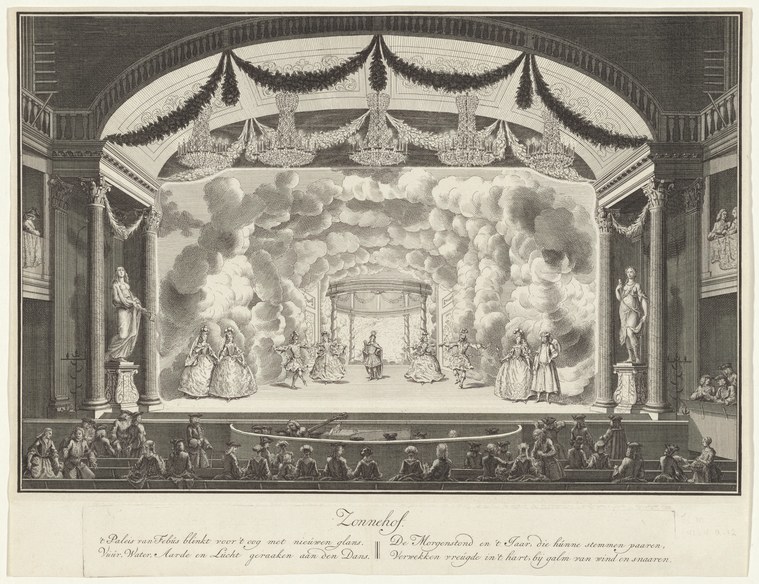
This is an engraving of a theatrical scene, likely from the 18th century, depicting an elaborate stage production. The proscenium is framed by classical columns and a richly decorated arch swag with deep festoons. The stage floor holds a formal arrangement of costumed figures in what appears to be a court or ballroom setting. Center stage sits a large decorative structure—possibly a pavilion or throne—around which the dancers are positioned. Massive clouds of smoke or theatrical effect billow upward in the background, creating a romantic or celestial atmosphere. An orchestra or musicians occupy the space above the stage action. The theater itself is fully populated: the pit and boxes are filled with spectators in period dress, suggesting this was a significant court entertainment or public theatrical event. The composition emphasizes symmetry and theatrical machinery as much as human movement.
The dancing
The dancers are arranged in a formal, processional configuration rather than in active social dance. They wear elaborate 18th-century costume—the women in full skirts with structured bodices, the men in coats and breeches. Their postures are upright and stately, with figures standing or moving at a dignified pace rather than executing rapid steps. No couples are in closed holds or frames. The grouping suggests a ceremonial or choreographed tableau rather than the social reciprocity of partner dance. The spacing is formal and the overall effect is of pageantry and visual spectacle organized for frontal viewing.
The dance depicted
This depicts a formal court entertainment or ballet de cour, a genre of theatrical spectacle that combined dance, music, machinery, and allegorical narrative. The title 'Zonnehof' (which may refer to a 'sun court' or solar theme) suggests this was a court production, possibly Dutch or Flemish given the name. The choreography visible here is processional and geometric rather than balletic in the later sense—the dancers are arranged and moved as elements of a larger visual composition. The extensive machinery, scenery, and orchestration indicate this was a high-investment court production meant to demonstrate wealth, sophistication, and royal power through spectacle. Without access to a libretto or clearer documentation, the specific narrative cannot be determined, but the formal arrangement and heavenly apparatus suggest an allegorical or mythological theme.
How it was made
This is an engraving—a print made from an incised metal plate—in black and white. The fine parallel lines (hatching and cross-hatching) create tonal gradation and atmosphere, particularly visible in the clouds and architectural details. Engravings of this type were the primary method for documenting and circulating images of court spectacles in the 17th and 18th centuries, before photography. This technique allowed multiple copies to be printed and distributed, making such performances known to audiences and courts far beyond the original venue. The level of detail and the composition suggest this was a commissioned record of a significant event, made for courtly circulation or publication in a festival book.
About this work
Zonnehof is a formal record of an 18th-century court theatrical spectacle, captured in engraving to preserve and publicize the event. The work documents not primarily a social dance but a theatrical machine—a complex production combining music, scenery, costume, procession, and coordinated movement to create an allegorical or mythological entertainment. It sits at the intersection of dance history and theater history, showing how courts used movement and spectacle to construct ceremony and authority. The work belongs in a dance gallery because dance, however formal and processional, was central to the court's self-representation; but it also demonstrates the limits of dance as social practice—this is dance deployed as architectural and political spectacle.
How to look at it
Attend to the formal, geometric arrangement of the figures and the dominance of architecture, clouds, and machinery in the composition. The dancers themselves are small relative to the scenic apparatus, emphasizing that this spectacle was theater first and dance second. Notice the full house—the performance was a public or semi-public court event. Look at the positioning of the orchestra and musicians above, indicating that music and dance were coordinated from a composed score. The smoke effects and architectural frame tell you that the event was about creating an illusion of a supernatural or allegorical realm, not about displaying individual skill or social virtuosity in dance.
The period
This engraving dates from the era of the court ballet in its maturity—likely the 17th or 18th century, when elaborate theatrical productions were a central element of court ceremony and diplomacy in France, the Dutch Golden Age, and other European courts. Dance at this period was split: the ballroom saw the rise of social dances like the minuet, gavotte, and contredanse, while the court stage produced increasingly spectacular ballets de cour that combined allegorical narrative with spectacular machinery. The engraving medium allowed such productions to be documented and their prestige distributed across courts and collections. By the time this work was made, the ballet de cour was beginning to evolve toward the modern ballet, but its machinery and spectacle remained dominant.
Where it lives
The work is held in the New York Public Library's collection of prints depicting dance. The title and the Dutch-language inscription at the foot suggest this may be a record of a Dutch or Flemish court production, or a print circulated among Dutch collectors of theatrical imagery.
Dance in this work
Questions about this work
Is this a ballet?
It is a court theatrical spectacle that includes dance, but it is not ballet in the modern sense. Dance is one element among music, machinery, costume, and procession. The dancers are arranged in formal groups and do not execute the rapid, virtuosic footwork of later ballet.
What is the title 'Zonnehof' and what does it mean?
The title appears to be Dutch or Flemish. 'Zonnehof' may refer to a 'sun court,' suggesting an allegorical or mythological theme, but without a libretto or additional documentation, the exact narrative cannot be determined from the image alone.
How do we know this was a real event and not an imagined scene?
Engravings of this type were commissioned as official records of court spectacles and were published in festival books or distributed as prestige items among courts and collectors. The level of detail, the inscription, and the style of the print all indicate this documented an actual production, not a fantastical invention.
Who would have danced in a production like this?
Court dances of this type included members of the royal family and nobility, professional courtiers trained in dancing, and sometimes imported dancers or theater professionals. Men and women danced separately or in formal groupings rather than as partners in the modern ballroom sense.
More dance artwork





