30 works in this view — arrow keys or swipe to move between them.
Dance in Art
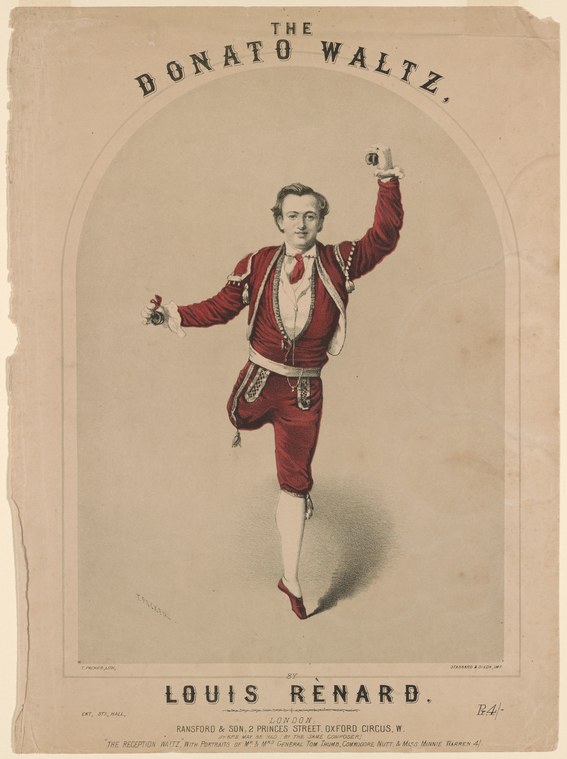
The Donato waltz, by Louis Renard
Unknown artist
- Medium:
- Lithograph
- Dance:
- Waltz
- Era:
- Early 1800s (Waltz Revolution)
- Source:
- New York Public Library
- Rights:
- Public domain — free to use, share and adapt.
- Recorded as:
- public_domain
The image documents a crucial moment in dance history when the waltz, originally a folk and rural social dance, was being adopted, refined, and theatricalised by urban professional dancers and choreographers. It shows how a single named step or variation—attributed here to someone called Donato—could become a vehicle for display and innovation. The work also illustrates the role of commercial print in spreading knowledge of new dances, making named steps and dancers known to audiences who might never see them live.
What you are looking at
A single male dancer in elegant early-19th-century costume is caught mid-movement against a plain background. He wears a burgundy velvet jacket trimmed with gold braid, a white shirt visible at the chest, and matching burgundy breeches that end above the knee. His posture is animated and theatrical: one leg is raised and bent, the torso leans forward with a slight twist, and his arms are raised—one higher than the other—in a gesture of exuberance or flourish. His weight appears to be on the supporting leg, captured in the instant of a turn or leap. The figure occupies the centre of a framed oval composition, and the artist has used shading beneath the dancer to suggest the ground plane. The overall effect is of a virtuoso performer in the moment of display.
The dancing
The single dancer demonstrates an upright posture with an active, asymmetrical arm position—one arm raised higher than the other in a gesture of panache. The raised leg is bent at the knee and lifted high, suggesting either the apex of a hop or the preparation for a turn; the supporting leg appears straight and engaged. The frame is open and expressive rather than closed or formal. The body shows flexibility and control; there is no partnering, and the dancer's orientation suggests performance toward an audience rather than social reciprocal movement.
The dance depicted
This is identified in the title as the Donato Waltz, a named waltz variant from the early 19th century. The image shows the theatrical solo interpretation or showcase of a waltz step rather than the social couple dance for which waltzes were typically known. The Donato waltz appears to have been a display piece or character variation, performed here by a professional dancer in formal costume. The posture and gesture suggest the virtuosic, almost balletic treatment that some popular dances of the period received when lifted into theatrical contexts. The raised leg and energetic arm work go well beyond the basic three-step pattern, indicating embellishment or a stylised interpretation for performance.
How it was made
This is a hand-coloured lithograph, a reproductive technique that allowed for wider distribution and lower cost than engraving alone. The printer's marks at the bottom indicate it was issued by Hansford & Son, a London publisher. Lithography enabled soft gradations of tone, visible here in the shading of the figure and background; the colouring was applied by hand after printing, which explains slight variations in register and coverage. This production method indicates a work made for a broad market—sheet music covers, theatrical souvenirs, or dance instruction—rather than a unique or expensive object.
About this work
This is a hand-coloured lithograph depicting a male dancer performing the Donato Waltz, a named variant of the waltz that emerged during the early 19th-century dance revolution. The image shows not the social dance as practised by couples but its theatrical transmutation into a solo showpiece for a professional performer. The elegant costume, fluid pose, and raised leg signal the influence of ballet technique on popular dance; the waltz itself was still relatively new and fashionable during this period, and named variants—named often after celebrated dancers—were part of its rapid dissemination and transformation across social and theatrical contexts. The work is a commercial print, made for circulation among dancers, theatre-goers, and the general public interested in current fashions in movement.
How to look at it
Note the moment chosen: not the beginning of a step but the peak or climax of the movement, where the raised leg and lifted arms convey maximum energy and extension. This is a professional performer's device—showing the dance at its most visually striking rather than its most typical. Look at the arms: the asymmetry, the openness, and the slight torsion of the torso reveal the influence of ballet and theatrical training on what began as a simple rotational social step. The elaborate costume also signals that this is performance dress, not the evening wear a couple would wear to a ball. The artist has chosen to show virtuosity and display rather than the intimate partnering that defined the social waltz.
The artist
The cataloguer has not recorded the artist or designer. The work is published by Hansford & Son of Princess Street, Oxford Circus, a London theatrical publisher. The print likely reproduces a design by a theatrical illustrator or dance artist of the period, but no signature is legible in the image. The unsigned or unattributed status was common for commercial dance prints, which were often produced rapidly to capitalise on popular performers or crazes.
The period
This work belongs to the opening decades of the 19th century, a period of explosive enthusiasm for the waltz across Europe and North America. The waltz had arrived from rural Austria and Bavaria and was adopted by urban ballrooms and theatres with extraordinary speed, despite moral objections to its close partnering and rotational momentum. Within this fervour, professional dancers began to create and name variations: specific step sequences or stylistic treatments that could be attributed to themselves or celebrated dancers. The waltz was also beginning to influence theatrical dance and ballet, which had previously been dominated by narrative pantomime and court dances. The Donato Waltz sits at this intersection of social, commercial, and theatrical dance innovation.
Where it lives
The work is held by the New York Public Library. It is a commercially printed theatre or dance souvenir, likely produced in London for retail sale in the 1810s or 1820s. Such prints were typically sold as individual sheets, sometimes bound into collections, and circulated among dancers, musicians, and fashionable society.
Dance in this work
Questions about this work
What is the Donato Waltz?
The Donato Waltz is a named variant or embellished interpretation of the waltz, likely created or made famous by a dancer or choreographer named Donato in the early 19th century. Rather than the basic three-step rotational pattern of the social waltz, it appears to have included raised legs and arm work suitable for theatrical display. Named waltzes were common during this period as the dance spread rapidly across Europe and professionals competed to create distinctive variations.
Why does this look more like ballet than a ballroom dance?
By the early 19th century, theatrical and ballroom dance were beginning to influence each other. Professional dancers who performed waltzes in theatres brought ballet training and technique to the form, adding extensions, turns, and arm movements that went far beyond the couple dance. This image shows that theatrical translation: the raised leg, the open frame, and the energetic gesture are balletic interventions applied to a popular social form.
Was this a solo dance or a couple dance?
The waltz as a social dance was almost always danced by couples in a closed embrace. This image shows a solo theatrical performance or showcase, a vehicle for a professional dancer to demonstrate skill and virtuosity. Such display pieces coexisted with the social form and were often used to introduce or popularise new steps and variations.
How was this print made and distributed?
This is a lithograph, a print made from a stone or metal plate. The image was first drawn or transferred to the stone, then inked and printed on paper. Hand-colouring was added afterwards by workers using watercolour or similar pigments. This method was cheaper and faster than engraving, allowing London publishers to produce dance prints in quantity for sale to theatre-goers, dancers, and the fashionable public.
More Waltz artwork