49 works in this view — arrow keys or swipe to move between them.
Dance in Art
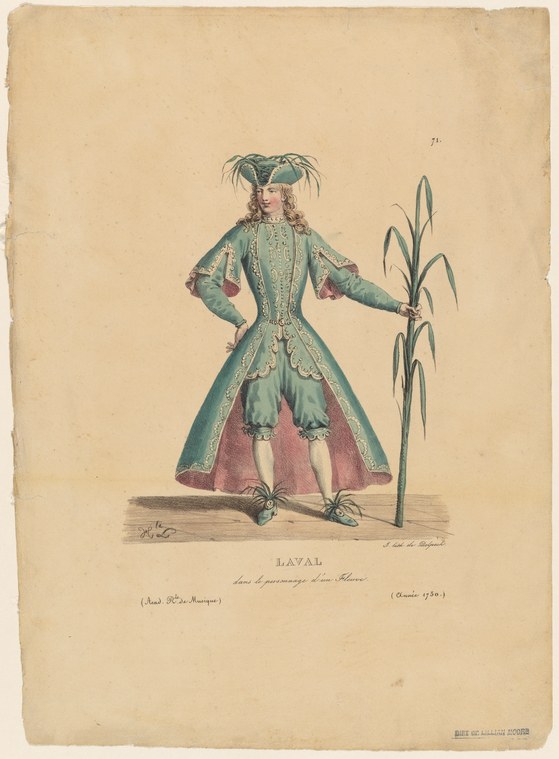
Laval dans le personnage d'un Fleuve
Unknown artist
- Collection:
- Prints depicting dance
- Source:
- New York Public Library
- Rights:
- Public domain — free to use, share and adapt.
- Recorded as:
- Public Domain
This work preserves evidence of an entire genre of baroque character dance now known only through prints, librettos, and written accounts. For historians of dance, costume, and theater, it documents both the movement vocabulary of an identified performer and the visual conventions used to represent allegorical roles on stage and in circulation. The inscription provides a rare named attribution, making this a potential record of a specific historical dancer's celebrated role.
What you are looking at
A single figure stands in three-quarter view against a pale background, dressed in an elaborate early 18th-century costume of teal-green silk with rose-pink underskirts and matching trim. The garment features a fitted bodice with a deep décolletage, long sleeves, and a full skirt that falls to mid-calf, revealing silk stockings and heeled shoes. The figure's dark hair is arranged high on the head with feathered plumes rising above. The left arm extends outward with palm upturned in a graceful gesture; the right arm holds a similar pose at the hip. To the right of the figure stands a single tall plant stem with drooping leaves—iconographic shorthand for a river or water element. The image is executed in hand-colored engraving or etching, with careful attention to the play of light across the silk fabrics and the precision of the costume's cut.
The dancing
The single dancer stands in a composed, upright posture characteristic of formal court presentation. Both arms are raised and extended in elegant port de bras, with soft, turned-out positions suggesting trained movement vocabulary. The weight appears evenly balanced on both feet, with no indication of active stepping or traveling; the body faces the viewer with an open, frontal presentation. The extended arms and open frame suggest a pose held for display rather than mid-motion, typical of allegorical or character dance presentation in the baroque and early rococo periods.
The dance depicted
This appears to be a representation of an allegorical character dance or divertissement from the early 18th century, most likely from French court or theatrical tradition. The inscription identifies the figure as 'Laval dans le personnage d'un Fleuve' (Laval in the character of a River). Such personified dances, drawn from classical mythology and allegory, were central to court ballets and theatrical entertainments of the period. The formal presentation and refined costume suggest this documents either a specific historical dancer's role or an idealized type of character dance for genteel audiences. The plant device beside the figure reinforces the allegorical identity rather than depicting actual stage scenery.
How it was made
This is a hand-colored engraving or etching, likely mid-to-late 18th century based on the printing style and coloring technique. The artist has employed fine line work to establish the costume's structure and the figure's outline, with colored washes—predominantly teal, rose, and flesh tones—applied by hand afterward. This technique allowed for reproducible imagery circulated among educated, affluent audiences interested in court fashion, theatrical gossip, and dance history. The care taken in rendering fabric texture and the fashionable detail suggest this was a prestige production, possibly related to a specific celebrated dancer or performance.
About this work
This is a hand-colored engraving documenting a character dance or divertissement role, likely from early 18th-century French court or theater tradition. The figure identified as Laval performing the allegorical role of a River exemplifies the genre of mythological and personified character dances that formed a staple of baroque and rococo theatrical entertainments. Such images circulated among elite audiences as records of celebrated dancers, fashionable roles, and refined courtly movement. The work sits at the intersection of dance history, costume documentation, and allegorical theatrical tradition, preserving both the visual language of a specific performer and the conventions of a now-vanished performance mode.
The print demonstrates how allegorical character was conveyed through pose, costume, and symbolic objects rather than through narrative action. Laval's identity as a river is established not through flowing motion but through the heraldic plant device and the graceful, static presentation of the figure. This approach to documenting dance—freezing a single posed moment rather than capturing movement—was standard practice for theatrical prints of the period and reveals how contemporaries understood and valued these roles.
How to look at it
Attend to the precise posture and arm position, which convey a trained, formal movement vocabulary distinct from the naturalistic gesture of portrait or everyday life. Notice how the costume—its cut, the play of light on silk, the coordination of color—is as central to the image as the body itself; for allegorical character dances, costume and pose together constituted the role. The placement of the plant symbol beside the figure is the key to reading the allegory; this is how the artist conveyed the river identity without depicting motion or scenery. The upright, frontal presentation suggests a moment of display rather than action—this is a pose held for recognition and appreciation, not a freeze-frame of traveling or turning movement.
The artist
The artist is not recorded in the catalogue. The engraver's signature or initials, if present, are not legible in the image provided. The work appears to be French or French-influenced, produced for a market in theatrical and court entertainment documentation. Such prints were often executed by commercial engravers working from designs by theatrical or court artists, distributed by publishers to audiences hungry for images of celebrated performers and fashionable roles.
The period
In the early 18th century, allegorical and character dances derived from classical mythology and pastoral tradition were standard ingredients of court ballets and theatrical divertissements across Europe. In France, the ballet d'action was emerging as a narrative form, while character dances—often danced by named professionals—remained popular as discrete numbers within larger entertainments. The rococo taste for refined, mannered elegance is evident in the figure's pose and the delicate rendering of costume. Hand-colored engravings of famous dancers and roles were a thriving commercial practice, documenting the ephemeral art of performance for audiences who could not attend live theater and for those who wished to preserve the memory of celebrated performers.
Where it lives
The print is held in the New York Public Library's collection of prints depicting dance. It is a commercial theatrical print, likely French, produced for circulation among educated audiences interested in court and theater entertainment. Such works were typically sold individually or in series and often collected by enthusiasts of dance, fashion, and theater.
Dance in this work
Questions about this work
Who was Laval?
The inscription identifies this figure as 'Laval dans le personnage d'un Fleuve'—Laval in the character of a River. This is likely a record of a named dancer performing an allegorical role in an early 18th-century court ballet or theatrical divertissement. Without additional documentation, we cannot confirm Laval's first name, career span, or other roles, but the fact that this dancer was deemed worthy of a printed and hand-colored engraving suggests considerable renown among contemporary audiences.
What is this character dance, and how was it performed?
This is an allegorical character dance, a short, self-contained dance number performed in court ballets and theatrical entertainments. The dancer portrayed a mythological or personified figure—in this case, a river. Such dances were typically performed in formal dress (as shown here) and emphasized refined, mannered movement, graceful port de bras, and elegant posture rather than vigorous traveling or turning. The pose preserved here—upright, frontal, with arms extended—suggests the kind of composed, display-oriented movement that characterized character dances of the period.
How do we know this is a dance image and not just a portrait?
Several elements signal this as a dance document rather than a portrait: the allegorical identity (identified by inscription and the symbolic plant), the formal pose with extended arms in a deliberate port de bras rather than a natural standing position, the theatrical costume and styling, and the presence in a collection specifically of 'Prints depicting dance.' The pose is too formal and conventionalized to be a naturalistic portrait; it is a record of how the dancer appeared in a specific, celebrated role.
Why is there a plant next to the figure?
The drooping plant is a symbolic device indicating that the dancer is performing the role of a river. In allegorical theater and ballet of the baroque and rococo periods, such objects were used to establish character identity without depicting realistic scenery. The plant—possibly a willow or similar drooping form—functioned as visual shorthand for water and fluidity, making the dancer's allegorical identity immediately legible to the contemporary audience.
More dance artwork





