49 works in this view — arrow keys or swipe to move between them.
Dance in Art
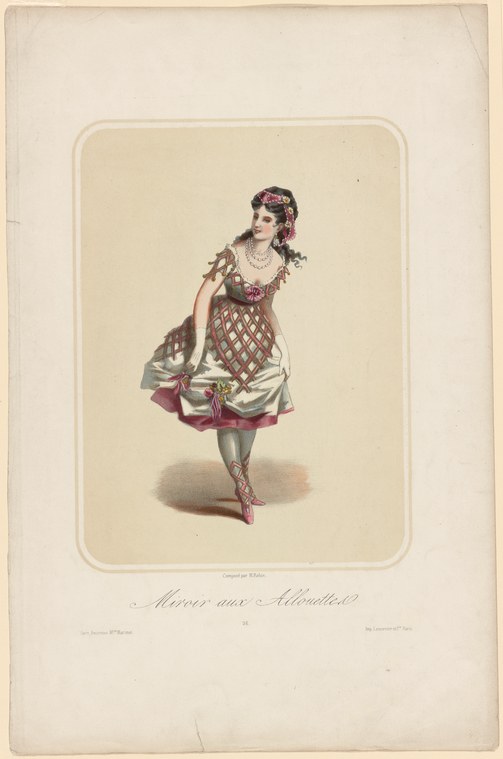
Miroir aux allouettes [sic]
Unknown artist
- Collection:
- Prints depicting dance
- Source:
- New York Public Library
- Rights:
- Public domain — free to use, share and adapt.
- Recorded as:
- Public Domain
This image documents the material reality of mid-19th-century theatrical dance—the actual weight and volume of stage costume, the posture and bearing expected of performers, and the specific aesthetic conventions of Romantic ballet in its regional variations. It is a rare surviving record of a titled role that likely disappears from written theater histories, preserving both the visual vocabulary of professional dance and a glimpse of a dancer whose name the print may not even record.
What you are looking at
A single female dancer is pictured in three-quarter view against a plain cream background, isolated within a rounded rectangular frame. She wears a richly colored costume typical of mid-19th-century theatrical dress: a burgundy bodice with short puffed sleeves trimmed in gold or bronze, a latticed or diamond-patterned overskirt in warm earth tones, and a voluminous white underskirt gathered at the hem with burgundy trim. Her hair is styled in long ringlets crowned with flowers or ornamental detail. She stands in a relaxed pose with her weight on one leg, the other foot pointed forward, her left arm extended gracefully outward and slightly behind her body. The composition is intimate and focuses entirely on the dancer's figure and costume, with no setting, musicians, or other performers visible.
The dancing
The dancer's posture suggests ease rather than formal tension: her body is upright but natural, weight distributed through a single supporting leg while the other extends in a soft pointed position. Her arm carriage is fluid and linear, extending away from her torso with relaxed elegance. Her gaze is directed away from the viewer, adding to the portrait-like quality. There is no visible closed hold or partner interaction; this is a study of an individual performer's bearing and costume.
The dance depicted
The costume and pose are consistent with Romantic-era theatrical dance, particularly the popular demi-caractère or character dance roles that emerged in the 1840s–50s. The diamond-patterned skirt and ornamented styling suggest a role from the continental European stage, possibly inspired by folk or exotic themes popular in ballet of the period. The title *Miroir aux Allouettes* (The Lark's Mirror) suggests a specific theatrical piece, likely a short divertissement or solo number. The relaxed, almost promenading posture indicates this may represent a moment of display or introduction rather than virtuosic movement. Without further documentation, the exact piece and choreography remain unclear, but the vocabulary and presentation point toward the theatrical ballet of France or Italy in the mid-19th century.
How it was made
This is a hand-colored engraving or lithograph, evident from the fine linear detail in the costume patterning, the crisp contour line defining the figure, and the delicate color application—particularly visible in the modulated tones of the skirts and the careful rendering of the bodice ornament. The technique allowed for multiple impressions and wide distribution to audiences who could not attend the theater; such prints were sold as souvenirs and documents of celebrated performances and dancers. The rounded border and inscription below are typical of theatrical portraiture of the period, positioning this as both a record of costume and a commercial artifact.
About this work
This is a mid-19th-century theatrical dance portrait: a hand-colored engraving documenting a solo performance, likely from a Romantic-era ballet or divertissement. The work captures the aesthetic and costume vocabulary of the European stage during a period when theatrical dance was becoming increasingly spectacle-driven and costume-dependent. The isolated figure-study format, combined with the titled role, marks it as a keepsake or promotional image—evidence of how dance was circulated and remembered before photography became common. Such prints formed an important visual archive of performance, making dancers' likenesses and repertory available to the reading public.
How to look at it
Note the careful detail in the costume: the artist has taken pains to render the diamond pattern of the skirt precisely and to differentiate the textures of silk, lace, and linen trim. Observe the dancer's posture and the distribution of weight—this is not a frozen moment of climactic motion, but rather a composed portrait stance that shows off the costume and the dancer's line. The gaze directed away from the viewer is a formal convention of portraiture that gives the figure dignity and a kind of internal focus. The rounded frame and inscription create an object of display and memorialization—this is both art and commercial product.
The artist
The artist and engraver are not identified in the catalogue record. The style and production method are consistent with the work of commercial theatrical print publishers active in Paris, London, or Vienna during the 1840s–50s. Such prints were often produced by workshop teams in which the designer, engraver, and colorist may have been different hands, and individual attribution was often not recorded.
The period
The mid-19th century saw a boom in theatrical dance portraiture following the success of the Romantic ballet in Europe. The tight-laced, heavily ornamented costumes visible here—the diamond-patterned overskirt, puffed sleeves, and floral crown—are hallmarks of the demi-caractère or character ballet style that sat between classical tragedy and folk spectacle. This was also the height of the star system in dance: famous performers like Marie Taglioni, Fanny Elssler, and their successors had their likenesses circulated in prints to cultivate public devotion and provide souvenirs. The theatrical print industry was booming, and dance prints were among the most popular subjects.
Where it lives
The work is held in the New York Public Library's Prints collection. It is part of a broader archival assemblage of 19th-century theatrical dance imagery, which formed an important visual documentation of performance before the advent of photography.
Dance in this work
Questions about this work
What is the title 'Miroir aux Allouettes'?
The title translates as 'The Lark's Mirror,' likely the name of the theatrical piece or character this dancer performed. It may derive from a folktale, fairy tale, or commedia dell'arte tradition; such evocative titles were common in 19th-century ballet divertissements and character dances. Without access to playbills or a theater archive, the specific plot and choreography remain unrecovered.
When was this print made?
The costume, printing style, and aesthetic conventions place it in the mid-19th century, likely the 1840s–50s, but no date is recorded in the catalogue. The Romantic ballet period and the prevalence of such theatrical prints suggest this timeframe, though confirmation would require additional documentation.
How was this used?
Theatrical prints like this were sold as souvenirs at the stage door or in print shops, allowing theatergoers to keep a record of celebrated performances and the dancers who performed them. They also served a promotional function, advertising new roles and attracting audiences. Unlike photographs, which were rare and expensive until later in the century, these prints were affordable and widely distributed.
What dance technique would this performer have trained in?
The posture and costume suggest training in the Italian or French theatrical tradition of the Romantic period. The relaxed arm carriage and upright spine are consistent with the academic ballet technique codified in the 19th century, though the character costume indicates she was also skilled in the demi-caractère style—a blend of classical technique with pantomime and folk movement.
More dance artwork





