49 works in this view — arrow keys or swipe to move between them.
Dance in Art
Le rêve
Unknown artist
- Collection:
- Prints depicting dance
- Source:
- New York Public Library
- Rights:
- Public domain — free to use, share and adapt.
- Recorded as:
- Public Domain
This image documents the aesthetic and commercial presentation of early 20th-century theatrical dance at the moment when Romantic ballet was becoming theatrical spectacle rather than concert form. For dancers and historians, it shows how the dream narrative—central to ballet from Giselle onward—was still being visualized and sold to audiences in the years before Diaghilev and modernism reshaped what ballet could be. It also captures a lesser-documented category: character and pantomimic roles, where technique mattered less than personality, beauty, and the ability to embody a narrative moment.
What you are looking at
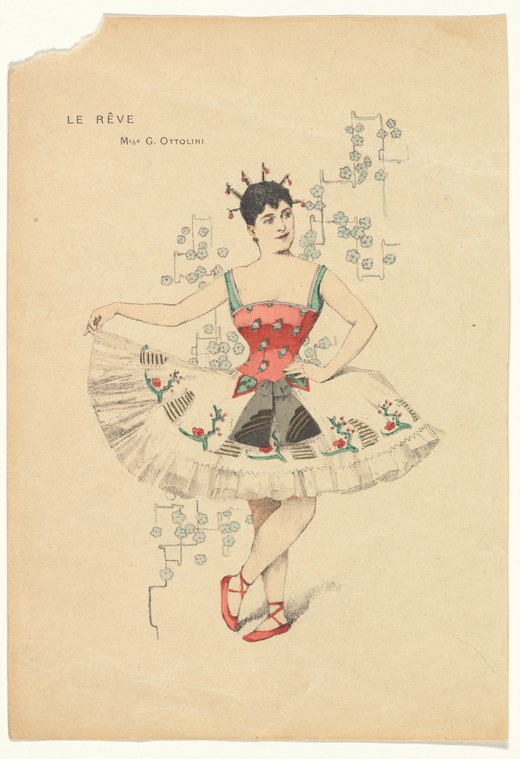
A young woman in theatrical costume stands in a balletic pose against a pale cream background. She wears a striking red corseted bodice with green underpinnings, a voluminous tiered white tulle skirt caught mid-swirl, and red heeled slippers. Her dark hair is styled close to her head in an early 20th-century fashion, and she gazes upward and to the side in a dreamy expression. Surrounding her are delicate line drawings of flowering vines or climbing plants that seem to float in the negative space, creating a fantastical, dreamlike atmosphere that gives the work its title. The composition is intimate and focused on the figure, with the botanical elements suggesting reverie or imagination rather than a specific theatrical setting.
The dancing
The dancer stands in a contrapposto stance with her weight shifted to one leg, her body angled in three-quarter view. Her left arm extends gracefully across her body while her right arm hangs naturally; the pose suggests a moment between movements rather than the apex of a jump or turn. Her head tilts upward with a contemplative or aspirational gaze. The pose demonstrates understanding of balletic port de bras—the carriage and positioning of the arms—though the figure is not en pointe and maintains contact with the ground, suggesting either a pantomimic moment or a demi-caractère position.
The dance depicted
This is almost certainly a theatrical ballet illustration, most likely a costume or character study for a Romantic-era ballet of the early 20th century, or a retrospective work in that idiom. The title 'Le Rêve' (The Dream) and the figure's upward gaze are consistent with the Romantic ballet aesthetic of aspiration, fantasy, and otherworldly yearning. The costume—a hybrid of corsetry and tulle—and the lack of classical pointe work suggest either a character role (a peasant girl or sprite rather than a prima ballerina) or a work in the lighter, more commercial theatrical vein of the period. The dream theme was common in late 19th and early 20th-century dance, from the pantomime scenes of classical ballets to the nouvelle danse aesthetics.
How it was made
This is a hand-colored lithograph or similar color print technique, likely from the 1890s–1910s. The delicate line work, the subtle gradations of watercolor or colored-ink tinting, and the typography all support this identification. The technique allowed for relatively inexpensive reproduction and circulation among theatrical audiences and collectors of theatrical imagery—this is popular entertainment art, not a unique canvas. The floral borders are drawn in a lighter hand, suggesting either a second printing stage or skillful restraint by the artist to keep focus on the costumed figure.
About this work
This is a theatrical costume or character study for a ballet or pantomime-ballet performance, rendered in the commercial illustration style of the turn of the 20th century. The work captures both the visual spectacle of early modern stage dress and a distinctly Romantic sensibility—the dreamy title, the upward gaze, the ethereal floral surround—that was still potent in popular theater of the period. It belongs in a dance archive as evidence of how ballet and theatrical dance were marketed and imagined by audiences: as gateways to fantasy and transformation, and as intimate character studies as much as feats of technique.
How to look at it
Attend first to the tension between the figure's physical pose—calm, grounded, almost static—and the emotional content of her gaze and title. The artist has chosen not a moment of virtuosity or climactic movement, but a moment of reverie, of looking beyond the stage into an imagined world. The floral borders reinforce this: they are not realistic stage decoration but symbols of fantasy and growth. Notice how the costume, despite its artificiality, sits on a real body with weight and presence; this is not idealization but character portrayal. The color—the assertive red against pale tulle and cream paper—grounds the figure without overwhelming the delicate linework that surrounds her.
The artist
The artist is not recorded in the catalogue. The signature or attribution, if present, is not legible in the image. The style is consistent with French or Central European theatrical illustration of the 1890s–1920s, a period of extraordinary output in chromolithographic costume and character studies for Paris theaters. The hand is competent and assured, suggesting a professional theater illustrator with training in figure drawing and costume design—the kind of commercial artist whose work circulated widely in programs, journals, and collected portfolios but whose individual names are often now lost.
The period
The work dates to a moment of transition in theatrical dance. The classical ballet tradition of the 19th century—Romantic ballet, Imperial Russian ballet—was still the dominant form of theatrical dance, but its cultural meaning was shifting. By the 1890s–1910s, ballet was increasingly spectacle and entertainment rather than the high art form of the mid-Victorian era. Simultaneously, the vogue for theatrical character studies and costume albums was at its peak; collectors and theater enthusiasts purchased these prints and lithographs as souvenirs and records of performances. The dreamlike, introspective quality of this image also reflects broader artistic movements of the period—Symbolism, Art Nouveau, and the cult of youth and transformation that saturated turn-of-the-century culture.
Where it lives
The work is held in the New York Public Library's collection of prints depicting dance. It entered the collection as part of the broader acquisition of theatrical ephemera and illustration that NYPL systematized in the late 20th century. The catalogue record is minimal, suggesting the work was accessioned as a type example rather than as a documented piece with known performance history or artist attribution.
Dance in this work
Questions about this work
Is this a costume design or a costume record?
It appears to be a record or character study—a finished theatrical print meant for distribution or collection—rather than a designer's working sketch. The production quality, the refined color and composition, and the title inscription all suggest a finished work for a public or semi-public audience. Whether it documents an actual performance or represents a fantasy costume conceived for sale or publication cannot be determined from the image alone.
What does 'Le Rêve' mean, and is it the title of an existing ballet?
Le Rêve means 'The Dream' in French. While it was a popular theme in 19th-century ballet (many ballets had dream scenes or dream narratives), no single definitive ballet of this title can be confirmed from the image. The title is likely either that of a specific work now lost to record, a pantomimic interlude, or a character name. The dreamy aesthetic was common enough in turn-of-the-century theatrical dance that the title may also have been aspirational—a marketing tool to evoke the emotional tenor of the piece rather than its literal subject.
Why is she not on pointe?
The absence of pointe work indicates she is either a character dancer (in a peasant role, or as a comic or demi-caractère character) rather than a classical prima ballerina, or she is captured in a pantomimic moment where character and narrative matter more than technique. Pointe work was not mandatory for all ballet roles in the theatrical tradition; many roles, especially younger or more naturalistic characters, were performed en demi-pointe or flat. The artist may also have chosen this pose precisely to convey a moment of introspection and dream rather than climactic virtuosity.
What theatrical tradition is this from?
The style—the costume, the character pose, the lithographic technique, the commercial presentation—suggests either the French or Central European theatrical tradition of the 1890s–1910s. This was an era when Paris theaters, especially the Opéra-Comique and popular music halls, presented hybrid forms mixing ballet, pantomime, and theatrical spectacle. The work may also be from the Russian Imperial tradition, which exported costume and character studies widely to Western Europe and America during this period.
More dance artwork





