49 works in this view — arrow keys or swipe to move between them.
Dance in Art
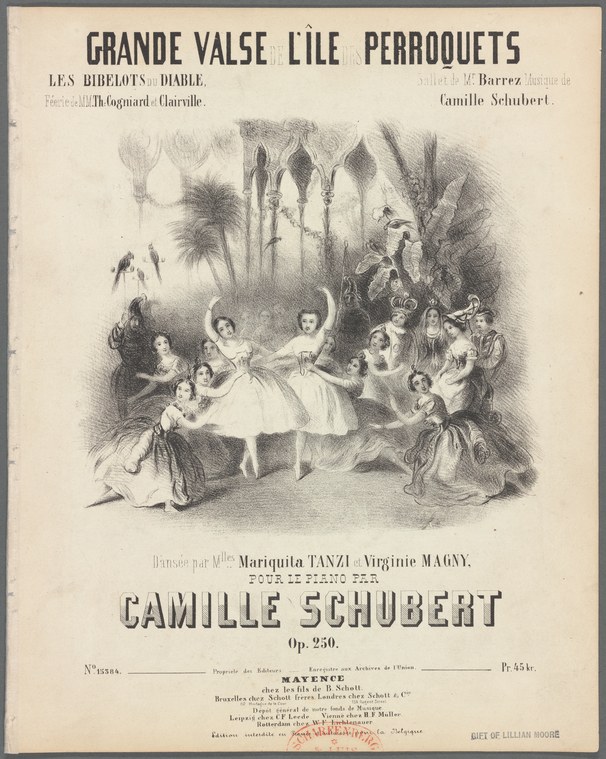
Grande valse de l'île des perroquets: dansée par Mlles. Mariquita Tanzi et Virginie Magny
Unknown artist
- Collection:
- Prints depicting dance
- Source:
- New York Public Library
- Rights:
- Public domain — free to use, share and adapt.
- Recorded as:
- Public Domain
This print documents the actual stage appearance and composition of a specific mid-nineteenth-century ballet performance, showing how corps and principal dancers were arranged in space and how the relationship between body, costume, and fantastical decor created meaning on the Romantic stage. For ballet historians, it is a rare record of the visual grammar of Romantic ballet outside the written score.
What you are looking at
A fantastical ballet scene set among towering, exotic plants—birds of paradise with long plumes dominate the shadowy background. In the center, two principal dancers in pale tulle skirts execute a pas de deux, their bodies angled in conversation with each other. They are surrounded by a corps of secondary dancers in similar costume, some kneeling, some standing in attitudes of attention or wonder. The composition radiates outward from the principals with a dreamlike, theatrical quality characteristic of mid-nineteenth-century Romantic ballet design. The engraving technique renders the scene in precise tonal gradations, with deep shadow giving the fantastical setting genuine spatial depth. The overall mood is otherworldly: a moment suspended between the dancers and an imagined tropical landscape.
The dancing
The two principal dancers occupy the visual center in a classical balletic frame—both upright, weight poised on supporting legs, the nearer dancer angled in profile conversation with her partner. Both wear the characteristic tulle skirts of the period, and their arms and carriage suggest the refined elevation and port de bras of academic ballet training. The surrounding corps dancers adopt poses of graceful passivity: some en attitude, some kneeling in attitudes of reverence or observation, their bodies arranged to frame the principals without competing for attention. The geometry is formal and hierarchical, typical of ensemble work in mid-century theatrical ballet.
The dance depicted
This is a Romantic ballet scene, almost certainly from the 1850s or 1860s based on the choreography visible in the image and the names of the dancers. The title *Grande Valse de l'île des perroquets* (Grand Waltz of Parrot Island) indicates a divertissement or scene built around a fashionable waltz form, set in an exotic locale. The dancers named in the print—Mariquita Tanzi and Virginie Magny—were ballerinas of the mid-nineteenth-century Paris Opéra. The parrot-island theme, the impossible tropical setting, the lightness of the costumes, and the compositional emphasis on the female body and ethereal movement all mark this as characteristic Romantic ballet: narrative and decor take second place to the display of virtuosity and beauty in the female form.
How it was made
This is a steel or copper engraving, a reproductive print designed for distribution to the theater-going public and print collectors. The technique allowed fine tonal control: the artist has used cross-hatching and careful line work to create atmospheric depth, particularly in the shadowed foliage. The legibility of the dancers' bodies and the precision of the line work suggest this was engraved after a more finished design, possibly a painting or detailed drawing. As a reproductive print, this would have circulated widely and been affordable to a middle-class audience, making it a primary document of how Romantic ballet was visualized and consumed in print form.
About this work
A mid-nineteenth-century theatrical ballet scene engraved for the Paris print market, showing two principal dancers in an exotic Romantic setting. The work captures the aesthetic and ideology of mid-century ballet: female grace, ethereal movement, and fantastical narrative scenario are the subjects. The print commemorates a specific divertissement and its performers, making it both a theatrical document and an object of visual culture in its own right. It belongs in a dance history collection as evidence of how ballet was marketed, visualized, and remembered during the height of the Romantic era.
How to look at it
Attend to the stillness and formal geometry of the pose: this is not the climactic moment of action but a held tableau—a moment of display and formation. The artist has chosen a moment of classical repose, allowing the eye to admire the line of the body and the arrangement of the ensemble. Notice how the engraver has used shadow and cross-hatching to push the exotic foliage back into darkness, keeping attention on the pale, luminous bodies of the dancers; this is a deliberate choice to emphasize the female form as the primary subject.
The artist
The composer is named as Camille Schubert (Op. 250), a prolific composer of dance music for the Paris Opéra in the mid-nineteenth century. The dancers Mariquita Tanzi and Virginie Magny were professional ballet dancers of the 1850s. The engraver is not identified in the catalogue record, but the work was published by the Paris house Mayence (visible in the imprint), a major publisher of theatrical and musical prints.
The period
This print dates to the height of the Romantic ballet era (c. 1830–1870), when European ballet was dominated by ethereal, otherworldly narratives and the virtuosity of the female dancer. The exotic setting—Parrot Island—reflects the period's fascination with orientalism and the tropical world. The waltz, a relatively recent import from Vienna, had become a staple of ballet divertissements by mid-century. The technical refinement visible in the dancers' bodies and the formal composition reflect the standardization of academic ballet training and the consolidation of the Paris Opéra as Europe's leading ballet institution.
Where it lives
The print is held by the New York Public Library in its collection of prints depicting dance. It was published as a theatrical print by the Paris publisher Mayence, indicating it was sold as a souvenir or promotional object at the time of performance.
Dance in this work
Questions about this work
Who were Mariquita Tanzi and Virginie Magny?
They were professional ballet dancers of the Paris Opéra in the 1850s, celebrated enough to be named in printed souvenir engravings of performances. Little biographical detail survives, but their appearance in such prints testifies to their prominence in Romantic-era ballet.
What is a 'valse' in the context of ballet?
A waltz is a ballroom dance in triple meter that became fashionable in ballet divertissements from the 1830s onward. In the theater, it often served as a vehicle for showcasing a dancer's grace and technical control, and could be incorporated into narrative scenes or performed as pure spectacle.
Why are there parrots in a ballet?
Exotic and fantastical settings were central to Romantic ballet aesthetics. Parrot Island represents an imagined tropical world—a escape from everyday Europe into the picturesque and marvelous. Such scenarios justified elaborate decor and gave license for displays of beauty and otherworldliness.
More dance artwork





