49 works in this view — arrow keys or swipe to move between them.
Dance in Art
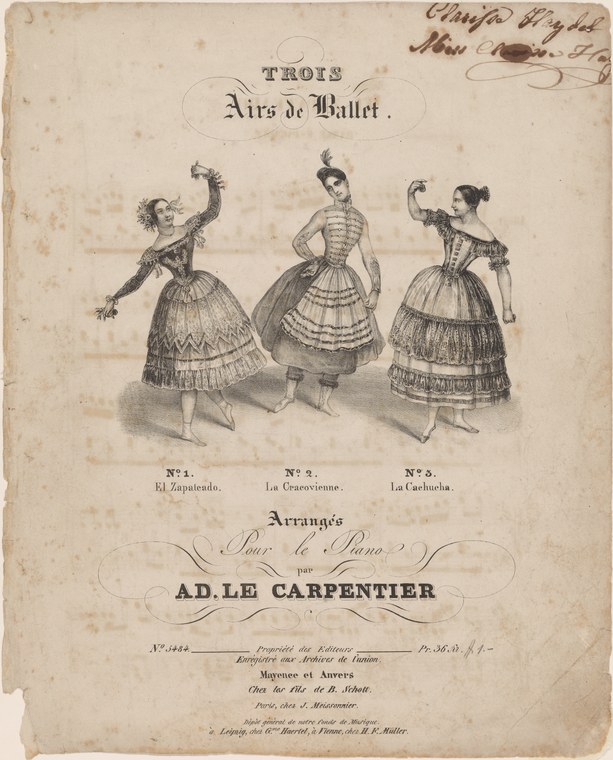
Trois airs de ballet: No. 1. El zapateado. No. 2. La cracovienne. No. 3. La cachucha
Unknown artist
- Collection:
- Prints depicting dance
- Source:
- New York Public Library
- Rights:
- Public domain — free to use, share and adapt.
- Recorded as:
- Public Domain
This print documents how the Romantic ballet era (1830–1850) standardized and taught European character dances—Spanish, Polish, Hungarian—as codified theatrical types rather than living regional practices. For a historian of dance, it shows the mechanisms by which folk and social dances were absorbed into the ballet repertory and given fixed costumes, names, and movement vocabularies. For a dancer or costumer, it is a precise visual record of how these dances were dressed and carried on the Paris stage in this period, making it invaluable for historical reconstruction.
What you are looking at
This is a printed sheet presenting three named Spanish and Central European dances in the form of costume studies. Three female dancers are shown in three-quarter view, each wearing the characteristic dress of her dance: the leftmost figure in a full skirt with horizontal pleats and fitted bodice performs El Zapateado with raised arms and lifted gesture; the center figure in a simpler but fuller skirt with tight corseting stands in a more composed pose typical of La Cracovienne; the rightmost figure in a layered, voluminous skirt with deep horizontal flounces assumes an alert, lifted posture for La Cachucha. All three wear their hair up with decorative elements and are rendered in the stippled, fine-lined engraving style typical of early 19th-century dance prints. The figures are arranged against a plain background, neither in a stage setting nor in narrative scene, but as a gallery of movement types—what a dancer or costume maker would need to know to perform these roles correctly.
The dancing
All three figures stand with weight lifted, suggesting the buoyancy expected in Romantic-era social and theatrical dance. The Zapateado dancer has arms raised high and spread, with an energetic lift through the torso that implies the foot-stamping and rapid lower-body articulation the name promises. The Cracovienne dancer stands more contained, with a straighter spine and lower arm carriage, suggesting the processional dignity of Polish court dance. The Cachucha dancer shows an intermediate energy, with arms in a semi-raised position and the torso slightly angled, her weight poised as if about to turn. None of the figures shows pointe work or the extreme extension characteristic of later ballet; all three maintain the turned-out posture and high-waisted silhouette of the 1830s–1840s stage.
The dance depicted
This is a teaching or promotional sheet for three European social and character dances that were fashionable in the Romantic ballet era (roughly 1830–1850). El Zapateado is a Spanish dance built on rapid footwork and heel-striking, named for its percussive lower-body articulation; La Cracovienne is a Polish mazurka-like processional dance; La Cachucha is a Spanish solo dance for a female dancer, typically flirtatious and playful in character. These three dances were standard items in the mixed-dance repertory of Romantic ballet and in ballroom and theatrical performance. The print is arranged by AD. Le Carpentier, described as a "danse maître" (dance master), and was published in Paris, where such dances were a staple of both court and commercial entertainment. The image shows these as codified types with fixed costumes and characteristic carriage rather than as improvised or regionally variable forms.
How it was made
This is a steel or copper engraving, hand-colored or printed in black ink (the record does not specify). The technique is typical of early 19th-century dance instruction and promotion: fine parallel lines (hatching and stippling) create tone and form, allowing fine detail in the folds of fabric and the articulation of the body. Engraving was the dominant medium for circulating dance images before lithography became cheaper; it implies a professional publication, likely sold to dance masters, students, and wealthy amateurs. The precision and delicacy of line suggest this was produced for a educated, paying audience—dancers, teachers, or patrons who could read French and afford the sheet price. The hand-coloring of some copies (this copy appears to be uncolored or partially colored) would have increased the cost and desirability.
About this work
This is a working document for the teaching and performance of three European character dances in the Romantic ballet era. It presents three named dances—one Spanish, one Polish, one Spanish—as standardized types, each with its own costume, carriage, and implied movement vocabulary. The three figures are shown as costume and deportment studies rather than as a narrative or scenic scene, making clear that the print's purpose was to instruct dancers and teachers in the visual markers and conventions of each form. These dances were staple items in the ballet repertory of the 1830s–1840s, and this print would have circulated among professionals and serious amateurs in Paris and beyond. It is a rare surviving example of how the Romantic ballet codified and taught character dances as distinct, named, repeatable forms with stable visual identities.
How to look at it
Look first at the costumes and how they differ: the depth and pleating of the skirts, the tightness and cut of the bodices, the hair ornaments. These visible markers allowed a dancer or audience member to identify which dance was being performed before any steps were executed. Then look at the bodies: the energy and lift of the Zapateado dancer contrasts sharply with the composed, processional carriage of the Cracovienne, and both differ from the alert, almost playful readiness of the Cachucha dancer. Notice that the artist has frozen each figure in a standing pose, not mid-step—this is a costume and carriage study, not a moment of extreme action. This choice tells us that the identity and character of each dance resided in the body's habitual posture and orientation, not in a single signature step.
The artist
AD. Le Carpentier is identified as a "danse maître"—a dance master and teacher—who arranged these three airs (movements or pieces) "pour le piano" (for piano accompaniment). He is not a visual artist; the engraving itself is uncredited. Le Carpentier's role was to select and notate the three dances and to authorize this teaching sheet, positioning himself as the custodian of these standardized forms. The publication details indicate that the sheet was "propriété des Éditeurs" (property of the publishers) and bore a privilege notice ("Propriété des Éditeurs"), meaning it was registered with the French royal or imperial authorities—standard practice for published music and dance instruction in early 19th-century France.
The period
These three dances represent the Romantic ballet's fascination with folk and character dance. In the 1830s–1840s, when this print was likely made, the Paris Opéra and commercial theaters were incorporating Spanish, Polish, Hungarian, and other European dances into mixed-repertory performances and into the divertissement sections of multi-act ballets. This was part of a broader Romantic interest in the picturesque, the exotic, and the regionally authentic—though of course the "authenticity" was staged and conventionalized. At the same time, the same dances were popular in the ballroom and in drawing-room entertainment, so a print like this served both theatrical and social dancers. The coordination with piano music underscores that these dances, though originally folk or court forms, had been absorbed into the urban, middle-class world of the piano and the published music sheet.
Where it lives
This sheet is part of the New York Public Library's collection of prints depicting dance. The pencil inscription at the top right ("Amelia Byfield, New York") suggests it was owned by an American dancer or enthusiast in the 19th century. The publication privilege and printer's mark indicate it was a commercial product, likely purchased by individuals rather than commissioned or collected as an institutional archive.
Dance in this work
Questions about this work
What is El Zapateado and why is the dancer's posture so energetic?
El Zapateado is a Spanish solo dance built on rapid, percussive footwork—the name comes from "zapato" (shoe) and refers to the heel-striking and foot-stamping that define it. The raised, spread arms and lifted torso shown here convey the energy and foot-articulation that the dance demanded. In the ballroom and on stage, this was a brilliant, virtuosic display, typically performed by a single dancer while others watched.
Why are these three dances on the same sheet?
This sheet was likely a teaching aid or promotional material for dance masters and students learning the 'mixed repertory' of ballroom and theatrical dance. By presenting three popular character dances on a single sheet, with music arrangements for piano, it enabled a teacher to instruct students in the visual markers, costumes, and carriage of each form. It may also have been sold to dancers preparing roles in the Romantic ballet.
How do we know these are Romantic-era dances?
The costumes, the hair styles, the body postures, and the engraving technique all date to the 1830s–1850s. More importantly, these three dances—particularly the Cachucha and the Zapateado—became famous in the Romantic ballet repertory, especially after their inclusion in major Paris productions. The print's coordination with music, its focus on visual type and costume, and its Parisian publication all mark it as a product of the Romantic era's fascination with codified character dance.
Could these dances have been performed in the ballroom as well as on stage?
Yes. The Cracovienne and other character dances were standard items in the ballroom repertory of the 1830s–1840s, and amateurs learned them from published sheets like this one. The Zapateado and Cachucha, while sometimes performed as theatrical solos, could also be danced socially in modified form. The boundary between stage and ballroom was much more porous in the Romantic era than we might assume.
More dance artwork





