49 works in this view — arrow keys or swipe to move between them.
Dance in Art
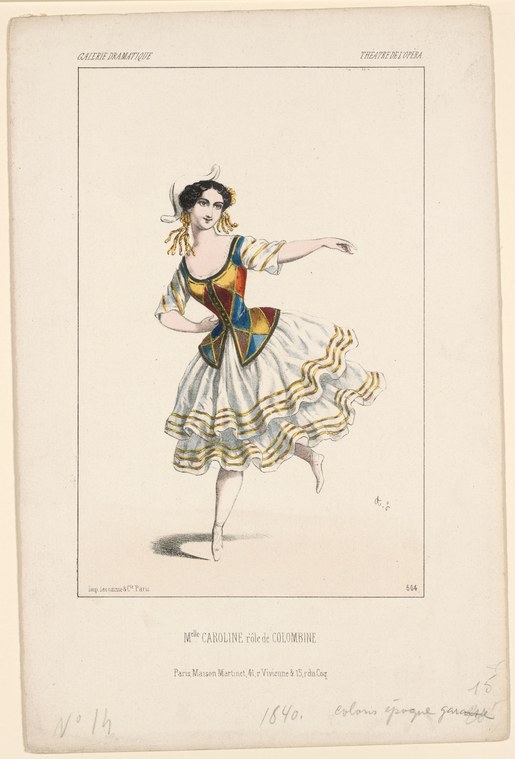
Melle Caroline, rôle de Colombine
Unknown artist
- Collection:
- Prints depicting dance
- Source:
- New York Public Library
- Rights:
- Public domain — free to use, share and adapt.
- Recorded as:
- Public Domain
This image is a primary document of how Commedia dell'arte characters were danced and performed in nineteenth-century Paris, and it preserves the specific stage costume and theatrical gesture of Colombine at a moment when the role was at the height of its popularity. For dancers and historians, it demonstrates the continuity between classical ballet technique and theatrical character performance, and shows that what appears in modern dance history as 'pure ballet' was in fact deeply entangled with pantomime, comedy, and the traditions of popular street theater.
What you are looking at
A young woman in theatrical costume performs a solo dance against a plain cream background, her body caught in a moment of dynamic motion. She wears a striking dress in the Romantic-era ballet style: a short skirt with multiple horizontal tiers or flounces edged in gold braid, creating a bell-like silhouette as it moves. Over this she wears a darker bodice in deep blue or teal with gold trim and short puffed sleeves, suggesting both the Commedia dell'arte tradition and the theatrical fashion of early-nineteenth-century Paris. Her curled dark hair is topped with a small cap or ornament. Her right arm extends outward in a gesture of invitation or comic flourish; her left arm is positioned at her side. She stands in a three-quarter profile, her weight shifted onto her left leg while her right foot appears to lift or pivot, suggesting a turning or traveling step. The pose conveys liveliness and comedic character rather than the ethereal verticality of high Romantic ballet.
The dancing
The dancer is isolated in a single portrait-like composition. Her body shows the turned-out carriage and lifted port de bras of ballet training, but her pose is far more gestural and animated than the stillness of a classical arabesque or attitude. The extension of her right arm suggests a moment of theatrical address—speaking to or gesturing toward an unseen scene partner. Her legs and feet suggest a traveling step or turn in progress rather than a held position, with the supporting leg bent and the working leg engaged. The overall frame reads as a character pose rather than a technical demonstration.
The dance depicted
This is a representation of Colombine, the maidservant character from Commedia dell'arte, as performed in nineteenth-century French theatrical ballet and pantomime. The Colombine role was a fixture of Romantic-era stage entertainment, especially in Paris, combining elements of ballet technique with comedic character and physical virtuosity. The costume—the short, tiered skirt trimmed in gold and the fitted bodice—is the recognizable stage dress for this role in the mid-nineteenth century. The inscription identifies the performer as Mlle Caroline, and the title indicates this is her performance of the Colombine role. The image captures not a moment of pure ballet vocabulary but rather a characteristic pantomimic gesture: the outreached arm and turned body suggest a moment of flirtation, appeal, or comic address typical of how this character moved on stage.
How it was made
This is a hand-colored engraving or lithographic print, evidenced by the fine linear work in the figure, the precise outlines, and the selective hand-coloring of the costume and hair. The technique allowed for theatrical images to be mass-produced and circulated to Parisian audiences, performers, and dance enthusiasts. The flatness of the background and the precise contour of the figure suggest this was made from a drawing or a previous engraving, then colored by hand. Such prints were sold in Paris as theatrical souvenirs and as documentation of celebrated dancers and roles, forming part of a substantial market in dance imagery throughout the nineteenth century.
About this work
This is a theatrical portrait print documenting the performance of Mlle Caroline in the role of Colombine, likely made in the 1840s–1850s during the height of Romantic ballet in Paris. Colombine was one of the most enduring and beloved comic characters in French pantomime and ballet, and this print preserves both the specific costume of the period and a characteristic moment of the role—a gesture of playful interaction and theatrical charm. The print belongs to a rich tradition of mid-nineteenth-century Parisian theatrical documentation and fan culture, in which single-figure portraits of celebrated performers were disseminated to a broad public. Such images offer historians direct visual evidence of how specific roles were embodied, dressed, and staged during an era when most performances were undocumented by photography.
How to look at it
Note the specificity of the costume: the gold-braided flounces of the skirt, the fitted bodice, the puffed sleeves, and the small head ornament are all markers of the Colombine role. Observe the pose itself—the outreached arm and the turning motion of the body—which is caught mid-gesture rather than in a finished classical position. The artist chose to show her in a moment of theatrical address, engaging with an implied partner or audience, which tells us that the Colombine role called for a kind of embodied charm and interaction rather than the introspective verticality of the Romantic heroine. The hand-coloring of the print, especially the deep teal of the bodice against the pale skirt, would have made this a vivid and appealing souvenir of a live performance.
The period
This print dates to the era of Romantic ballet, roughly the 1830s–1850s in Paris, when theatrical dance reached a wide public through both live performance and mass-produced prints. Colombine had been a stock character in Italian commedia for centuries, but in the nineteenth-century Parisian theater she became a staple of melodrama, pantomime, and ballet divertissement. The Romantic period saw a fascination with character dances and national or 'exotic' styles performed alongside the ethereal ballets that dominate modern memory—ballets like La Sylphide. Solo prints of celebrated performers in iconic roles were a form of fan culture and theatrical publicity, much like playbills and later theatrical photographs.
Where it lives
This print is held in the New York Public Library's collection of prints depicting dance. It is catalogued by performer name and role title, part of a broader NYPL archive of theatrical documentation and fan culture from the nineteenth-century Parisian stage.
Dance in this work
Questions about this work
Who was Colombine and why did she matter to dance?
Colombine was a stock character from Italian commedia dell'arte—a clever, flirtatious maidservant. In the nineteenth-century Parisian theater, she became a celebrated role that dancers performed in pantomimes, melodramas, and ballet divertissements. The role allowed performers to combine ballet technique with comic acting and physical expressiveness, and it remained popular well into the twentieth century.
How was this print made and used?
This is a hand-colored engraving or lithograph, a mass-production technique that allowed theatrical images to be sold cheaply to audiences and performers. Such prints were souvenirs of a night at the theater, similar to modern playbill photos. Collectors would amass them into portfolios or albums, creating a visual record of celebrated performances and celebrated dancers.
What does this image tell us about Romantic-era ballet?
It shows that nineteenth-century ballet was not all ethereal sylphs and tragic heroines. Character roles like Colombine drew on older theatrical traditions and required dancers to be actors and comedians as well as technicians. The print documents the specific costume and gestural vocabulary of the role, showing how dance technique and theatrical character were inseparable.
More dance artwork





