33 works in this view — arrow keys or swipe to move between them.
Dance in Art
Soupirs des fleurs polka and the Camellia polka mazurka
Unknown artist
- Medium:
- Lithograph
- Dance:
- Polka
- Era:
- Late 1800s (Victorian Ballroom)
- Source:
- New York Public Library
- Rights:
- Public domain — free to use, share and adapt.
- Recorded as:
- public_domain
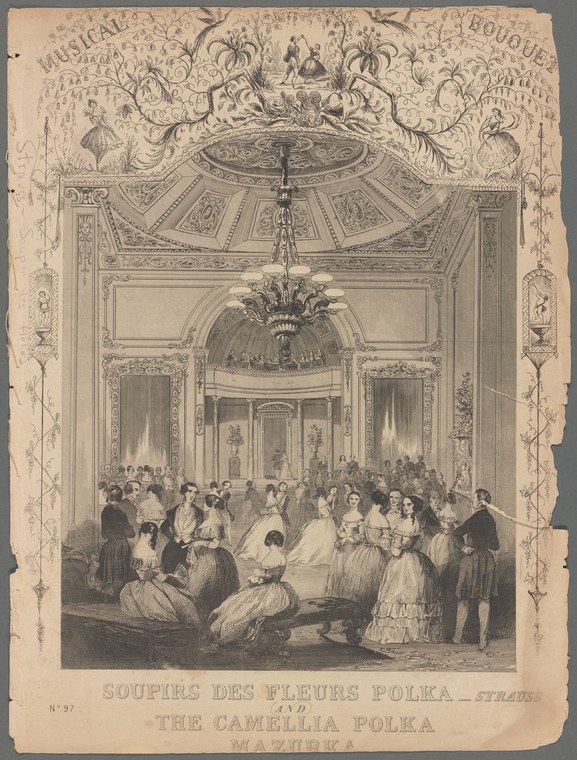
This print is valuable visual evidence of the ballroom environment and dress conventions within which polka and mazurka functioned as social dances. For dancers and historians, it reveals the architectural setting, clothing silhouette, and social grouping that shaped how these dances were performed and experienced.
What you are looking at
A grand ballroom filled with fashionably dressed figures in mid-nineteenth-century attire, lit by an ornate chandelier suspended from a coffered ceiling. The room's architectural grandeur is emphasized by classical columns, arched doorways, and elaborate wall panels decorated with scrollwork and medallions. The crowd is distributed across the floor in loose clusters, with couples and groups standing rather than in active dance formation. Women wear full-skirted dresses with fitted bodices typical of the 1840s–1860s; men are in tailcoats and dress trousers. The mood is one of social gathering rather than dynamic movement—this is a ballroom scene depicting the social context of dance rather than active dancers performing.
The dancing
The figures stand upright in conversational poses and loose social groupings rather than in closed dance holds. Some couples face each other or stand adjacent, but there is no visible unified choreographic positioning. The women's voluminous skirts and the men's formal posture create an impression of restraint and decorum. No footwork is visible, and the bodies convey social interaction and courtship rather than the physical engagement of active dancing.
The dance depicted
This is a ballroom scene depicting the social context of polka and mazurka—the two dances named in the title—rather than showing those dances in active performance. The polka and mazurka were the dominant social dances of the mid-nineteenth-century ballroom, but what we see here is the ballroom gathering where such dances would have occurred. The scene captures the formal social setting and dress conventions of the period rather than the movement vocabulary of either dance.
How it was made
This is a hand-colored lithograph, as indicated by the tonal variations and the refined detail characteristic of mid-nineteenth-century ballroom prints. The elaborate decorative border with botanical and figural ornaments framing the scene was typical of printed music covers and salon prints of the period. Lithography allowed for wide circulation among the middle-class ballroom-dancing public, making such images both documentary and aspirational records of fashionable society.
About this work
This lithographic print documents the fashionable mid-nineteenth-century ballroom as the social venue for polka and mazurka dancing. The title identifies the specific dances that would have been performed, while the image itself records the dress, architecture, and social formation of the Gilded Age ballroom. Rather than freeze a moment of dancing, the artist chose to show the ballroom itself as a complete social environment—a record of where and how polka and mazurka were danced, and by whom. The work belongs in a gallery of dance as a crucial document of ballroom sociability and the aesthetic of the Gilded Age ballroom dance world.
How to look at it
Look at the architectural framing and the static poses of the figures rather than at any individual movement phrase. The artist has chosen to represent not a moment of dance but the ballroom as an idealized space—note the refined perspective drawing, the symmetrical composition, and the formal dress of every figure. The ornamental border itself, with its Rococo flourishes and botanical detail, signals that this is a print made for an aspirational audience eager to see what fashionable ballroom life looked like.
The artist
The artist is unknown and unrecorded. The lithograph's refined technique and wide circulation suggest it was produced as a professional music-cover or salon print, likely by a commercial printmaker working in the ballroom-dance print trade of the 1840s–1860s.
The period
The polka emerged in Bohemia in the 1830s and became the dominant social dance of the mid-nineteenth-century ballroom, rivaling the waltz. The mazurka, a Polish processional and courtship dance, became fashionable among European and American society dancers at roughly the same period. Both dances were associated with modernity and European cosmopolitanism. Lithographic prints like this were a major vehicle for promoting fashionable dances and recording the idealized social world in which they were performed. The Gilded Age ballroom itself—with its classical architecture, gaslight, and carefully orchestrated social hierarchies—was a central institution of upper-class leisure.
Where it lives
This lithograph is part of the New York Public Library collection, suggesting it was acquired as a document of nineteenth-century popular dance culture and ballroom life in America. It likely originated as a music cover or salon print.
Dance in this work
Questions about this work
Is this showing people actually dancing?
No—it shows the ballroom social gathering where polka and mazurka would have been danced. The figures stand in conversational poses rather than in active dance formations. The artist chose to document the ballroom setting and dress conventions rather than freeze a moment of choreography.
What were polka and mazurka?
The polka was a lively couple dance that emerged in 1830s Bohemia and became the dominant social dance of mid-nineteenth-century ballrooms. The mazurka was a Polish processional and courtship dance associated with aristocratic society. Both were performed at balls like the one depicted here, to live orchestral music.
How do we know this is from the 1800s?
The women's dress—full skirts, fitted bodices, the silhouette of the 1840s–1860s—and the men's tailcoats and formal posture date the scene to this period. The catalogue record also identifies it as Late 1800s, though the fashion suggests the middle decades rather than the very end of the century.
What is the ornate border for?
This was almost certainly a music cover or a salon print. The decorative border with botanical and figural ornaments was typical of such commercial prints, which were collected and displayed as records of fashionable society and as promotional material for specific dances and musical compositions.
More Polka artwork