49 works in this view — arrow keys or swipe to move between them.
Dance in Art
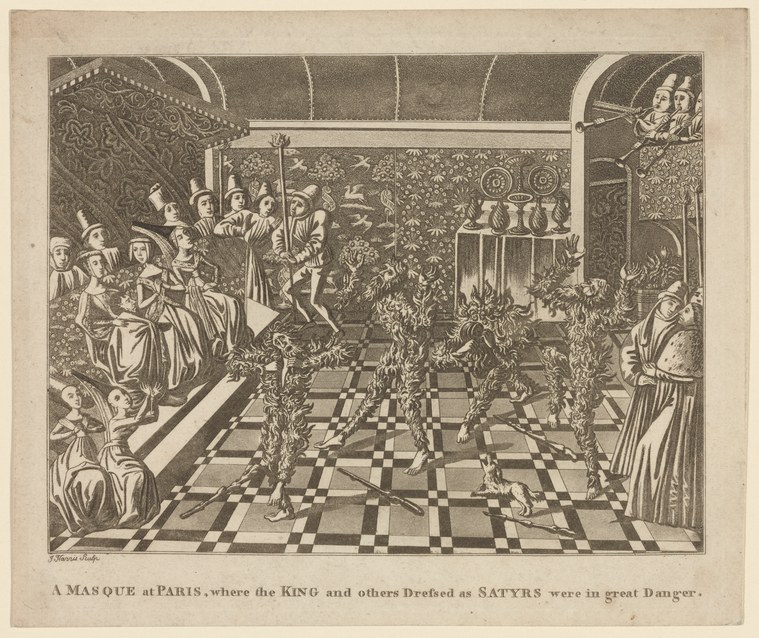
A Masque at Paris, where the King and others dressed as satyrs were in great danger
Unknown artist
- Collection:
- Prints depicting dance
- Source:
- New York Public Library
- Rights:
- Public domain — free to use, share and adapt.
- Recorded as:
- Public Domain
This work documents the relationship between costume, transgression, and spectacle in Renaissance court culture, showing how masquerade functioned as a licensed space for behavior that would otherwise violate courtly hierarchy and decorum. For dance historians, it reveals how court performance could be less about refined technique and more about the transformative power of costume and the temporary suspension of social norms.
What you are looking at
A crowded interior scene depicts a moment of chaos and danger at a royal masquerade in Paris. The composition is divided between two spaces: at left, a group of elaborately dressed courtiers and attendants observe from a raised platform; at right, dancers in satyr costumes—with exaggerated features and animal-like proportions—move across a checkered floor in a grand hall with decorative wall panels and vaulted ceiling. The satyr costumes are striking: figures with animalistic heads, furry or scaled bodies, and contorted postures create an unsettling spectacle. The scene suggests a moment of peril: the satyrs' uncontrolled movements and the onlookers' apparent alarm indicate that the masquerade has descended into danger. The architectural setting is rendered with careful perspective, emphasizing the formal grandeur of the space—a royal palace or great hall with patterned walls and structured geometry—against which the wild, transgressive performance unfolds.
The dancing
The satyr figures display exaggerated, grotesque postures far removed from courtly dance convention: their bodies are bent, twisted, and animalistic, with little evidence of the controlled frame or alignment expected in formal Renaissance or Baroque court dance. Some appear to be in active, almost frenetic motion across the tiled floor, their limbs splayed and bodies unstable. The courtiers at left are static and formal by contrast, arranged in hierarchical clusters that emphasize observation and distance. The satyrs' gestures read as uncontrolled and transgressive rather than choreographed—they occupy space chaotically rather than in organized formation.
The dance depicted
This appears to depict a moment from a real historical event: a masquerade at the French royal court where courtiers dressed as satyrs, a costume choice that proved dangerous and scandalous. The satyrs' costumes and contorted, barely human movement suggest a performance style rooted in court spectacle and carnival inversion—the deliberate transgression of courtly norms through mythological disguise. The image shows not refined dance technique but rather the spectacle of masquerade itself: the point was the costume, the transformation, and the temporary license for behavior that formal court etiquette would normally forbid. This sits at the boundary between court dance, theatrical spectacle, and carnival excess rather than as a depiction of a defined dance style.
How it was made
This is a woodcut or engraving (medium not recorded in the catalogue; the technique is established from the image). The print shows the characteristic line work, tonal modeling through parallel hatching, and spatial recession typical of Northern European engraving or woodcut of the 16th century. The level of detail—the patterned walls, the individual features of dozens of figures, the architectural perspective—suggests a skilled engraver's work, probably created after the event as a documented record. The technique allowed wide circulation of the image as a printed broadside or book illustration, making this a form of news or spectacle reporting rather than a unique artwork—it preserved a memorable (and cautionary) moment for audiences across Europe.
About this work
This is a historical engraving or woodcut documenting a royal masquerade at the French court where courtiers dressed as satyrs with results described in the title as dangerous. The image records not a formal dance style but a moment of courtly spectacle and transgression: the deliberate inversion of court decorum through mythological costume. The composition emphasizes the contrast between the static, formal observation of the courtly onlookers and the wild, chaotic movement of the costumed performers, rendering visible the danger that the title announces. As a printed document, it functioned as a form of historical record and moral commentary, circulating widely among educated audiences in early modern Europe and preserving a memorable episode of courtly excess and its consequences.
How to look at it
Attend first to the contrast between the two spaces: the formal, hierarchical arrangement of courtly observers on the left and the disordered, chaotic movement of the satyr performers on the right. Notice how the satyrs' costumes and postures are rendered as grotesque and barely human, with twisted limbs and distorted features—this is the visual language the artist uses to convey danger and transgression. The checkered floor creates geometric order beneath the chaos above, emphasizing the inversion of courtly control. Finally, observe how the architectural setting frames the event as taking place within a formal, royal space, making the satyr performance a violation of that decorum rather than an independent spectacle.
The period
Masquerades and carnival entertainments were central to Renaissance and early modern court culture, particularly in Italy and France, where they provided occasions for satire, role inversion, and licensed transgression. The satyr—a classical figure from ancient drama and mythology—was a familiar costume choice for such events, associated with uncontrolled appetite, sexuality, and wildness. By the 16th century, court spectacle had become increasingly elaborate and theatrical, blending dance, costume, music, and narrative into multimedia events. The documented danger of this particular masquerade may reflect the genuine risks of elaborate costumes (fire from candles, restricted vision, overheating) or the social danger of costumes that allowed courtiers to violate decorum. The choice to commemorate this event in a widely circulated engraving suggests that such spectacles held public interest and moral significance beyond the court itself.
Where it lives
Held in the New York Public Library's collection of prints depicting dance. The work is documented as a historical record of a court event, preserved in this collection as evidence of Renaissance spectacle and performance practice.
Dance in this work
Questions about this work
Did this masquerade really happen?
The title describes a specific historical event—a masquerade at the French court where courtiers dressed as satyrs with dangerous results. Without additional archival confirmation, the engraving itself is the primary historical evidence, but such events were common in Renaissance court culture. The detail and specificity of the image suggest it was based on an actual occasion rather than a fictional fantasy.
What made the masquerade dangerous?
The title states danger occurred, but the image does not make the precise cause clear. Possibilities include fire hazards from candles near elaborate costumes, physical injury from the chaotic movement, the social danger of costumes that enabled courtiers to violate decorum, or the uncontrolled behavior that the satyr costume licensed. The engraving emphasizes the chaos and alarm of the moment without specifying the threat.
Is this a dance, or is it spectacle?
It is both and neither in the modern sense. The satyr performance shows choreographed court entertainment involving music, costume, and organized movement—what courts of the period would have called a 'masquerade' or 'ballet.' But the image does not depict refined dance technique in the formal sense. The point of the event was the costume, the transformation, and the license for transgression rather than the demonstration of dance skill.
More dance artwork





