49 works in this view — arrow keys or swipe to move between them.
Dance in Art
Habit d'orfevre
Unknown artist
- Collection:
- Prints depicting dance
- Source:
- New York Public Library
- Rights:
- Public domain — free to use, share and adapt.
- Recorded as:
- Public Domain
This print preserves the visual identity of a specific theatrical character and the acrobatic, non-balletic dance practices that populated early modern European entertainment. For historians of dance, it demonstrates that theatrical performance in this period encompassed far more than the codified steps of court dances or ballet technique—contortion, comic excess, and spectacular display were central to how audiences experienced dance on the stage.
What you are looking at
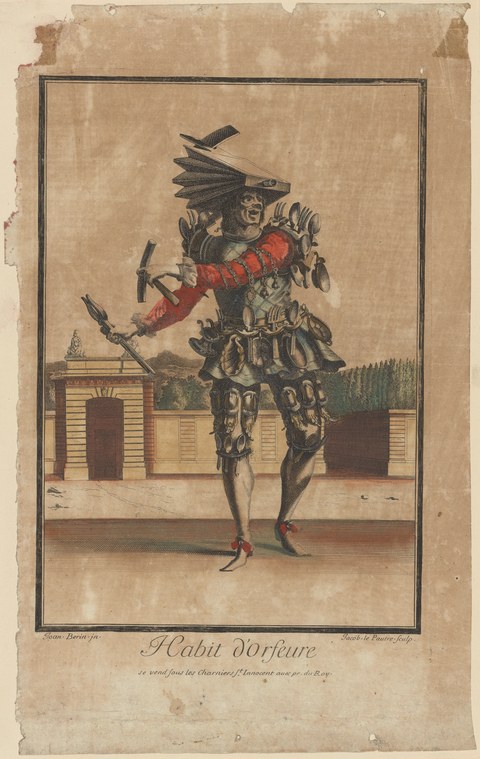
A single figure in an exaggerated theatrical pose dominates the composition, set within a classical architectural courtyard. The dancer wears a striking costume: a dark patterned or textured jacket or tunic, prominently displaying a brilliant red silk or satin garment across the torso and limbs—possibly a sash, cloak, or integrated costume piece. The figure's pose is highly stylized and acrobatic, with one leg extended upward at an extreme angle while the body twists dramatically, the arms positioned to enhance the sense of motion and spectacle. The head is adorned with an elaborate feathered headdress or tall decorative crown. The setting includes a classical portico with rusticated stonework and a fence or palisade in the background, suggesting a formal garden or palace courtyard rendered in muted tones. The floor beneath is a flat plane, emphasizing the isolated, performative nature of the pose. The print's hand-coloring in reds and blacks against the pale paper creates strong visual contrast and focuses attention on the costume elements.
The dancing
A solitary male figure (indicated by the inscription and period costume conventions) executes a pose of extreme extension and contortion. One leg is raised nearly vertical, the knee bent dramatically upward; the supporting leg appears nearly straight, creating an unstable, performative stance. The torso is twisted to display the red drapery, and the arms are spread asymmetrically—one raised, one extended—to frame the body and enhance visual drama. The posture suggests neither a functional movement nor a contained ballroom frame, but rather a moment of peak spectacle, possibly from a comédies-ballets or baroque theatrical entertainment.
The dance depicted
This is almost certainly a costume print for a character from French baroque theatrical entertainment, likely from a comédies-ballets tradition (approximately 17th–early 18th century). The title *Habit d'orfèvre* identifies the figure as an *orfèvre* (goldsmith or metalworker), suggesting this is a named character type from a specific production or commedia dell'arte-influenced tradition. The extreme pose—neither a recognizable social dance form nor classical ballet vocabulary—suggests acrobatic or clownish display typical of theatrical comedy dances. The costume, pose, and architectural setting all point to a theatrical court or professional stage performance rather than social dancing.
How it was made
This is a hand-colored engraving or etching, characteristic of French theatrical costume prints from the 17th–18th centuries. The line work is crisp and controlled, establishing form and detail; the hand-coloring in red and black pigment was added after printing, a labor-intensive process that indicates this was a luxury object aimed at courtly, theatrical, or educated urban audiences. The technique allowed wide circulation of costume designs and theatrical imagery among dancers, patrons, and theaters across Europe, making it a primary document of how specific character types were visualized and remembered.
About this work
This is a theatrical costume print depicting a character identified as an *orfèvre* (metalworker) in an exaggerated, acrobatic pose. The figure wears an elaborate costume with a prominent red silk element and feathered headdress, set within a classical architectural courtyard. The work belongs to the French baroque tradition of theatrical dance imagery, documenting both the character types and the performance conventions of court and professional entertainment. It is a primary visual source for understanding how dance and spectacle were combined in early modern French theater, where comedy, acrobatics, and music created hybrid entertainment forms.
How to look at it
Attend to the impossible geometry of the pose—this is not a moment in a functional movement sequence, but a frozen instant of spectacular display. The figure is not balanced but posed, the extreme leg extension and twisted torso emphasizing flexibility and showmanship rather than grace or control. Notice how the red drapery is arranged to catch light and draw the eye, and how the feathered headdress adds height and visual drama. The classical architecture in the background paradoxically frames something entirely anti-classical: an excess of motion, flexibility, and theatrical artifice. This contrast—between the orderly courtyard and the contorted body—encapsulates the energy of baroque theatrical entertainment.
The artist
The artist is not recorded in the catalogue. However, the style, technique, and subject matter are consistent with French theatrical costume print production of the late 17th or early 18th century. Such prints were often commissioned by theaters, choreographers, or wealthy patrons to document and disseminate designs for costumes and character types. Many were produced in collaborative workshops and distributed to audiences as merchandise, similar to modern playbills and souvenir programs.
The period
This work dates to the era of the comédies-ballets, a hybrid theatrical form pioneered by Molière and Jean-Baptiste Lully in France during the reign of Louis XIV (mid-to-late 17th century). These works combined spoken comedy, dance, and music in productions that served both the court and increasingly professional theaters. Theatrical dance in this period was not limited to the formalized courtly dances (minuet, courante, etc.) documented in other sources; performance also included acrobatic display, pantomime, and comic business derived from commedia dell'arte. The costume print tradition was essential for documenting and promoting these performances across cities and courts.
Where it lives
Held in the New York Public Library's Prints collection, part of their extensive holdings of European theatrical and dance imagery. The work is catalogued as a print depicting dance, part of the curatorial framework that recognizes costume prints and theatrical imagery as primary documents of dance history.
Dance in this work
Questions about this work
What is an 'orfèvre' and why would there be a dancer in this costume?
An *orfèvre* is a goldsmith or metalworker. In baroque theatrical entertainment, character types from different professions or social roles were given dances and comic routines. This figure was likely part of a larger theatrical work—possibly a comédies-ballets—where the goldsmith's role provided occasion for acrobatic comedy and spectacle. The character may have appeared in scenes involving trade, craft, or urban life, allowing for both satire and physical display.
Is this classical ballet?
No. While classical ballet was being codified in France during this period, this work predates or stands outside that tradition. The extreme, unstable pose and acrobatic emphasis reflect theatrical comedy and spectacle rather than the controlled, turned-out vocabulary of ballet. This is evidence that early modern dance entertainment included multiple styles: ballroom dances, court dances, and theatrical-comedic acrobatics did not yet have the hierarchical separation they would later acquire.
How do we know this was meant for performance and not just fantasy?
The costume is specific and functional: the red drapery would move dramatically; the feathered headdress would catch light; the pose is held, not transitional. The architectural setting establishes a real place, and the inscription names a character type. This is a working design document, not a fanciful invention. Similar prints were used by theaters to brief performers, by patrons to remember productions, and by dancers to study costume designs.
More dance artwork





