49 works in this view — arrow keys or swipe to move between them.
Dance in Art
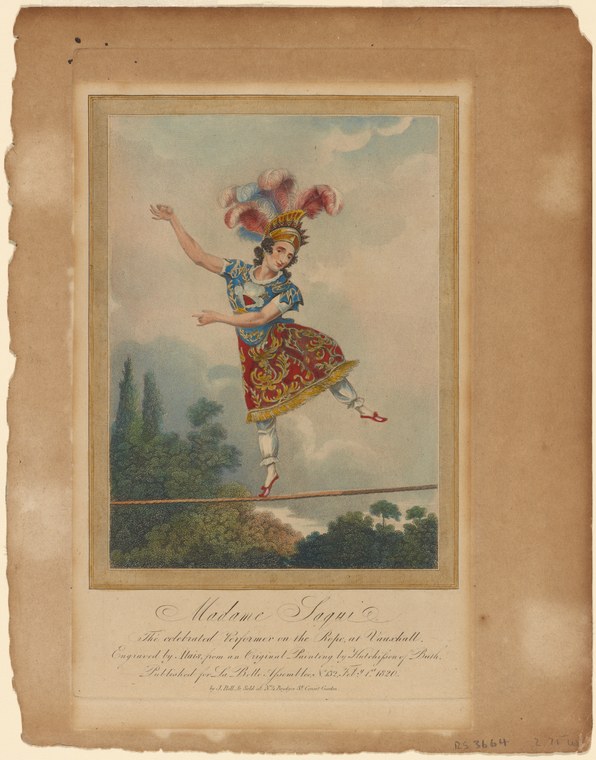
Madame Saqui, the celebrated performer on the rope, at Vauxhall
Unknown artist
- Collection:
- Prints depicting dance
- Source:
- New York Public Library
- Rights:
- Public domain — free to use, share and adapt.
- Recorded as:
- Public Domain
Rope dancing was a major performance genre across the nineteenth century and Madame Saqui was its undisputed star, yet the form is almost unknown today and receives minimal attention in histories of dance, circus, and performance. This print is direct visual evidence of how the art was practised, what it required of the body, and what audiences travelled to see. The image also captures the relationship between spectacle, costuming, and bodily display that defined nineteenth-century entertainment culture—a relationship that remains central to contemporary circus and acrobatic performance.
What you are looking at
A female performer balances on a taut rope strung across a landscape, captured mid-leap or stride in a moment of spectacular physical suspension. She wears an ornate costume: a fitted blue bodice with gold embroidery, a voluminous red skirt with gold patterning, and white stockings and shoes. Her headdress is an elaborate construction of tall feathers in shades of pink and red, rising high above her head. Her arms are spread wide for balance, one raised higher than the other, her body arched with controlled tension. The rope itself runs diagonally across the composition, anchored in the middle distance. Below and behind her stretches a Romantic-era landscape: dark evergreen trees in the middle ground, a hazy vista with water or sky in the distance, and soft clouds above. The print's hand-coloured palette—delicate greens and blues in the landscape, warm flesh tones, rich crimsons and golds in the costume—gives the scene an almost dreamlike intensity. The figure dominates the composition, her precarious balance and elaborate dress commanding complete attention.
The dancing
A single female figure stands on the rope with weight distributed across both feet, legs in a slightly flexed position suggesting active engagement with the unstable surface. Her torso is upright but dynamic, with arms spread wide in a classical balance position—the right arm higher and more extended than the left—that both steadies her and creates visual drama. Her head is held high and proud, face serene, body language suggesting confidence rather than struggle. The pose captures a moment of equilibrium that would require exceptional proprioceptive control and lower-body strength. Her costume, though cumbersome by modern standards, appears neither to impede her nor to be incidental decoration; it is part of the performer's body language and visual presence.
The dance depicted
This depicts rope dancing, a spectacular acrobatic performance genre that flourished in the eighteenth and nineteenth centuries as a centerpiece of circus, fair, and theatrical entertainment. Madame Saqui was the most celebrated rope dancer of her era, performing publicly from at least 1815 until her death in 1866, and this print documents her signature feat: performing on an inclined rope strung at height, often with added obstacles or theatrical staging. Rope dancing demanded extreme balance, spatial awareness, and lower-body control—the performer essentially walked or danced across a moving, yielding surface with no safety measures. The elaborate costume and feathered headdress were not mere decoration but part of the spectacle, adding visual complexity and demonstrating that the feat was achieved without simplification or reduction.
How it was made
This is a hand-coloured engraving or aquatint, a reproductive print technique that allowed wide circulation of the image. The fine lines and delicate tonal work visible in the landscape suggest engraving, while the soft transitions in shadow suggest aquatint or stippling. The hand-colouring—applied after printing and visible in slight imperfections at the edges of forms—indicates this was a commercial print, expensive enough to warrant individual painting but aimed at a market that could afford such works. Such prints were the principal means of documenting and publicizing celebrity performers and spectacular entertainments before photography; they circulated in portfolios, were glued into scrapbooks, and served as both souvenirs and advertisements.
About this work
This is a record of one of the most celebrated physical performers of the nineteenth century at the height of her fame. Madame Saqui's rope dancing was not a minor curiosity but a major attraction, commanding audiences across Europe and America for fifty years. The print documents not merely a feat of balance but a complete theatrical production: the costume, the landscape setting, the moment chosen. It shows us how rope dancing was understood by its era—not as a test of survival but as a disciplined, elegant, almost balletic display of bodily control. The image is a crucial document of nineteenth-century circus and theatrical history, and a record of a physical art form that has largely vanished from contemporary performance culture.
How to look at it
Attend first to the precarious geometry of the scene: the diagonal line of the rope, the suspended weight of the body, the landscape depth below. The artist has chosen a moment of static balance rather than movement, which paradoxically makes the sense of danger and difficulty more pronounced—we see the equilibrium achieved but must imagine the effort to maintain it. Notice how the costume and headdress are rendered as part of the challenge: they add visual complexity and weight distribution, increasing the apparent difficulty of the feat. The serenity of the performer's expression is key to the image's meaning—this is not struggle but mastery.
The artist
The artist is not recorded in the available catalogue information. The print's inscription attributes it to 'Madame Saqui' as the performer and records publication details but not the engraver's or colourist's name, which was common practice for commercial theatrical prints of this period. The omission reflects the celebrity of the performer rather than the artist.
The period
Rope dancing and slack-rope performance were entertainment forms that reached their commercial peak in the late eighteenth and nineteenth centuries, enabled by advances in rope manufacture and the growth of permanent circus venues and touring companies. Madame Saqui's career spanned the heyday of the Romantic circus, a period when acrobatic spectacle was a principal attraction of public entertainment. The Romantic era's fascination with physical transcendence, danger, and the display of disciplined virtuosity across traditionally female bodies is reflected in the landscape setting and the costume's theatrical grandeur. This was the era of the tightrope walker as celebrity star, before motion pictures and mass entertainment displaced the circus from the center of public culture.
Where it lives
This hand-coloured engraving is held in the NYPL's collection of prints depicting dance, one of a substantial archive of theatrical and performance imagery spanning multiple centuries and media. The inscription identifies the subject as Madame Saqui and provides publication information, standard for commercial theatrical prints intended for collectors and theatre-goers.
Dance in this work
Questions about this work
Was Madame Saqui a real person?
Yes. Madame Saqui (c. 1786–1866) was a legendary rope dancer and acrobat, possibly the most celebrated of her era. She performed across Europe and America for decades, including at Vauxhall Gardens (a major London pleasure garden) and in circuses. She pioneered high-wire and rope-dancing as theatrical spectacle and is documented in contemporary prints, playbills, and memoirs as one of the most notable performers of her time.
What was Vauxhall Gardens?
Vauxhall Gardens (or Vauxhall Park) was one of London's principal pleasure gardens from the eighteenth century through the mid-nineteenth century, a public space for music, theatre, acrobatics, fireworks, and social promenade. It attracted performers of all kinds and was a venue for celebrity entertainers. The reference in the print's inscription places Saqui's performance in a specific, prestigious context.
Is rope dancing still performed?
Contemporary circus and acrobatic performance includes tightrope, slack-rope, and highwire acts, but the specific genre of theatrical rope dancing with costume and landscape staging that Saqui pioneered is not a common sight in modern circus. The skills are still practised, but the theatrical and cultural context has shifted entirely.
How did rope dancers train?
Historical records are sparse, but rope dancers typically began training in childhood and came from circus families or were apprenticed to established performers. Training involved repeated practice on progressively more difficult ropes and tasks. The art required exceptional proprioception, ankle and foot strength, and a developed sense of balance—skills acquired through thousands of hours of repetition, much like ballet or gymnastics today.
More dance artwork





