49 works in this view — arrow keys or swipe to move between them.
Dance in Art
La filleule des fées: ballet toujours pantomime, en trois actes et ses tableaux; à la queue d'un prologue, par MM. Singe-Orge et Pierrot
Unknown artist
- Collection:
- Prints depicting dance
- Source:
- New York Public Library
- Rights:
- Public domain — free to use, share and adapt.
- Recorded as:
- Public Domain
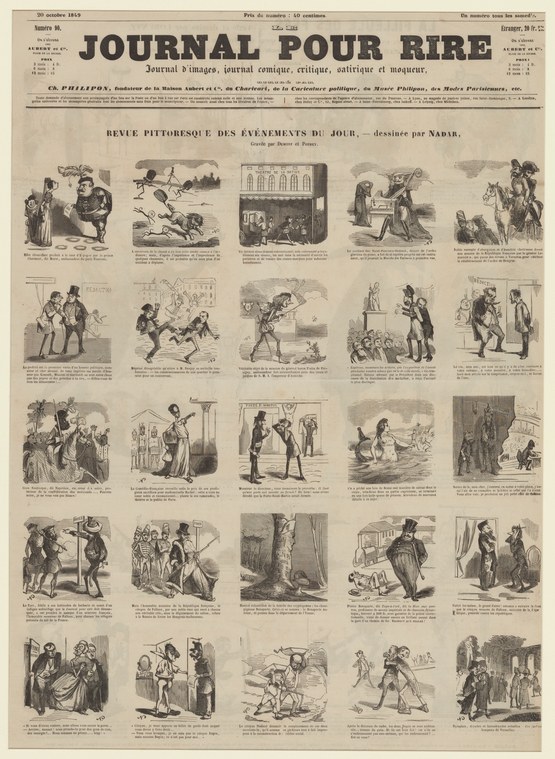
This work captures the satirical critique of Romantic ballet that circulated in popular French culture, revealing what non-specialist audiences found to mock and exaggerate about the form. It documents the centrality of pantomime and narrative spectacle to 19th-century ballet, and shows that the codified technique we associate with classical ballet was not what popular culture saw or valued. The image is a primary source for understanding how ballet was actually experienced and consumed in the 19th century.
What you are looking at
This is a satirical French illustrated broadsheet presenting a continuous narrative of twenty-five small scenes arranged in a grid, each captioned with comic text. The work depicts episodes from a ballet pantomime titled *La Filleule des Fées* (The Fairy's Goddaughter), with a prologue and three acts. The scenes show theatrical and domestic scenarios rendered in fine engraving: characters in 19th-century dress interact in interior and exterior settings, with some scenes showing obvious pantomime action—exaggerated gesture, falls, physical comedy, and theatrical posturing. The figures range from aristocratic women in full skirts to men in tailcoats and top hats, alongside what appear to be fairy or supernatural characters. The composition treats the ballet as material for social satire, with each vignette isolating a moment of comedic action or emotional excess typical of Romantic-era melodramatic performance.
The dancing
The figures are uniformly rendered in a documentary engraving style that prioritizes clarity of action over grace. Bodies are shown in exaggerated attitudes—extreme arm reaches, stumbling or falling poses, rigid terror, and emphatic pointing. There is no suggestion of turnout, ethereal lightness, or the codified port de bras of classical ballet. Instead, the bodies move like commedia dell'arte characters or pantomime performers: they lurch, recoil, clutch, and sprawl. Couples appear in several scenes but in unstable domestic or comic contexts rather than in dance embrace. The artist shows no understanding of or interest in balletic technique; the work lampoons the narrative excess and physical contortion of Romantic ballet rather than celebrating its aesthetics.
The dance depicted
This is a satirical representation of a Romantic ballet, not a dance manual or celebratory image. *La Filleule des Fées* appears to have been a pantomime-ballet in the tradition of early-to-mid 19th-century French theatre, structured around narrative spectacle and magical transformation rather than pure dance. The individual scenes suggest plot points: seduction, revelation, supernatural intervention, domestic chaos, and reconciliation—the staples of Romantic ballet dramaturgy. The work's value is as evidence of what audiences understood ballet to *be*—a vehicle for melodramatic storytelling, physical comedy, and sentimental excess—rather than as documentation of how ballet was actually danced. The exaggeration implies the real performances were probably equally theatrical and text-driven.
How it was made
This is a wood engraving or steel engraving, identifiable by the fine linear hatching, precise parallel lines for shading, and the uniform black-and-white tonality characteristic of 19th-century print reproduction. The technique allowed for mass production and rapid circulation as a broadsheet or cheap illustrated journal page. The use of engraving rather than lithography (which offered softer tonal control) suggests this was made for a publication with wide distribution and a working-class or popular audience. The style is typical of French satirical journalism from the 1830s–1850s, when illustrated comic serials were a major form of social commentary and entertainment.
About this work
This is a satirical engraved broadsheet depicting scenes from a Romantic ballet pantomime, arranged as twenty-five comic vignettes. Rather than documenting actual choreography or celebrating ballet technique, it uses exaggerated gesture and melodramatic action to mock the narrative excess and emotional intensity of early 19th-century theatrical ballet. The work is evidence of how ballet was perceived by popular audiences and satirists of the period—as a vehicle for sentimental storytelling and physical comedy, not for pure dance. It belongs in a dance gallery as a window into Romantic-era ballet culture and the tension between the medium's narrative ambitions and its physical possibilities.
How to look at it
Read the broadsheet as a sequence, following the captions to understand the narrative progression. Note how the artist exaggerates the attitudes and expressions typical of Romantic ballet—the extreme arm reaches, the rigid postures of fear or surprise, the physical pratfalls. Compare a single vignette (e.g., a scene of seduction or supernatural revelation) with your knowledge of how classical ballet actually moves; the contrast reveals what satirists wanted to emphasize. The engraving technique itself—the fine, precise linework and absolute clarity of every gesture—allows the exaggeration to read as deliberate caricature rather than incompetence. Observe how the artist renders the supernatural or magical elements (likely fairies, spirits, or enchantments) through the same physical vocabulary as the mundane scenes, collapsing the hierarchy between the real and the fantastical.
The artist
The broadsheet is credited to NAVAR (visible in the caption), whose full identity is not recorded. The style is consistent with French satirical illustrators of the 1830s–1850s, an era when illustrated journalism was a major vehicle for social and artistic criticism. Artists like Honoré Daumier, Charles Philipon, and others working in similar modes produced thousands of comic engravings for publications like *La Caricature* and *Le Charivari*. Without further documentation, NAVAR's biographical context cannot be established, but the professional quality of the engraving suggests a trained printmaker working within the established satirical press.
The period
This work emerges from the Romantic era (1820s–1850s) when ballet was dominated by narrative spectacle, magical transformations, and the cult of the female dancer as ethereal supernatural being. Ballets like *La Sylphide* (1832) and *Giselle* (1841) were enormously popular with audiences, but they were also targets of satire by critics and journalists who saw them as emotionally excessive or narratively implausible. The illustrated press, which flourished in France after 1830, made visual satire a central form of cultural commentary. Comic engravings of theatrical subjects were enormously popular and allowed artists to critique the conventions of opera, ballet, and melodrama through exaggeration and visual pun. This broadsheet sits within that tradition of theatrical mockery.
Where it lives
The work is held by the New York Public Library as part of a prints collection documenting dance imagery. It appears to be a single broadsheet or journal page rather than a book illustration, suggesting it was printed for wide distribution and affordable sale to a popular audience. The exact publication context—whether from a periodical like *Le Charivari* or *La Caricature*, or as an independent satirical print—cannot be confirmed from the record.
Dance in this work
Questions about this work
Is this actually a ballet, or a parody of ballet?
Both. *La Filleule des Fées* was a real ballet pantomime performed in France, but this engraving is a satirical representation of it by a comic illustrator. The artist exaggerates the physical language and narrative excess of the performance to mock it. You are seeing not what the ballet was, but what a 19th-century satirist thought was ridiculous about it.
Why does this look nothing like classical ballet?
Because Romantic ballet (1820s–1850s) was fundamentally different from classical ballet. It prioritized narrative, emotion, and theatrical spectacle over pure dance technique. Pantomime—exaggerated gesture and physical comedy—was central to how these ballets told their stories. The satirist is not misrepresenting ballet; he is exaggerating its actual visual language.
Who is NAVAR, and why is there no artist name?
NAVAR is the credited engraver or illustrator, but no biographical information is recorded in the collection. Many broadsheet satirists and engravers of the 19th-century French press worked under pseudonyms or initials, and some remain unidentified. The professional quality of the work indicates training in fine engraving.
How does this fit into the history of ballet?
This is evidence of how ordinary audiences and critics experienced Romantic ballet—as melodramatic, emotionally excessive, and driven by narrative and spectacle rather than by codified technique. It captures a moment when ballet was moving away from pure dance toward story ballets, and when that transition was still controversial enough to be worth satirizing.
More dance artwork





