49 works in this view — arrow keys or swipe to move between them.
Dance in Art · 2023
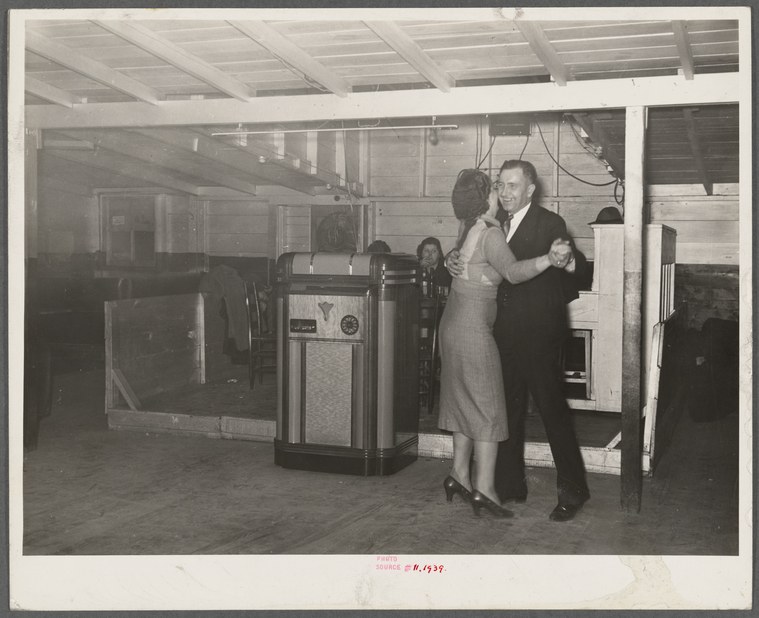
Interior of Oke-Doke dance hall. Williamson County, Illinois
Unknown artist
- Medium:
- Source:
- New York Public Library
- Rights:
- Public domain — free to use, share and adapt.
- Recorded as:
- public_domain
This photograph is rare evidence of how ordinary Americans danced together in their own spaces, without performance intention or theatrical design. It shows the closed-frame partner dancing that shaped American social life for generations, but which is now often encountered only in competitive or revivalist contexts. For dancers and historians, it is a document of a lost social world—not how dance was performed, but how it was lived.
What you are looking at
A black-and-white photograph taken inside a dance hall captures an intimate moment between a couple in mid-dance. The woman, dressed in a light-colored dress typical of mid-20th century casual wear, is held close by a man in a dark suit and white shirt. The couple occupy the center foreground of the frame, their bodies angled to the viewer's right. Behind them, the cavernous interior of the hall stretches back into shadow—tall support columns are visible, and what appears to be a bandstand or stage structure recedes into darkness on the left. The floor is bare concrete or wooden planking. The overhead ceiling is coffered or paneled, with exposed beams visible. The lighting is flat and even, typical of documentary photography, with no spotlight or theatrical illumination. A few other figures are barely discernible in the shadowed background, suggesting this was an active venue. The photograph has the look of a candid moment captured during normal operation, not a posed or rehearsed scene.
The dancing
The couple dances in a closed ballroom hold—the man's right hand at the woman's back, her left hand on his upper arm or shoulder, their other hands joined. The man leans slightly forward from the hips, his weight centered, guiding. The woman's body is upright and responsive, her head turned away from her partner in a posed line typical of formal ballroom dancing. Both bodies are relaxed and at ease, suggesting familiarity with the form. The posture and distance between them indicate a smooth, controlled frame rather than a vigorous or gymnastic movement—this is partner dance, not solo or acrobatic form.
The dance depicted
This is social ballroom dancing, almost certainly a foxtrot or waltz—the closed frame, the upright posture, the formal dress, and the ballroom setting all point to American smooth or American rhythm styles. The dance hall itself (an 'Oke-Doke') was a working-class or rural social venue, which narrows the likely style: foxtrot and waltz were the dominant partner dances in American dance halls of this era, accessible to ordinary people and requiring no specialized training. The image documents not performance dance but social dancing—ordinary people enjoying an evening out. The relaxed, unperformed quality of the pose and the candid nature of the photograph suggest this is how people actually danced in such venues, not a theatrical interpretation.
How it was made
This is a gelatin silver print—a black-and-white photograph, likely taken with available light and a simple camera. The flat, documentary quality and the absence of shadow drama suggest it was taken by a press photographer or documentary photographer, possibly as part of a Works Progress Administration (WPA) or similar government documentation project. The source note indicates it is held in the New York Public Library collection, which acquired many such documentary photographs. The print's modest size and technical straightforwardness suggest it was made for publication or archival record rather than as fine art photography.
About this work
This photograph documents a moment of social ballroom dancing in a rural Illinois dance hall, capturing how ordinary Americans danced in the mid-20th century. It is neither a performance nor a posed studio image, but a candid record of the kind of partner dancing that filled American dance halls—foxtrot or waltz in a closed hold, in a plain concrete-floored venue lit by overhead ceiling panels. The image sits in a long tradition of documentary photography that treats dancing not as spectacle but as everyday social practice, and it belongs in a dance gallery because it shows what dancing actually looked like to people who did it, before it became either heritage or spectacle.
How to look at it
Look at the frame the couple holds: formal, closed, upright, with clear lines of connection between the bodies. This is not improvisation or solo dancing. The woman's head position—turned away from her partner, her gaze not meeting his—is a convention of ballroom dancing, not of social intimacy. Notice the plainness of the setting: no band visible, no theatrical lighting, no stage. This is a working space, not a theater. The candid nature of the photograph—no one is performing for the camera—makes it an unusually honest record of how the dance actually looked when it was lived rather than displayed.
The artist
The photographer is not recorded. The image appears to be part of a documentary project, possibly a WPA-era documentation of rural American life. The straightforward, unadorned photographic approach and the choice of subject—the ordinariness of the scene—suggests a photographer working in the social documentary tradition, interested in recording how people actually lived rather than in artistic effect.
The period
This photograph was likely taken in the 1930s–1940s, a period when social ballroom dancing was at its height in America. The foxtrot and waltz dominated American dance halls, having been standardized and popularized through the 1920s and 1930s. The jukebox era was beginning, and dance halls like the 'Oke-Doke' were primary venues for socializing, courtship, and entertainment. This was the moment before rock and roll transformed popular dance in the 1950s; the photograph captures the end of an era of partner dancing in closed holds. Meanwhile, documentary photography itself was flourishing, supported by government programs and by a cultural interest in recording 'the American way of life.'
Where it lives
The photograph is held in the New York Public Library collection. It is catalogued as a print and has been assigned a source reference number. No photographer, date, or prior provenance is recorded.
Dance in this work
Questions about this work
What is an Oke-Doke dance hall?
An Oke-Doke was a type of casual, working-class or rural American dance hall, typically featuring live music or recorded music via jukebox. The name suggests a modest, unpretentious venue. Such halls were common in small towns and rural areas in the mid-20th century and served as primary social spaces for dancing, courtship, and entertainment.
How do we know this is foxtrot or waltz?
The closed-frame hold, the upright and formal posture of both dancers, the dressy but non-theatrical clothing, and the ballroom setting all point to American smooth dances (foxtrot, waltz, or tango). In a rural dance hall of this era, foxtrot and waltz were overwhelmingly the most common partner dances. The relaxed, social context rules out performance styles.
Who took this photograph?
The photographer is not recorded. The photograph was likely taken as part of a documentary or journalistic project, possibly a WPA-era documentation of American life. The style and approach suggest a photographer trained in social documentary work rather than a local or amateur photographer.
When was this taken?
The photograph's style, the quality of the film, the clothing, and the condition of the print suggest it was taken in the 1930s–1940s. The catalogue record does not specify a precise date.
More dance artwork