49 works in this view — arrow keys or swipe to move between them.
Dance in Art
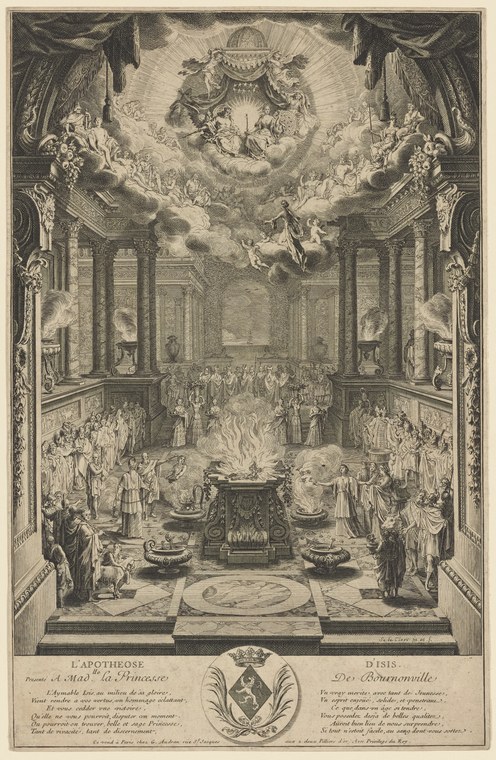
L'apotheose d'Isis presenté a Madlle. La Princesse de Bournonville
Unknown artist
- Collection:
- Prints depicting dance
- Source:
- New York Public Library
- Rights:
- Public domain — free to use, share and adapt.
- Recorded as:
- Public Domain
Ballet de cour was the dominant form of court spectacle in 17th-century Europe, a laboratory for theatrical innovation and a vehicle for royal propaganda. This print preserves visual evidence of how such spectacles were conceived, staged, and commemorated—offering a rare window into the architecture of aristocratic dance and the relationship between bodily movement and symbolic architecture in the Baroque imagination.
What you are looking at
This is an engraved architectural fantasy depicting a grand Baroque interior transformed into a celestial theatre. The composition is rigorously symmetrical: a vast hall with Corinthian columns receding in perspective, its barrel-vaulted ceiling open to a divine vision. Clouds and light rays pour down from above, where cherubs and putti surround heraldic insignia (likely that of the Bournonville family). On the floor of the hall, a crowd of courtiers in 17th-century dress assembles around a central altar or shrine, with smaller groups clustered in the colonnaded galleries on either side. The architectural setting reads as a temple or chapel reimagined as a stage, with the divine realm above and the mortal assembly below framed in Baroque illusionistic space. The entire scene is conceived as an *apotheosis*—a transformation or elevation of the princess named in the title into divine status.
The dancing
The figures are numerous but rendered small and in silhouette against the architectural grandeur, which subordinates individual gesture to the overall ceremonial composition. Those visible stand or process in formal court dress—long skirts and coats typical of the late 17th century. No distinct dance frame or hold is visible at this scale; the assembly appears to be standing, processing, or kneeling in ritual rather than executing choreographed steps. The arrangement suggests hierarchical court ceremony rather than social or theatrical dance.
The dance depicted
This engraving commemorates a court spectacle or ballet de cour, a multimedia genre fusing music, verse, dance, and visual spectacle that dominated French and European aristocratic culture in the 17th century. The inscription confirms this was presented to Mademoiselle de Bournonville (the title notwithstanding the spelling variation). Whether a full ballet with dancing or a processional/ceremonial display incorporating dance is not entirely clear from the image alone, but the architecture, the title referencing apotheosis, and the frontal staging convention all align with ballet de cour. The setting is deliberately theatrical and divine rather than naturalistic, which was essential to the genre's allegorical ambition.
How it was made
This is an engraving (likely line engraving), a printmaking technique that allowed fine detail, precise linear perspective, and mass reproduction. The intricate cross-hatching throughout creates tonal modulation and shadow without color. Engravings of this calibre were expensive to produce and were created for a learned, wealthy audience—in this case, the court circle around the Bournonville family and those in orbit around the French crown. The technique's precision suits the architectural rendering and the allegorical program of the print. Publication as a print records the spectacle for posterity and circulation among those who could not attend in person.
About this work
This engraving documents a court ballet of the late 17th century, likely from the French court orbit, though the record does not establish the date or printmaker with certainty. It commemorates a spectacle presented to Mademoiselle de Bournonville, in which dance, music, and visual illusion combined to stage the apotheosis—the elevation to divine or heroic status—of a princess. The work exemplifies the baroque marriage of architecture, theatre, and dance in the ballet de cour tradition. It belongs in a gallery of dance imagery because it shows how dance functioned in courtly life not as a separate entertainment but as the physical embodiment of allegorical and political meaning within a total theatrical environment.
How to look at it
Approach this engraving as architectural theatre rather than pure dance document. The artist has chosen to render the *setting* and *occasion* of the spectacle rather than freeze a moment of choreography. The viewer's eye is led through the hall in recession toward the divine vision above, replicating the participant's experience of the apotheosis unfolding. Notice the formal symmetry—it enforces the idea of order, ceremony, and divine harmony. The small scale of the figures emphasizes that they are parts of a larger allegorical whole, rather than individualised performers. To understand the dance itself, look to the posture and grouping of the courtiers; they appear formal and processional, suggesting that baroque court dance combined geometric arrangement with measured steps and arms rather than locomotor vigour.
The artist
The engraver is not recorded in the catalogue. The inscription credits the design to no individual, suggesting either that the printmaker's name is lost or that the architectural design was the collaborative work of court artists (common in spectacle production). The style and technique are consistent with professional court printmaking of the late 17th century.
The period
The ballet de cour flourished from the early 16th century through the early 18th century, reaching its apogee in 17th-century France under patronage of Louis XIV and the nobility. These spectacles combined dance (executed by courtiers and trained dancers), music, poetry, and elaborate scenic design—often involving perspective scenery and mechanical special effects. The form was deeply allegorical: dances and tableaux embodied virtues, elements, seasons, or political meanings, and the climax often involved the elevation or apotheosis of a royal or noble figure. Dance in the court ballet was both social accomplishment (courtiers were expected to dance) and art form. The late 17th century, when this print likely dates, saw the formalization of dance technique and the emergence of professional dancers, though court ballet remained an aristocratic occasion.
Where it lives
Held by the New York Public Library in its collection of prints depicting dance. The work is a print (likely an impression of a copper engraving) and would have circulated among the educated nobility and courtiers of the period as a commemorative object and record of a prestigious event.
Dance in this work
Questions about this work
What is a ballet de cour?
A ballet de cour was a multimedia spectacle that combined dance, music, verse, and elaborate stage design in the courts of Renaissance Italy and Baroque France. Typically lasting several hours, it told an allegorical story—often involving mythological or political themes—and culminated in the elevation or transformation of the patron or a royal figure. Court nobles and professional dancers performed, and the spectacle was a vehicle for displaying power, learning, and artistic refinement.
Who was Mademoiselle de Bournonville?
The catalogue does not identify her beyond the title. However, the Bournonville family was a noble family with connections to the Danish and French courts. It is likely she was a noblewoman for whom this spectacle was mounted or dedicated, though the exact date and her relationship to the spectacle are not established in the record.
Why is the architecture so important in this image?
In baroque spectacle, architecture was not merely a backdrop—it was an allegory. The perspective, proportions, and classical orders conveyed symbolic meaning (order, harmony, divine geometry). The opening of the vault to the celestial realm above was a common device to stage the apotheosis: the transition from earthly to divine space was literally built into the theatre, and dancers or courtiers would process or ascend through this space as part of the choreography.
Can you see the dancing in this print?
Not in close detail. The figures are too small and numerous to read individual steps or formations. What you can see is that the assembly is formal, processional, and symmetrically arranged—consistent with the measured, geometric style of late 17th-century court dance. The actual choreography would have been visible to spectators in the hall but is sacrificed here in favour of recording the total architectural and allegorical effect.
More dance artwork





