49 works in this view — arrow keys or swipe to move between them.
Dance in Art
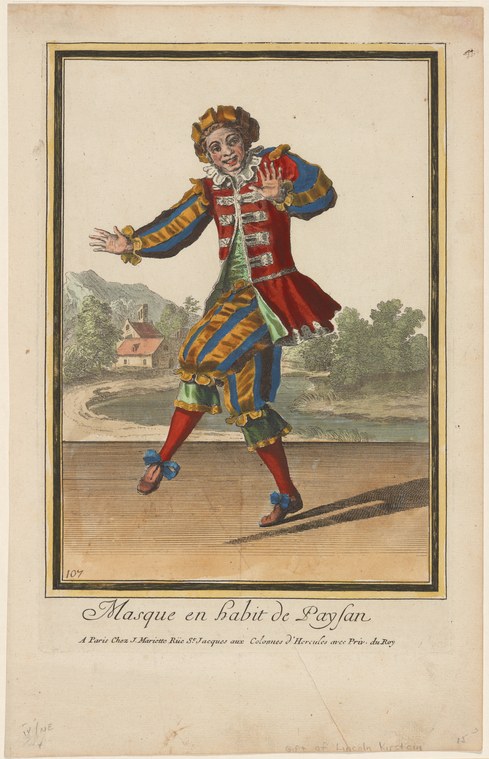
Masque en habit de paysan
Unknown artist
- Collection:
- Prints depicting dance
- Source:
- New York Public Library
- Rights:
- Public domain — free to use, share and adapt.
- Recorded as:
- Public Domain
Character and pantomimic dances were considered minor compared to ballet, but they constituted the majority of theatrical entertainment and preserved a gestural and comedic vocabulary that modern dance has largely lost. This single image captures the physicality and personality of that tradition—the open arms, the buoyant extension, the painted face—and reveals it as a skilled performance mode, not a subordinate one.
What you are looking at
A single figure in theatrical costume strikes an exuberant pose against a rural landscape. The dancer wears an elaborate habit—a red coat with gold braid trim and blue sleeves striped in gold, paired with red breeches and blue stockings. A large bow adorns the chest; the face is painted white with exaggerated features and rouged cheeks. The figure's weight is thrown to one side, one leg extended in a springing attitude, arms spread wide in an expansive gesture. The setting shows a river in the middle distance, trees, and a cottage with a red roof, rendered in pale watercolor washes. The composition places the figure center-stage against this Arcadian background, isolating the performer and emphasizing the theatrical artifice of the costume against the natural landscape.
The dancing
A single dancer occupies the entire composition. The pose is one of exuberant extension: the body leans diagonally across the frame, one leg in a high, springing extension, the other supporting weight in a flexed position. Both arms are flung wide and upward in an open, celebratory gesture. The posture conveys buoyancy and theatrical abandon rather than the controlled line of classical dance. The painted face and stylized costume suggest a pantomimic or commedia character rather than a ballet dancer.
The dance depicted
This is a pantomime or theatrical character dance, almost certainly a *paysan* (peasant) figure. The title *Masque en habit de paysan* (Mask in peasant dress) indicates this is a masquerade costume, probably for a ball or theatrical entertainment. The exaggerated facial paint, elaborate costume, and the peasant themeing suggest this belongs to the tradition of rustic or comic characters in 18th-century French theatrical entertainment. The posture and gesture are those of a character dance—playful, uninhibited, and designed to entertain through mimicry and personality rather than balletic technique.
How it was made
This is a hand-colored engraving or etching, typical of 18th-century French theatrical costume documentation. The line work is fine and precise, establishing the figure's contours and costume detail; color has been applied by hand in watercolor or gouache, laid down in translucent washes. The technique allowed wide circulation: these prints were collected, mounted in albums, and served as costume reference for performers and spectators. The pastoral background is rendered in the same careful, pale washes, keeping emphasis on the costumed figure. Such prints were standard documentation of court and theatrical spectacles.
About this work
This hand-colored engraving documents a masquerade character—a *paysan* or peasant figure in theatrical dress—probably from a French court or aristocratic entertainment of the 18th century. The exuberant pose and elaborate costume are characteristic of the theatrical character dances that filled the interstices of court spectacles and masked balls. The work sits at the intersection of costume documentation, pantomimic dance, and printmaking practice: it records both what was worn and how the wearer moved. For dance historians, it preserves evidence of the comic, playful repertoire that existed alongside ballet at a moment when theatrical spectacle was a normal feature of aristocratic life.
How to look at it
Notice the asymmetry of the pose: this is not a moment of repose or classical alignment, but a captured instant of movement—a spring or leap. The raised arm and extended leg work together to suggest buoyancy and momentum. The painted face and elaborate costume are inseparable from the movement; the performer's body, the mask, and the clothing are one unified statement. Look at how the engraver has used line to suggest the muscularity and extension of the limbs, not just their outline—this is a dancer, not a lay figure.
The period
This print dates to the 18th century, an era when masquerades and costume balls were major entertainments for the French and European aristocracy. Theatrical spectacles, including ballet, pantomime, and character dance, were central to court life. The *paysan* character—a rustic or comic peasant figure—was a stock type in commedia dell'arte, French comedy, and the comedic interludes (*divertissements*) that punctuated court entertainments. The exaggerated, playful movement style documented here contrasts sharply with the formalized technique of ballet proper, yet both existed in the same theatrical ecosystem. Such costume prints were widely circulated and collected, serving as records of fashionable entertainment and guides for performers.
Where it lives
This engraving is held in the New York Public Library's collection of prints depicting dance. The inscription at the foot reads 'À Paris chez l'Auteur, Rue S.t Marguerite, No. L'Imprimé s.e', indicating a Paris imprint from the 18th century.
Dance in this work
Questions about this work
What is a 'masque en habit de paysan'?
A masquerade costume depicting a peasant or rural character, typically worn at aristocratic balls and theatrical entertainments. The 'masque' refers to the painted or masked face; the 'habit de paysan' is the costume. Such costumes were popular props for playful, comedic performance at court.
Who performed in these costumes?
Aristocrats themselves, professional dancers, and actors at court and private entertainments. Masquerades were occasions for the nobility to perform, often in disguise, allowing them to behave in ways normally prohibited by court etiquette.
Is this a ballet dancer?
No. This is a character or pantomimic dance, part of the theatrical ecosystem that existed alongside ballet. The open, exuberant gesture and painted face mark it as a comic or playful performance, not the formalized technique of ballet.
How do we know this was actually performed?
The print's existence as a costume document, its careful rendering, and the inscription indicating a Paris publisher all suggest this circulated widely among people who attended or performed in these entertainments. Such prints were collected and used as reference materials.
More dance artwork





