49 works in this view — arrow keys or swipe to move between them.
Dance in Art
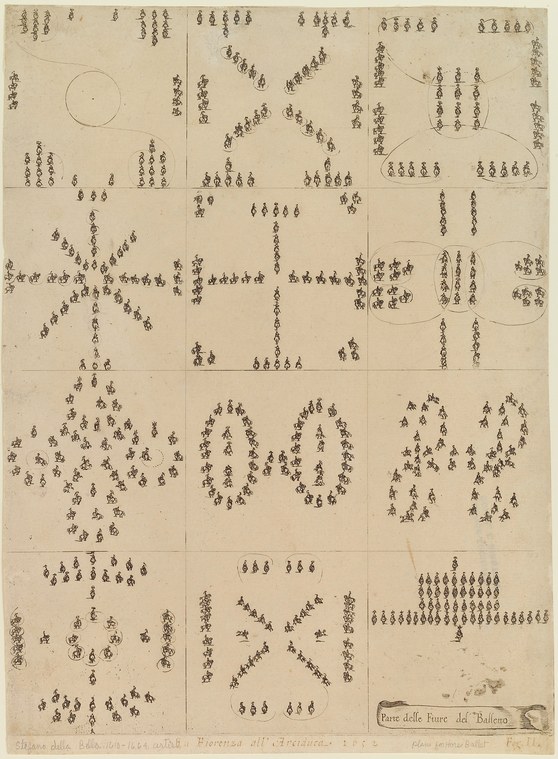
Parte delle Fiure del balletto
Unknown artist
- Collection:
- Prints depicting dance
- Source:
- New York Public Library
- Rights:
- Public domain — free to use, share and adapt.
- Recorded as:
- Public Domain
This diagram preserves the spatial logic of Renaissance or early Baroque court ballet at a moment when choreography was understood primarily through floor pattern and group geometry rather than individual movement. For dance historians, it is evidence of how ballet was notated, taught, and remembered before the development of modern dance notation systems. It demonstrates that the visual spectacle of ballet—its appeal to the eye of the patron or courtier—was built on precise, almost mathematical arrangements of the human body in space.
What you are looking at
This is a composite print showing multiple formations of dancers arranged across the page in a systematic, diagrammatic manner. The figures are depicted as small silhouettes arranged in ordered geometric patterns—lines, circles, curves, and blocks—suggesting a choreographic notation or instructional diagram rather than a naturalistic scene. Each formation is separated and numbered or labeled in Italian script. The dancers appear as simplified human figures in profile or frontal view, wearing what seems to be period dress with full skirts for women and fitted clothing for men. There is no background or setting; the figures float on a plain cream-colored paper. The overall effect is pedagogical: this reads as a technical guide to dance arrangements and floor patterns rather than a moment captured from performance.
The dancing
The figures are rendered as simple silhouettes without individual detail or dynamic gesture. They stand upright or in neutral posture, their bodies arranged to show spatial relationships rather than movement quality. The emphasis is on positioning: how many dancers occupy a space, how they are distributed relative to one another, and the geometric shape their collective placement creates. There is no indication of hold, frame, or the specific arm and leg positions that would reveal dancing technique. This is intentional—the diagram prioritizes formation over motion.
The dance depicted
This appears to be a choreographic or balletic diagram, most likely from the late Renaissance or early Baroque period, showing the floor patterns and group arrangements for a court dance or ballet. The Italian title *Parte delle Figure del balletto* ("Part of the Figures of the Ballet") suggests it documents formations from a larger ballet production. The systematic notation of multiple dancers in precise geometric formations—circles, lines, arches, blocks—is consistent with the notation systems used for court ballets of the 16th and 17th centuries, where intricate floor patterns and group geometries were central to the visual spectacle. The diagram format indicates this was instructional material, likely for choreographers, dancers, or patrons learning or recording the work.
How it was made
This is a print, almost certainly an engraving or etching on paper, executed in black ink on cream or aged paper stock. The technique allows for precise, repeatable lines and small-scale figural elements that can be arranged systematically across the sheet. The paper has aged to a tan or buff color typical of 16th–17th-century printmaking. The clarity and regularity of the lines suggest engraving rather than etching. As a printed work, it was reproducible and portable, suited for circulation among dance practitioners, court musicians, and nobility—an instructional or documentary tool that could be distributed and referenced rather than a unique artwork.
About this work
This is a choreographic diagram documenting the floor patterns and formations of a court ballet, presented as a composite print of multiple dancers arranged in ordered geometric shapes. Each formation is a separate notation showing how dancers should be positioned and moved through space. The work belongs to the tradition of Renaissance and early Baroque dance notation, a period when the visual geometry of group dance was as important as individual technique, and when such diagrams served as both records of prestigious performances and teaching tools for the dance masters who created and transmitted these works.
For a historian or dancer, this print offers direct access to how court ballet was spatially conceived and executed. It shows that ballet of this period was as much about visual pattern and symmetry as about the dancers' bodies themselves—the formations are almost architectural in their precision. The composite format, with many examples on one sheet, suggests this was part of a larger instructional or archival project, possibly documenting a complete ballet or a dance manual.
How to look at it
Read this print as you would a map or floor plan rather than as a representation of movement. Each labeled formation shows a snapshot of where dancers stood at a particular moment in the ballet. Notice how the formations progress from simple (small groups, linear arrangements) to more complex (large circles, intricate arches, dense blocks). The empty space on the page between formations is significant—it suggests the sequence in which dancers moved through these positions. Pay attention to the scale and proportion of the figures to one another; they are standardized, reinforcing the idea that what matters is the pattern the group makes, not the individuality of the performers. This is choreography rendered as geometry.
The period
This print belongs to the era of the court ballet, flourishing in Renaissance Italy and early Baroque France (roughly 1570–1650). During this period, ballet was a courtly entertainment combining dance, music, poetry, and elaborate costume in service of dynastic power and prestige. The ballet was a total art work (*gesamtkunstwerk* avant la lettre), and its choreography was as much about creating pleasing geometric shapes and processional patterns as about the skill of individual dancers. Dance masters and composers documented these ballets through notation, description, and sometimes—as here—through diagrammatic prints that showed floor patterns. The rise of printing made it possible to circulate choreographic knowledge across courts and cities. This was an era before the codification of ballet technique into the vocabulary we recognize today; the dance vocabulary was courtly, the training informal, and the emphasis was on grace, nobility, and the creation of visual harmony.
Where it lives
This work is held in the New York Public Library's collection of prints depicting dance. The catalogue record indicates the date and artist are unknown; the title and format alone establish the work as a dance diagram from the early modern period. It is part of a broader archive of historical dance imagery at the institution.
Dance in this work
Questions about this work
What is a court ballet and why did it use these diagrams?
Court ballet was a form of entertainment performed by nobles and professional dancers at royal courts from the late 16th century onward. The visual geometry of the dance—the patterns formed by multiple dancers moving together—was central to its appeal and meaning. Diagrams like this one allowed choreographers to plan and record these patterns, and enabled dancers to learn their positions without requiring a master to be physically present. The printed diagram was a way to preserve and circulate choreographic knowledge.
How do I read this diagram as a dancer?
Each labeled section shows a formation: the positions and arrangement of dancers at one moment in the ballet. The figures indicate roughly where each dancer should stand. To follow the ballet, you would move from one formation to the next in sequence, traveling through the space to reach your position in the next pattern. The diagram does not show how you move between positions—that was either understood from tradition, learned from a master, or described in an accompanying text. Modern dancers often find these diagrams hard to parse because they lack the detail about technique, timing, and pathway that contemporary notation provides.
What period is this from?
The catalogue record does not specify a date, but the style of the print, the Italian language, and the format of the choreographic notation all suggest this is from the Renaissance or early Baroque period, likely the 16th or 17th century. Court ballet as a form was at its height in Italy during the late 1500s and in France during the 1600s. Without a known source, the exact date and origin remain uncertain.
Who would have used this print?
Dance masters, choreographers, and possibly talented courtiers learning a ballet would have used this. A printed diagram could be consulted during rehearsal or used to transmit a choreography to another court. Patrons or poets planning a ballet might also consult such diagrams to understand the visual design. Unlike a unique manuscript, a print could be distributed to multiple people, making it a practical tool for spreading choreographic knowledge across the aristocratic networks of Europe.
More dance artwork





