49 works in this view — arrow keys or swipe to move between them.
Dance in Art
Dancers on music covers
Unknown artist
- Collection:
- Prints depicting dance
- Source:
- New York Public Library
- Rights:
- Public domain — free to use, share and adapt.
- Recorded as:
- Public Domain
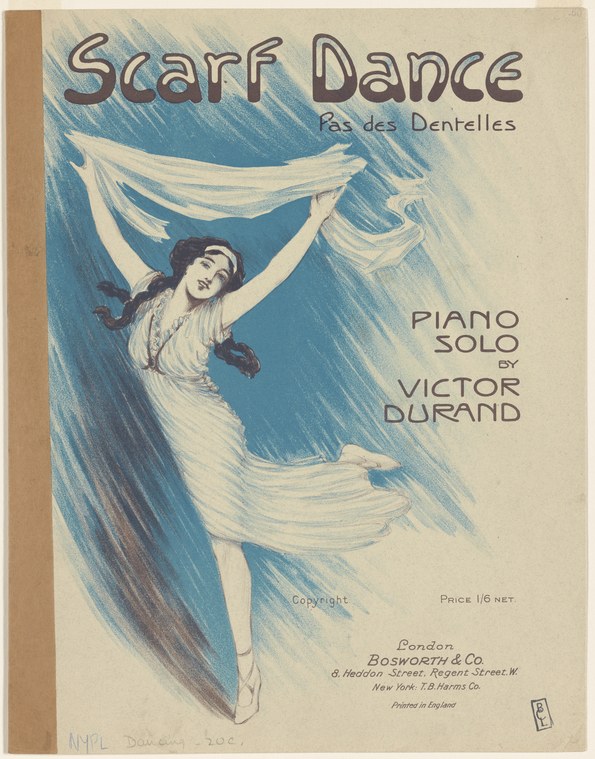
The work is a rare surviving commercial artifact of how early 20th-century theatrical dance was mediated and sold to the middle-class amateur audience through sheet-music covers. It shows us what choreographers and publishers believed would appeal visually to piano-playing audiences—the romantic solo female form, the emphasis on soft drapery and emotion over technique—and thus what conception of dance was being circulated beyond the professional theatre. For students of dance imagery and the history of how dance entered domestic and commercial culture, this is invaluable evidence.
What you are looking at
A young woman in a flowing white dress dances alone against a blue diagonal-hatched background suggesting movement or atmosphere. She holds a long translucent scarf or veil above her head with both arms raised, the fabric billowing in graceful curves around her body. The figure is caught mid-motion, her body weight shifted onto one leg in a balletic pose, her face tilted upward in an expression of joy or abandon. The composition is intimate and lyrical rather than grand—a single dancer rather than a corps, interior rather than staged. The art nouveau style of the lettering and the soft color palette of cream, white, pale blue, and brown suggest this is a cover for published sheet music, meant to evoke the romantic mood of the piece.
The dancing
A single female dancer stands in a classical-influenced pose with both arms raised and extended, holding a scarf that arcs above her head and shoulders. Her body is elongated and graceful, with her weight clearly on one supporting leg and the other leg extended or freed for movement. Her torso is upright but not rigidly formal; her face is lifted and her expression conveys lightness and emotional openness. The pose suggests neither the rigid geometry of classical ballet nor the grounded earthiness of folk dance, but rather a lyrical, romantic mode of movement emphasizing flow and the beauty of the draped fabric.
The dance depicted
This is most likely a romantic-era theatrical dance, consistent with the *Pas des Dentelles* (Dance of the Lace) referenced in the subtitle. The emphasis on flowing drapery, the ethereal solo quality, the upward gaze, and the use of a scarf or veil as a prop are all characteristic of late 19th-century romantic ballet and pantomime, particularly solo showpieces for female dancers. The pose and movement vocabulary reflect the balletic training and aesthetic of that era, though the softness and emphasis on textile and emotion over technical display suggests this may be theatrical-dance rather than academic ballet. Victor Durand, credited as the composer, created a piano solo to accompany this choreographed piece.
How it was made
This is a color lithograph, recognizable from the soft gradations of color, the way the blue background is built up in fine parallel hatching, and the characteristic crayon-like texture of the drawn lines in the lettering and figure. The technique allowed affordable reproduction of the cover art for sheet music distributed to amateur pianists—the intended audience for a 'Piano Solo' by a minor composer. Lithography was the standard commercial process for music covers in the early 20th century and could achieve the soft, romantic aesthetic needed to sell a piece marketed as delicate and feminine. The price noted (1/6 net) and London publisher (Bosworth & Co) confirm this as a commercial print product.
About this work
A color lithograph cover for a published piano solo titled *Scarf Dance: Pas des Dentelles*, composed by Victor Durand. The composition depicts a single female dancer in a graceful upright pose, holding aloft a flowing scarf, set against a dreamy blue background. The work exemplifies the romantic, feminine aesthetic that dominated theatrical dance and sheet-music marketing in the early 20th century, when such covers were a primary form of dance imagery accessible to the general public. The piece belongs to the tradition of solo showpieces for female dancers that flourished in that era—dances built around spectacle, emotion, and the beauty of draped fabric rather than technical virtuosity. This particular cover, drawn in a soft art nouveau style, was produced by a London publisher and distributed to amateur musicians, making it a document of how dance was understood, marketed, and consumed by non-professionals.
How to look at it
Attend to the moment the artist chose: not a moment of technical display or ground-covering movement, but a held, lyrical pose in which the dancer appears suspended in emotion. The lifted face, the raised arms, and the billowing scarf together create an impression of weightlessness and romantic rapture. The composition is vertical and intimate rather than panoramic—the viewer is close to the dancer, not watching from the house. This reflects the aesthetic priority of early 20th-century romantic dance: beauty of form and feeling rather than virtuosity or spectacle.
The artist
Victor Durand is not recorded in standard dance or music references available for this research. He was a composer of light classical and theatrical piano pieces published by Bosworth & Co in London in the early 20th century. His work represents the large body of minor but commercially successful composers who supplied music for theatrical dance and domestic entertainment during this period. The specific identity of the lithographer is also not recorded on the cover.
The period
This cover dates to the early 20th century, a period when the romantic ballet tradition of the 19th century was still the dominant aesthetic in popular dance imagery, even as modernist and avant-garde movements were beginning to challenge it in the professional theatre. Solo female dancers and romantic pantomime remained the commercial norm for sheet-music covers and popular theatrical entertainment aimed at middle-class audiences. Lithographed covers for piano solos were a major vector for dance imagery in this era—more widely distributed than photographs or posters, and more accessible to amateur consumers than theatre attendance. The art nouveau styling of the lettering suggests a date in the first two decades of the 1900s.
Where it lives
The work is held in the New York Public Library's collection of prints depicting dance, catalogued as part of their broader holdings of theatrical and commercial imagery. It is a commercial music-cover lithograph published by Bosworth & Co (London and New York), priced at 1/6 net.
Dance in this work
Questions about this work
What is a *pas des dentelles*?
*Pas des dentelles* translates as 'dance of the lace' or 'dance of the delicate things.' It was a stock theatrical solo for female dancers in the 19th and early 20th centuries, emphasizing graceful port de bras (carriage of the arms), flowing costumes, and emotional expression rather than difficult footwork or jumps. Such pieces were often performed in pantomimes, variety shows, and ballet programs as showpieces designed to display the dancer's beauty and elegance.
Who would have bought this sheet music?
Amateur pianists—primarily middle-class women and girls—who purchased sheet music to perform at home or in amateur theatrical productions. The publisher's notation of 'Piano Solo' and the modest price indicate this was marketed to domestic consumers rather than professional musicians. The cover art was a significant part of the product's appeal; romantic, beautiful imagery helped sell music to consumers who may never have seen the piece performed on stage.
How does this image relate to what dancers actually did?
The pose depicted—a classical ballet-influenced upright stance with arms raised and a raised gaze—was a standard finishing pose for romantic solo dances of this era. However, the cover artist has prioritized beauty and grace over anatomical accuracy or specificity about the actual choreography. The image tells us more about how dance was imagined and marketed than about what a real performance of this piece would have looked like.
More dance artwork





