49 works in this view — arrow keys or swipe to move between them.
Dance in Art
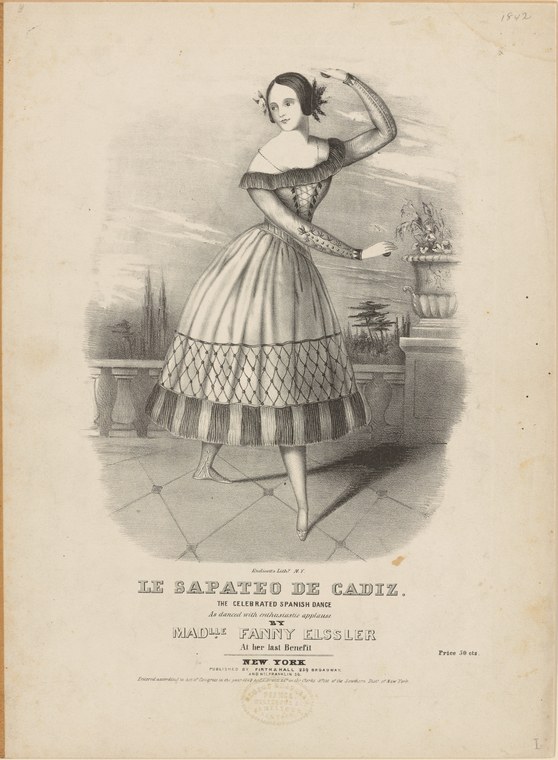
La sapateo de Cadiz: The celebrated Spanish dance as danced with enthusiastic applause By Madlle. Fanny Elssler, at her last benefit
Unknown artist
- Collection:
- Prints depicting dance
- Source:
- New York Public Library
- Rights:
- Public domain — free to use, share and adapt.
- Recorded as:
- Public Domain
Fanny Elssler was one of the most celebrated dancers of the nineteenth century, and her performances of Spanish and other character dances defined a major genre of Romantic-era ballet. This print is primary evidence of what the *Zapateado* looked like on stage, frozen in a moment that conveys both the technical demands (the alert, forward-balanced posture) and the theatrical style (the graceful arms, the elaborate costume) of the work. It also shows how lithography and mass-produced prints created and sustained the celebrity of dancers in the era before film.
What you are looking at
A young woman in theatrical dress stands in a classical interior, caught mid-performance of a vigorous Spanish dance. She wears a pale silk skirt with deep geometric patterning in the lower portion—a diamond lattice overlaid with vertical stripes—and a short-sleeved bodice with an off-shoulder ruffle that exposes her upper arm and shoulder. Her dark hair is bound up with ribbons or flowers. Her right arm is raised behind her head in a graceful arc; her left arm extends outward. Her posture is alert and energetic, with the weight forward on her feet. The setting suggests a ballroom or theater: a classical urn and draped fabric appear to her right; the background suggests architectural elements and a curtain. The whole composition is rendered in the soft grey tones of a lithograph, with careful attention to the fall of fabric and the play of light across her figure.
The dancing
A single dancer, shown in three-quarter view, dominates the composition. Her body inclines forward from the waist with evident spring and lightness; her feet appear to be in a position ready to spring or articulate rapidly. The raised arm creates a frame around her head; the extended opposite arm balances the composition and suggests active movement through space. The posture combines balletic lift—the straight spine, the extended limbs—with a sense of earthiness in the lower body that suggests footwork rather than sustained positions.
The dance depicted
This is a theatrical performance of the *Zapateado de Cádiz* (or *Tapatío* as the title variants it), a celebrated Spanish dance built on rapid, rhythmic footwork and regional character. The inscribed attribution to Mademoiselle Fanny Elssler identifies the work as a souvenir or advertisement for her 1840s performances of this piece—she was internationally famous for her performance of character dances and Spanish nationalistic material. The visible footwork emphasis (the active lower body, the forward weight) and the dramatic arm positions are consistent with the zapateado tradition, a dance centered on percussive heel-and-toe articulation. The balletic upper body and the theatrical setting confirm this as a theatrical Spanish dance rather than a vernacular form.
How it was made
This is a hand-colored or partially colored lithograph (stone printing), a mass-production technique well suited to theatrical souvenirs and sheet music covers of the 1840s–50s. The soft modelling and controlled gradation of tone are characteristic of lithography; the composition's careful symmetry and the attention to fabric texture suggest a skilled draftsperson. The technique allowed rapid circulation of images of celebrated dancers to a broad middle-class audience—this would have been sold as a print to theater-goers and fans of Elssler, making it both artwork and merchandise.
About this work
This is a lithographed souvenir of Fanny Elssler performing the *Zapateado de Cádiz*, a Spanish character dance that was part of the international Romantic-era ballet repertoire. The image captures the moment of performance—the dancer poised between steps, arms framing the body in a pose that combines balletic grace with the earthiness of regional Spanish movement. The work sits at the intersection of theater history, dance history, and print culture: it is both a record of what an important dancer did on stage and a commodity that helped construct her international fame. It belongs in a gallery of dance in art because it shows us how theatrical dance was circulated to the public before photography, and how a specific choreographic tradition—the Spanish character dances that dominated the 1830s–1850s stage—was visualized and celebrated.
How to look at it
Notice the moment the artist has chosen: the dancer is poised between steps, neither landed nor airborne, but alert and ready. The raised arm and extended opposite arm create a frame that both flatters the body and suggests the ornamental, theatrical use of the upper body in character dances. The lower half of the costume—the geometric patterning in the skirt—draws the eye downward, emphasizing that the true action of the dance lies in the feet and legs. The balletic posture and the elaborate dress show that this is a theatrical interpretation of Spanish folk material, not the vernacular form itself—a key convention of Romantic-era character dance.
The period
The 1840s–1850s were the height of Romanticism in European dance. Ballet had begun to incorporate character dances from Spain, Italy, Russia, and other regions as a form of exoticism and nationalist pride; these short character pieces often appeared as divertissements within longer ballets or as vehicles for star dancers. Fanny Elssler (1810–84) was the great rival of Marie Taglioni and the leading interpreter of character dances; her *La Cachucha* and her Spanish dances were sensations across Europe and America. Lithography had become the dominant medium for theatrical publicity and souvenirs, making dancers' images available to a broad audience for the first time. This print was likely created during or shortly after one of Elssler's tours, serving both as a memento and as advertising for future performances.
Where it lives
The print is held by the New York Public Library as part of its collection of dance-related prints and ephemera. It is a theatrical souvenir, likely sold at the theater or through music publishers as sheet music cover art or as a standalone print for fans and collectors.
Dance in this work
Questions about this work
Who was Fanny Elssler and why does she matter?
Fanny Elssler (1810–84) was an Austrian dancer and one of the two most celebrated performers of the Romantic era, alongside Marie Taglioni. While Taglioni was known for ethereal, weightless roles, Elssler excelled in character dances—Spanish, Italian, and other regional styles—that showcased technical brilliance and theatrical personality. Her performances of the *Cachucha* and Spanish dances made her an international celebrity; she toured extensively in Europe and America, and her image was circulated widely through prints like this one.
What is the zapateado and how is it danced?
The *zapateado* is a Spanish dance characterized by rapid, complex footwork—the name derives from *zapato* (shoe), emphasizing the percussion of the feet. The upper body remains relatively still and graceful, often with arms raised or extended in classical or ornamental positions, while the lower body articulates intricate rhythmic patterns. In the theatrical Romantic-era version danced by Elssler, this folk technique was integrated with balletic training and costume, creating a hybrid style that appealed to European audiences as both exotic and refined.
How can you tell this is a lithograph?
Lithography uses a greasy ink applied to a prepared stone surface; the technique allows for soft gradations of tone and careful detail without the sharp lines of an engraving. The image shows the characteristic even, velvety gray tones and the absence of cross-hatching or engraved lines. The care taken with fabric texture and the subtle modeling of the face and body are typical of skilled lithographic work.
Why is this image a souvenir rather than a document?
It was created for sale to theater-goers and fans, not as a record by a documenter. The romanticized pose, the careful attention to costume detail, and the inscription naming the dancer all mark it as promotional material designed to celebrate the performer and encourage attendance at future performances. While it does tell us something true about how the dance was performed and costumed, it prioritizes beauty and commercial appeal over documentary accuracy.
More dance artwork





