49 works in this view — arrow keys or swipe to move between them.
Dance in Art
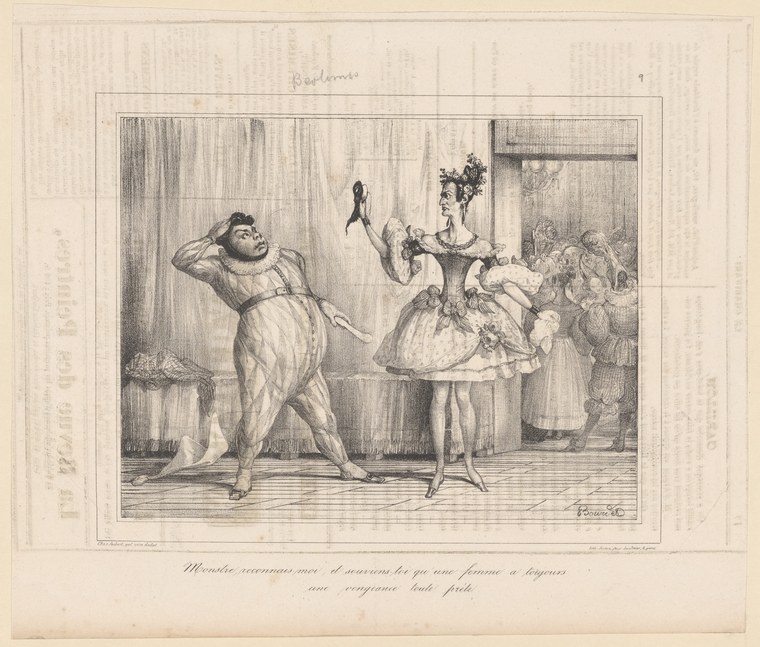
Monstre, reconnais-moi, et souviens-toi qu'une femme a toujours une vengeance toute prète
Unknown artist
- Collection:
- Prints depicting dance
- Source:
- New York Public Library
- Rights:
- Public domain — free to use, share and adapt.
- Recorded as:
- Public Domain
This engraving preserves evidence of how classical ballet and theatrical mime conveyed narrative and emotion through gesture and composition in the 18th century. The image shows a moment when ballet was a fully integrated art form within court and public theatre, serving dramatic as much as choreographic purposes, and when women on stage were depicted as agents of power and vengeance rather than passive ornaments.
What you are looking at
A theatrical scene of classical proportions, rendered in engraving with fine cross-hatching to create depth and shadow. A corpulent male figure dominates the left foreground, bare-legged and dressed in a tunic, one hand raised to his head in a gesture of consternation or recognition. Opposite him stands an elegantly dressed woman in a full skirt with elaborate detail, her body angled toward him in a posture of confrontation or accusation. Her left arm extends toward him, fingers splayed. Behind them, a gathered crowd of onlookers—some in classical dress, others indistinct—witnesses the exchange. The setting is a draped interior with columns suggested by vertical lines in the background. The composition creates a moment of dramatic tension: the French inscription below speaks of a monster recognizing itself and a woman's readiness for vengeance, situating this as a narrative scene rather than a simple dance depiction.
The dancing
Two principal dancers face each other across a shallow stage space. The male figure's weight is grounded; his raised hand and tilted head suggest surprise or shame rather than active movement. The female figure's extended arm and turned body present a classical contrapposto, her frame upright and controlled. Neither figure is captured in the midst of virtuosic footwork; instead, both embody emotional states—the male's posture one of vulnerability or recognition, the woman's one of authority and pointed address. The relationship between them reads as confrontational but posed, theatrical rather than improvisational.
The dance depicted
This is a theatrical scene from French classical ballet or court entertainment, likely from the 18th century based on the engraving style and costume vocabulary. The narrative involves a monster (or beast-like male figure) confronted by a woman asserting her power and right to vengeance—a theme common to fairy-tale adaptations and allegorical ballets of the period. The dance itself is secondary to the drama; we are witnessing a moment of recognition and conflict rendered in the formal, gestural vocabulary of classical theatre rather than pure dance technique. The figures' stillness and their framing by spectators suggest this is a tableau or a sustained dramatic moment rather than a passage of active movement.
How it was made
This is an engraving, identifiable by the fine parallel lines (cross-hatching) used to create tone, shadow, and the illusion of depth on the flat surface. The technique allows precise rendering of costume detail—the woman's skirt shows elaborate folds and trim—and the architectural framing of the scene. The medium suggests this was a print made for circulation, likely accompanying a published libretto or theatrical account. The quality and finish suggest professional production for a literate, courtly or urban audience familiar with classical theatre and allegory.
About this work
A satirical or allegorical theatrical scene rendered as an engraving, depicting a confrontation between a monstrous male figure and an assertive female character. The work belongs to the tradition of 18th-century French theatrical prints that documented ballet, pantomime, and court entertainments. The inscription—'Monstre, reconnais-moi, et souviens-toi qu'une femme a toujours une vengeance toute prête' (Monster, recognize me, and remember that a woman always has her vengeance ready)—suggests a narrative of power reversal and feminine agency, themes that appear throughout the period's fairy-tale adaptations and allegorical spectacles. The work documents not a specific, named ballet but a moment of theatrical language in which gesture, costume, and spatial arrangement carry narrative and emotional meaning.
How to look at it
Attend to the two figures' relative positions and the gestures that express their emotional relationship: the male figure's hand-to-head pose reads as shame, surprise, or recognition; the woman's extended arm and forward-angled body read as accusation or command. The crowd in the background establishes this as a public, formal moment rather than a private encounter. Notice how the engraver has used the fall of drapery and the positioning of limbs to suggest frozen movement—the female figure's skirt appears to have been captured mid-turn or mid-stride. The inscription is essential: it anchors the scene in a narrative of vengeance and power, and indicates that the 'monster' is being forced to recognize both the woman and her agency.
The period
This engraving dates to the height of the 18th-century ballet d'action movement, when dancers and choreographers sought to tell coherent narratives through movement and mime. The theme of a woman confronting or triumphing over a beast or monster appears in numerous works of the period, reflecting both the popularity of fairy-tale adaptations (particularly those derived from Madame de Villeneuve, Madame Leprince de Beaumont, and other sources) and a growing interest in spectacle and emotional drama. The formal, posed quality of the figures reflects the aesthetic of classical ballet as it was practiced in professional theatres and courts: movement is noble and controlled, even in moments of high emotion.
Where it lives
The work is held in the New York Public Library's collection of prints depicting dance. It is an engraving, likely from the 18th century, part of the broader archive of theatrical prints that documented European court and public entertainments.
Dance in this work
Questions about this work
What is this a scene from?
This appears to be a scene from a theatrical spectacle or ballet, possibly a fairy-tale adaptation popular in 18th-century French courts and public theatres. The inscription suggests a narrative involving a monstrous figure and a woman's righteous vengeance, but no specific named work is documented in the catalogue record.
Who made this print?
The artist's name is not recorded in the catalogue. The engraving is technically accomplished and was clearly made for circulation, suggesting a professional workshop, but attribution would require further research.
Is this an actual dance, or just a theatrical scene?
This is a theatrical scene rendered in the language of classical ballet and pantomime—gesture, posture, and costume carry meaning. It documents a moment in ballet history when dance and drama were inseparable, and when dancers were expected to act and mime as well as move.
What does the French inscription mean?
'Monster, recognize me, and remember that a woman always has her vengeance ready.' It situates the scene as one of power reversal and confrontation, with the woman in a position of authority and threat.
More dance artwork





