49 works in this view — arrow keys or swipe to move between them.
Dance in Art
Crinoline parasol
Unknown artist
- Collection:
- Prints depicting dance
- Source:
- New York Public Library
- Rights:
- Public domain — free to use, share and adapt.
- Recorded as:
- Public Domain
This work documents a form of entertainment—acrobatic performance in a tulle skirt—that has largely disappeared from live theatre, leaving only images like this as evidence of its existence and popularity. It shows that the division between 'dance,' 'acrobatics,' 'circus,' and 'theatre' was fluid and unmarked in the nineteenth century, and that women performers moved fluidly between these categories. For historians of the body, costume, and performance, the image is a rare record of a specific act and its visual presentation.
What you are looking at
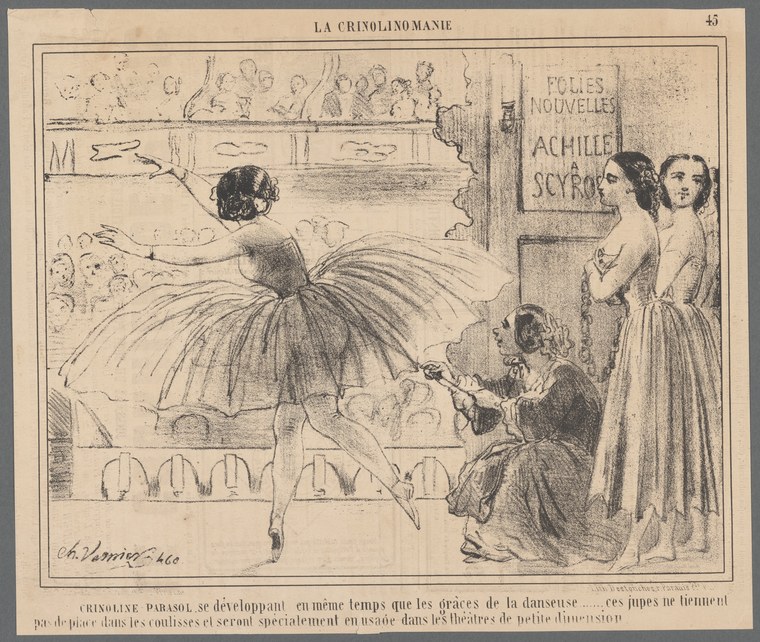
A young woman in a voluminous tulle skirt performs a balancing movement in a theatre or studio, her body angled dramatically forward, one leg extended behind her for counterweight. She wears a fitted bodice and the skirt billows in multiple layers, rendered with fine cross-hatching to suggest volume and movement. To the right stand two onlookers in classical drapery—one pointing or gesturing toward the performer, the other watching intently. Above them, spectators line a railing or gallery, their faces sketched lightly. The setting is spare and theatrical, with minimal background detail, focusing attention entirely on the acrobatic feat. A poster or placard reading 'ACHILLE SCYRO' is visible on the wall, suggesting a named performer or production.
The dancing
The central figure demonstrates extreme flexibility or acrobatic skill, arching backward with her torso nearly horizontal and her weight supported through what appears to be arm and core strength rather than a traditional dance frame. Her skirt, a key visual element, extends nearly to the floor in layered tulle that reads as both costume and impediment to movement. The two figures on the right maintain an upright, observational stance, their poses suggesting astonishment or approval. The composition isolates the dancer's body as the virtuosic center, with witnesses positioned as supporting elements.
The dance depicted
This appears to be a documentation of acrobatic or contortion performance rather than social dance, likely from a theatrical or music-hall context. The 'crinoline parasol' title and the visible tulle skirt suggest this may be a named act or speciality number—a turn in which the skirt itself became part of the spectacle, perhaps spinning or being held aloft. The performance style and setting point to late-19th-century variety theatre or circus. The extreme flexibility required indicates training in contortion or partner acrobatics, disciplines that occupied a distinctive category between dance, circus, and theatrical performance in this era.
How it was made
This is a lithographic print, identifiable from the characteristic soft grain, tonal variation, and the way fine lines are layered with broader washes to create volume and shadow. The medium's capacity for rapid reproduction and its affordability made it ideal for publicizing theatrical performances and novelty acts. The delicate rendering of the tulle skirt—achieved through careful cross-hatching and tonal gradation—demonstrates the lithographer's technical skill in conveying texture and movement on stone. The print style and subject matter suggest this was circulated as a promotional or documentary image, likely sold at the theatre or through popular print dealers.
About this work
This lithograph documents a specialized theatrical act from the Gilded Age—a demonstration of extreme acrobatic flexibility performed by or associated with a performer named Achille Scyro. The 'crinoline parasol' appears to have been a named turn or specialty, in which the performer's voluminous skirt became a visual and structural element of the feat. The image captures a moment of remarkable bodily control and shows how nineteenth-century theatre audiences consumed novelty and virtuosity as discrete, named performances. It belongs in a dance archive not because it depicts social or aesthetic dance, but because it reveals the spectrum of physical performance that existed under the umbrella of theatrical entertainment and because the body's training and control, however applied, is part of dance history.
How to look at it
Notice the extreme arch of the performer's body and the way her weight appears to be supported almost entirely by core and arm strength—this is not a dance movement but a held acrobatic position. Observe how the tulle skirt dominates the visual field, rendered with such care that it seems to be as much the subject of the print as the performer herself; the 'parasol' effect comes from the way the skirt is held or shaped, likely by the performer's positioning and possibly by hidden supports. Look at the faces of the onlookers: they register shock and admiration, cueing the viewer to see this not as everyday movement but as a feat.
The artist
The artist is not recorded. The lithograph bears the signature 'Ch. Jannot' or similar (partially legible in lower left), suggesting a mid-to-late nineteenth-century French printmaker working in the theatrical and entertainment press. The style and execution are consistent with popular French lithography of the 1870s–1890s, when such prints were a major medium for advertising theatrical acts and capturing fleeting performance moments for a mass audience.
The period
This image dates to the Gilded Age of European and North American theatre, when music halls, variety theatres, and circuses were at their commercial and artistic peak. Acrobatic feats, contortion, and other displays of bodily virtuosity were major attractions, often performed by women in elaborate costumes. The late nineteenth century saw a fascination with the limits of the human body, influenced by both circus traditions and emerging modern athletics. At the same time, theatrical dance was becoming formalized and codified—ballet was establishing itself as an art form with rules and aesthetics—making acts like this 'crinoline parasol' occupy an interesting middle ground between folk performance, circus, and theatre.
Where it lives
The work is held in the New York Public Library's collection of prints depicting dance. It appears to be a lithograph from a series documenting theatrical performances and acts, likely originally produced for circulation among theatregoers or in theatre magazines and promotional materials.
Dance in this work
Questions about this work
What is a 'crinoline parasol'?
Based on this image, it appears to be a named theatrical act in which a performer demonstrated acrobatic flexibility while wearing a voluminous tulle skirt. The skirt, which resembles an open parasol when held or positioned in certain ways, was likely part of the visual spectacle. The term suggests the act was known by this specific name and was marketable as a discrete turn or number in a variety programme.
Is this dance?
It documents a performance that sits at the boundary between acrobatics, theatrical entertainment, and dance. The performer demonstrates trained bodily control and flexibility; the act was presented in a theatre before an audience. However, it is primarily acrobatic rather than choreographic. In the context of nineteenth-century entertainment, such acts were part of the same ecosystem as dance and were often performed by dancers or ex-dancers.
Who was Achille Scyro?
The placard in the image suggests this was a named performer or company. Beyond this image, little is currently documented. The name may refer to an individual performer or to a production or act name. The prominence of the name in the print suggests Scyro was a known figure in contemporary theatre, though records of nineteenth-century variety performers are often fragmentary.
Why is the image so carefully rendered if it's just an advertisement?
The lithographer lavished considerable skill on this print, particularly in rendering the texture and volume of the tulle. This was standard practice for theatrical prints meant to capture the visual spectacle of a performance and to advertise it to potential ticket-buyers. The quality of the print itself was part of its appeal and reflected the status and popularity of the act it documented.
More dance artwork





