49 works in this view — arrow keys or swipe to move between them.
Dance in Art
Excelsior at the Éden Théâtre, Paris
Unknown artist
- Collection:
- Prints depicting dance
- Source:
- New York Public Library
- Rights:
- Public domain — free to use, share and adapt.
- Recorded as:
- Public Domain
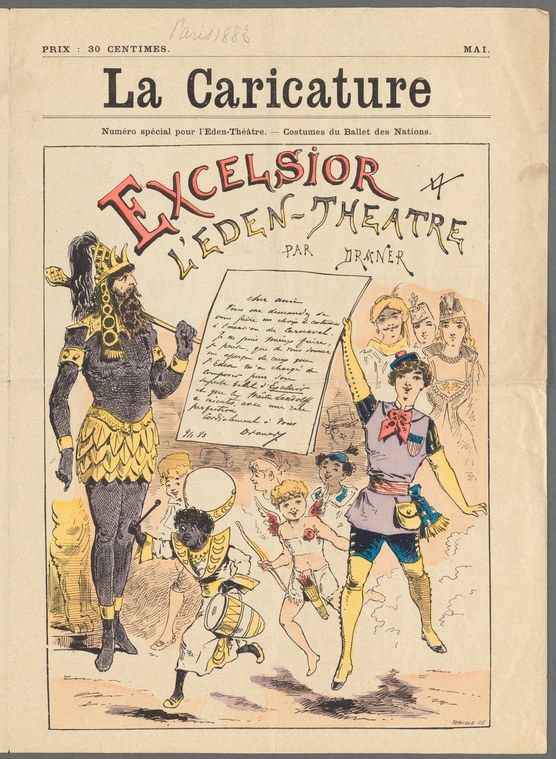
This caricature is direct evidence of how *Excelsior*—one of the most expensive and ambitious ballets ever mounted—was received by Parisian critics and the press. It documents the collision between classical ballet training and spectacular pantomime that defined late-19th-century theatrical dance. Understanding how satirists chose to mock the work reveals what audiences and critics found most striking (and most absurd) about its aesthetic choices.
What you are looking at
This is a cover or title page from *La Caricature*, a French satirical journal, depicting a theatrical extravaganza in caricature style. The composition centers on an enormous demonic or grotesque male figure in black and gold costume on the left, looming over a handwritten manuscript or program sheet at center. To the right, a woman in pale tulle and pink ribbons poses elegantly, flanked by three smaller figures in gold costumes—two cherubs or putti and a youth. The woman's dress and pose suggest classical ballet costume, while the other figures appear dressed as attendants or chorus members in commedia dell'arte style. The palette is predominantly sepia with hand-colored red, gold, and pink accents. The exaggerated scale of the central figure and the burlesque styling indicate this is satirizing a specific spectacular theatrical production—*Excelsior*, a major pantomime ballet mounted at the Éden Théâtre in Paris.
The dancing
The principal dancer, a woman in center-right, is positioned in a classical ballet pose with upright carriage and turned-out leg, wearing a short tulle skirt. The demonic left figure dominates through sheer size and theatrical posture, with exaggerated musculature and wild hair, wearing a plumed helmet and holding an ornate staff. The three smaller figures to the right display varied poses: the putti are playful and informal, while the male youth maintains a more formal stance. The overall composition uses scale and placement to mock the grandiosity of the production.
The dance depicted
*Excelsior* was a massive pantomime-ballet spectacular created by choreographer Luigi Manzotti and composer Romualdo Marenco, which premiered in Milan in 1881 and became an international sensation. This caricature evidently depicts the Paris production at the Éden Théâtre, mocking the work's extravagant narrative scope (it told the story of Progress conquering Darkness across global locations) and its mixture of classical ballet with melodramatic spectacle. The woman in ballet dress represents the principal dancer navigating the chaos of the production; the demonic figure embodies the theatrical excess and the work's grand pretensions. The satirical reduction of this elaborate five-act ballet to its essential elements—beauty, monsters, and choruses—suggests *La Caricature* was lampooning both the work's artistic ambition and its popular success.
How it was made
This is a hand-colored lithographic illustration, a technique that allowed rapid reproduction and wide circulation of satirical commentary. The black lithographic line is precise and expressive, capturing caricatural exaggeration through proportion and gesture rather than detail. The hand-coloring in watercolor or gouache (red, gold, pink, blue) was applied selectively to key costume elements, a common economy of period periodical production. Lithography made this accessible and affordable to the journal's audience, enabling visual political and cultural critique to reach a broad Parisian readership.
About this work
This is a theatrical caricature from a French satirical periodical, documenting the sensation caused by *Excelsior*, one of the most spectacular pantomime-ballets of the 1880s. It captures a moment when ballet was becoming increasingly inflated in scale and narrative ambition, mixing classical technique with melodramatic spectacle and elaborate stage machinery. The work is both a record of a specific production and a commentary on the aesthetics of theatrical excess that defined the era. For dance historians, it is valuable evidence of how a major work was received, interpreted, and critiqued by cultural observers; for art historians, it exemplifies the caricature tradition's role in documenting and satirizing contemporary performance.
How to look at it
Notice how the artist has made the demonic figure grotesquely oversized to mock the production's obsession with scale and visual sensation. The contrast between the graceful, classically posed woman in ballet dress and the monstrous figure dominating the composition captures the work's internal contradiction: high art technique deployed in service of melodramatic spectacle. The carefully rendered manuscript at center, labeled with what appears to be the work's credits, suggests the caricaturist is offering a wry commentary on authorship and production—who made this baroque extravaganza, and to what end? The formal clarity of the woman's ballet pose makes her appear almost rational amid the theatrical chaos surrounding her.
The artist
The artist is not recorded in the catalogue. *La Caricature* was founded by Charles Philipon in 1830 and became the most influential satirical journal in France under the July Monarchy and Second Empire, known for its political edge and incisive theatrical commentary. The journal published work by major caricaturists including Honoré Daumier. By the 1880s, when this *Excelsior* caricature was published, *La Caricature* was well-established as the arbiter of theatrical taste and irreverence in Paris.
The period
This caricature dates to the period of *Excelsior*'s triumph in European theaters (early 1880s), when pantomime-ballet was at the height of its commercial power and critical controversy. The work represents a shift away from pure classical ballet toward spectacular narrative productions with massive casts, elaborate machinery, and fusion of ballet with acrobatics, magic-lantern effects, and commedia dell'arte elements. Simultaneously, the caricature tradition itself was flourishing as a form of cultural criticism, with illustrated journals serving as the primary vehicle for commentary on contemporary performance. The tension between classical ballet values and theatrical spectacle—between refinement and excess—was a major aesthetic debate of the era.
Where it lives
This is a special issue of *La Caricature* dedicated to the Eden Theatre and the costumes of the Ballet of Nations (*Costumes du Ballet des Nations*), held in the Prints collection of the New York Public Library. It is a periodical illustration and was intended for broad circulation among the Parisian reading public.
Dance in this work
Questions about this work
What was Excelsior?
*Excelsior* was a five-act pantomime-ballet created by choreographer Luigi Manzotti with music by Romualdo Marenco. It premiered in Milan in 1881 and became an international sensation, known for its enormous scale, elaborate stage machinery, and narrative scope that took audiences on a journey through global locations, with Progress conquering Darkness as its central theme. The production featured hundreds of performers, including classical dancers, acrobats, and chorus members.
Why would a satirical journal mock a ballet?
*La Caricature* was primarily a political and cultural commentary journal that used sharp visual wit to critique public figures and fashionable institutions. By the 1880s, the spectacle-driven pantomime-ballets like *Excelsior*, while commercially successful, were often dismissed by critics as artistically hollow and excessively grandiose. The caricature both documents the work's popularity and mocks its pretensions to combine high art with mass entertainment.
Is this a record of what the ballet actually looked like?
Not exactly. This is a satirical interpretation, not a documentary record. However, it does capture genuine elements: the presence of a prima ballerina in classical costume, the use of mythological or allegorical figures (here rendered as a demon), the mixing of dancers with costumed attendants and putti, and the overall emphasis on visual spectacle over narrative coherence. For accurate staging details, one would consult playbills, photographs, or contemporary reviews; this caricature is more valuable as evidence of how the work was *perceived*.
What does the manuscript in the center say?
The manuscript is not clearly legible in reproduction, but it represents the ballet's program or credits, a common element in caricatures of theatrical productions. Its placement at the visual and compositional center, surrounded by the chaos of performers and monsters, may be the artist's way of suggesting that the production's elaborate credits and authorial apparatus matter more than coherent dramaturgy.
More dance artwork





