49 works in this view — arrow keys or swipe to move between them.
Dance in Art
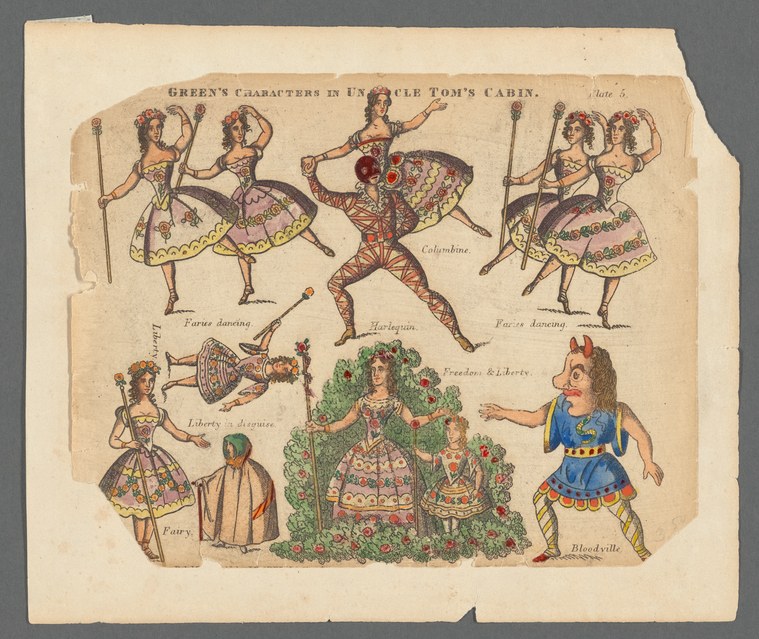
Green's characters in Uncle Tom's cabin, plate 5 [toy theatre figures and scenes, including Harlequin and Columbine]
Unknown artist
- Collection:
- Prints depicting dance
- Source:
- New York Public Library
- Rights:
- Public domain — free to use, share and adapt.
- Recorded as:
- Public Domain
This object sits at the intersection of dance history, theatre history, and the history of mechanical representation: it shows how balletic and pantomime movement was understood and adapted for mass production and childhood consumption. The hand-coloured engraving technique preserved and circulated images of theatrical dance to audiences who could not attend live performance, making it a precursor to later photographic and film documentation of dance. The survival of these sheets in archives is rare, as they were toys and ephemera, not fine art; they offer direct evidence of how nineteenth-century spectators saw and remembered dance movement.
What you are looking at
This hand-colored engraving depicts a toybox theatre scene arranged in a grid of eight vignettes, each populated by flat cardboard puppet figures of vivid corseted dancers and actors in mid-performance. The figures are rendered with stencilled detail: one pair of women dancers in matching ornate skirts and pale bodies face each other en face; a male harlequin in close-fitting patterned costume sprawls mid-leap or fall at centre; other dancers are frozen in posed attitudes—some with sticks or wands held aloft, others in profile showing exaggerated forward lunges or back arches. Beneath each figure is a hand-written caption identifying the character or action: "Farce dancing," "Harlequin," "Columbine," "Liberty in disguise," "Fairy," and "Bloodville." The vignettes include a scene of greater narrative density: a pastoral tableau with a woman figure framed within a large shrub or garden topiary, attended by smaller standing figures. The whole assembly is mounted on what appears to be aged cream card stock, with foxing and edge damage visible. The hand-colouring is deliberately bright—reds, greens, yellows, and blues applied in flat washes—against the printed black outlines of the engraving.
The dancing
The puppet figures show exaggerated balletic postures: high leg extensions, turned-out positions, and upright carriage typical of early nineteenth-century theatrical convention. Several dancers display arms raised or extended sideways in arabesques or ports de bras; the male harlequin figure shows extreme torso extension and splayed limbs suggesting acrobatic or comic physical licence. The cardboard flatness and stiffness of the puppets constrains anatomical naturalism, yet the engraver has incised clear lines indicating articulation at the joints and the volumetric structure of bodies in space. The scale relationships between figures in the garden scene suggest theatrical perspective.
The dance depicted
This is material from a toy theatre or peepshow tradition—cardboard actors and dancers sold as sheets for children to assemble, colour, and manipulate in small stage settings. The style and nomenclature (Harlequin, Columbine, Farce) point to the Commedia dell'arte tradition and its theatrical descendants of the early-to-mid nineteenth century. The dancing depicted is theatrical and comic in intent: the poses are balletic but exaggerated and unstable, designed for entertainment and spectacle rather than technical virtuosity. The presence of both pantomime characters (Harlequin) and named dance types (Farce dancing, Fairy dancing) suggests this theatrical genre blended multiple forms. The inscriptions and plate reference suggest this was part of a larger published series documenting scenes from popular theatrical works or pantomimes.
How it was made
The work is a hand-coloured engraving on cream wove paper, executed in the tradition of theatrical prints and toy theatre sheets that were mass-produced and sold in nineteenth-century Britain and Europe. The printing process allowed for fine linear detail in the engraved outline; the hand-colouring—applied after printing and likely in a workshop rather than by the engraver—gives each figure individual character and brightness. The technique was economical and suited to serial production: the same engraved plate could be printed and coloured many times, allowing for wide circulation at low cost. The condition of this particular example—foxing, damage at edges—suggests it was used, handled, and stored for many decades before archival preservation.
About this work
This is a hand-coloured engraved toy theatre sheet depicting scenes from a nineteenth-century pantomime or theatrical farce, likely inspired by Uncle Tom's Cabin or a related popular work. The eight vignettes show cardboard puppet figures of dancers and actors in balletic poses and commedia dell'arte costumes, accompanied by captions identifying character and action. It belongs to a distinct material culture of childhood, amateur theatricality, and print circulation: these sheets were affordable printed entertainment that allowed families and children to assemble, animate, and perform their own versions of popular theatrical spectacles. The dancing figures reflect the theatrical conventions of the period—turned-out postures, lifted carriage, exaggerated gesture—adapted for the flat, jointed form of the puppet. As a document of theatre history, material culture, and the visualization of dance in the nineteenth century, it reveals what dance looked like to the eyes of popular audiences and how theatrical movement was interpreted and transmitted through mechanical reproduction.
How to look at it
Look closely at the exaggerated postures and the way the engraver has positioned each figure at a moment of extreme extension or dynamic instability—these are not the balanced, held positions of classical ballet, but rather comic or theatrical moments frozen in time. Notice the flatness of the cardboard figures and the hand-colouring that compensates for sculptural depth with bright local colour and sharp outlines. The garden scene at centre-bottom suggests a different register of theatrical spectacle: pastoral and sentimental rather than comic. Compare the poses across the sheet to see how the engraver varied the body positions and gestures—each figure tells a different story about theatrical movement. The handwritten captions are clues to how nineteenth-century audiences categorized and named dance.
The artist
The engraver and colourist are not recorded, but the work belongs to the tradition of London theatrical print-makers and toy theatre publishers of the early nineteenth century—a commercial enterprise run by printers like William West, John Redington, and others who supplied sheets to toy theatres and peepshows. These were often journeyman engravers and colourists working in busy print shops, their labour pooled and anonymous. The quality of draughtsmanship and the precision of the line work suggest a trained engraver with knowledge of theatrical costume and movement, but the commercial purpose and workshop production model left no individual signature or biographical record.
The period
The early nineteenth century saw a flourishing of theatrical spectacle and pantomime in London, with works like harlequinades and burlettas drawing large audiences. Toy theatres—also called peepshows or Skelt's Juvenile Drama—emerged as a parallel entertainment industry for middle-class families and children: purchasers could buy sheets of actors and scenery, colour them by hand, and stage performances of famous plays and pantomimes in miniature. The period also saw growing interest in ethnographic and sensational subjects (including the American slavery narratives that generated Uncle Tom's Cabin materials), which theatrical entrepreneurs quickly adapted. Hand-coloured engraving was the dominant print technology before chromolithography became cheaper in the mid-century. The inscription notes "Plate 5," suggesting this was part of a numbered series, a commercial strategy that encouraged collectors to purchase multiple sheets.
Where it lives
This sheet is held in the New York Public Library collection of prints depicting dance. It is part of a larger holdings of toy theatre materials and theatrical prints that document the history of amateur and commercial theatre-making in the nineteenth century. As an object, it represents the category of ephemeral theatrical merchandise—printed, coloured, and distributed for domestic consumption rather than archival preservation.
Dance in this work
Questions about this work
What is toy theatre and why does it matter to dance history?
Toy theatre was a domestic entertainment system of the nineteenth century: purchasers bought engraved sheets of characters and scenery, coloured them by hand, assembled them into cardboard puppets, and performed them in small wooden stages. The sheets often depicted famous theatrical works, making them records of how popular spectacles looked to audiences. For dance history, they document theatrical movement, costume, and performance conventions that were then adapted for small-scale, amateur recreation.
Who made these sheets and how were they sold?
Toy theatre sheets were produced by commercial print shops in London, with engravers and colourists working in workshops under publisher names like William West and others. They were sold individually or in series (hence the "Plate 5" inscription) to middle-class families and children, making them affordable entertainment. The hand-colouring was labour-intensive but economical compared to other colour printing processes of the time.
Why are there Commedia dell'arte characters mixed with dancers?
Nineteenth-century pantomime and theatrical spectacle blended multiple traditions: Harlequin and Columbine were stock characters from the Commedia dell'arte, which had been absorbed into English pantomime. The theatre of the period was an eclectic mixture of dance, acrobatics, comic business, and plot, so a single theatrical work might feature pantomime scenes alongside dance numbers. This sheet reflects that theatrical mixture.
What does this tell us about how people danced in this period?
The exaggerated postures—high leg extensions, turned-out positions, splayed limbs—reflect the balletic vocabulary and theatrical conventions of early nineteenth-century performance. However, the comic and unstable poses suggest that theatrical dance was not always solemn or classical: comedy, spectacle, and acrobatic display were equally valued in popular entertainment. The flatness and jointed construction of the puppets also remind us that theatrical movement had to be visually clear and readable from a distance.
More dance artwork





