49 works in this view — arrow keys or swipe to move between them.
Dance in Art
Télémaque
Unknown artist
- Collection:
- Prints depicting dance
- Source:
- New York Public Library
- Rights:
- Public domain — free to use, share and adapt.
- Recorded as:
- Public Domain
This work preserves the gestural language of 17th-century court dance in visual form, showing how the body was posed and presented at the threshold of choreographed movement. It demonstrates that Baroque court dance was documented and circulated through engraved images, making it a crucial primary source for understanding what dancers of that period actually did. The emphasis on formal greeting and invitation reveals the social and theatrical function of dance as an art of courtship and alliance-making among the aristocracy.
What you are looking at
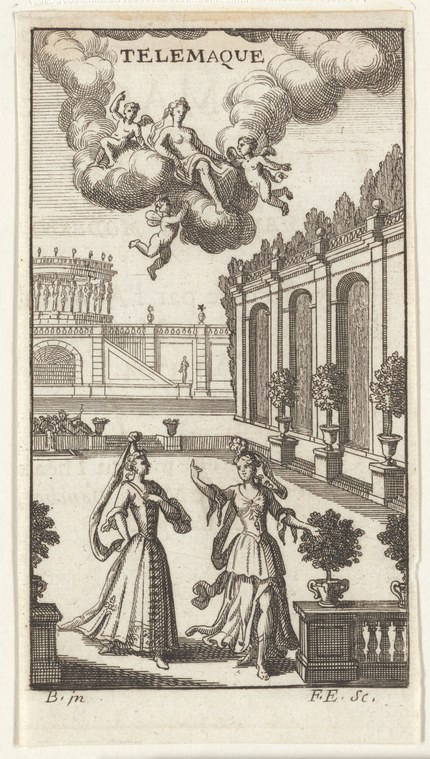
A Baroque engraving depicting a scene from the story of Telemachus. The composition is divided into two registers. In the upper portion, three cherubs or putti recline on billowing clouds above a grand architectural setting. Below, in the foreground, two elegantly dressed figures—a woman in a full skirt and fitted bodice, and a man in period dress—gesture toward each other in what appears to be a courtly encounter. The woman's right arm extends outward in an expressive gesture while her body turns; the man faces her with an equally animated pose. Behind them rises a monumental building with classical arches and rusticated stonework, flanked by topiary in large urns. A bridge or balustrade spans the middle distance. The setting is unmistakably aristocratic and theatrical—the kind of idealized garden or courtyard where court dances and galanterie would be performed. The sky is rendered with fine parallel lines typical of engraving technique, creating atmospheric depth.
The dancing
Both figures stand with weight distributed in a presentation stance rather than active stepping. The woman's body curves away from vertical, her left arm hanging naturally while her right extends diagonally upward and outward in a gesture of acknowledgment or invitation—a pose recognizable from court dance vocabulary. The man mirrors this with forward-leaning posture and raised arm, creating a complementary diagonal line. Their spatial relationship suggests they are meeting or beginning an interaction rather than mid-movement. The woman's full skirt with evident pleating and train would restrict jumping or rapid footwork but accommodate the gliding, processional movements and turning characteristic of Baroque courtly dance.
The dance depicted
This appears to depict a moment from a court ballet or dramatic entertainment based on classical narrative—in this case, the adventures of Telemachus, a popular subject in Baroque court spectacle. The figures' poses and setting align with the vocabulary of Baroque court dance (danse de cour), where couples approached one another with formal gestures before progressing into choreographed movement. The emphasis here is on the initial encounter rather than active steps; the artist has chosen to freeze the moment of greeting or invitation that would precede an allemande, courante, or other suite form. The engraving's didactic presentation suggests it may have served as documentation of a performed work or as a pattern for choreographic instruction.
How it was made
This is an engraving on paper, identifiable by the fine parallel hatching in the sky and shading, the sharp linear clarity of architectural forms, and the precise rendering of fabric folds and surface detail. The work exhibits the characteristics of northern European engraving of the 17th century—probably mid-century or later—with particular attention to linear perspective, classicizing architecture, and the refinement of costume detail. Engravings of this type circulated widely, making them more accessible than painted works and allowing them to serve as records of court spectacles, patterns for artists, or educational material about courtly conduct and choreography. The presence of text above the composition ("TELEMAQUE") and signatures or marks at the lower corners suggest this is a single plate from a larger series documenting narrative or theatrical content.
About this work
This engraving documents a moment of choreographed courtship from a Baroque court entertainment or ballet based on classical narrative. Two elegantly dressed figures meet in a formal garden setting under the blessing of hovering putti, their bodies arranged in the gestural vocabulary of 17th-century court dance. The work captures not a moment of rapid movement but rather the formal presentation and greeting that opens social and theatrical dance of the period—the moment when dancers acknowledge each other before progressing into the pattern-dances (figure dances) that would follow.
The print serves as both artistic record and potential instruction, preserving in line and shadow the bodily language of Baroque courtliness. The setting emphasizes the courtly context of such dancing—not folk recreation but the formalized spectacle of aristocratic performance, where classical narrative, visual splendor, and measured bodily movement combine.
How to look at it
Observe the precision of the woman's turning posture and the man's forward lean—these are not steps but the posed moments that punctuated court dances, moments of acknowledgment and presentation. Notice how the artist has rendered the woman's full skirt not as a static cone but with individual folds and movement, suggesting fabric responsive to a turning body. The architectural frame is not incidental; it places these dancers in the courtly spaces where such dance belonged. Read the title and any inscriptions at the lower corners, which may identify the source narrative or the performance or pattern being documented.
The artist
The artist is not recorded in the catalogue. The engraving's style and subject matter point to the northern European tradition of court spectacle documentation in the mid-to-late 17th century, possibly produced in France, the Netherlands, or the Holy Roman Empire. The quality of the architectural rendering and the refined presentation of aristocratic figures suggests work by a trained engraver familiar with court culture and classical narrative.
The period
This engraving belongs to the era of court ballet and courtly spectacle in the 17th century, when European aristocracies staged elaborate narrative entertainments combining dance, music, poetry, and visual splendor. In France, the court of Louis XIV was the epicenter of such productions, but similar entertainments were mounted across Europe. The story of Telemachus, drawn from Homer's Odyssey, was a popular subject for court ballets and printed narratives. Engravings served to publicize and preserve these ephemeral performances, allowing them to be admired, studied, and imitated across Europe. The refined architectural setting and mythological framing reflect the Renaissance recovery of classical learning and the Baroque appetite for theatrical spectacle.
Where it lives
The work is held in the New York Public Library's collection of prints depicting dance. It is an engraving on paper, likely a single sheet or leaf from a larger series documenting the Telemachus narrative or a specific court spectacle.
Dance in this work
Questions about this work
What is Telemachus and why was it a subject for court dance?
Telemachus is the son of Odysseus in Homer's Odyssey; the story of his adventures searching for his father was a popular subject for Baroque court ballets and literary works. The theme of heroic quest and courtly virtue made it suitable for aristocratic spectacle, allowing composers and choreographers to create narrative frameworks for dances, songs, and elaborate stage machines. Multiple versions were performed and published across Europe in the 17th and 18th centuries.
How do I know this is about dance and not just a courtly scene?
The formal posture, the deliberate gestural relationship between the two figures, and the title's association with a known court entertainment all point to dance. The engraving's inclusion in a collection of dance prints confirms it; the poses themselves—the extended arm, the turning body, the weight distribution—are recognizable as choreographed gesture rather than casual interaction. The architectural setting emphasizes the formality and deliberation of the moment.
What does this tell us about how Baroque court dances actually looked?
It shows that they involved formal, presented poses and measured gestures rather than constant movement. The emphasis on the greeting or invitation phase reveals that court dances were built on sequences of distinct moments—approaches, salutations, turns, and patterns—rather than continuous flowing motion. The woman's full skirt and the man's upright carriage tell us that these dances emphasized vertical line, turned-out positions, and clear spatial relationships between partners.
More dance artwork





