49 works in this view — arrow keys or swipe to move between them.
Dance in Art
Fleur de grenadier
Unknown artist
- Collection:
- Prints depicting dance
- Source:
- New York Public Library
- Rights:
- Public domain — free to use, share and adapt.
- Recorded as:
- Public Domain
This print is a primary historical record of how Romantic-era theatrical dance was performed and costumed—what the leg extensions, arm frames, and energetic jumps actually looked like in practice. It also reveals the commercial apparatus around dance: theater-goers collected these images as souvenirs, helping cement certain dancers and roles in the public imagination. Without such prints, our understanding of 19th-century stage dance would rely almost entirely on written criticism and choreographic notation, both of which omit the texture of lived performance.
What you are looking at
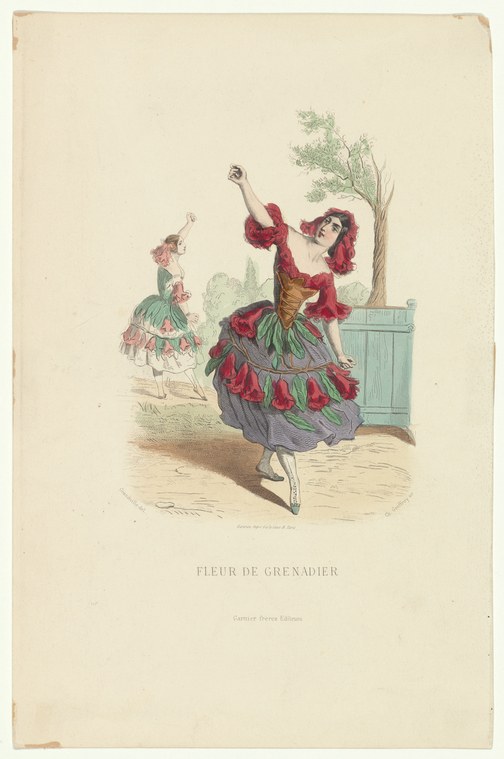
A woman in theatrical costume dominates the composition, caught mid-leap or pirouette against a garden setting. She wears a voluminous skirt of deep red silk with green underskirts visible, a fitted bodice in burgundy and gold, and a jaunty red cap with feathers or plumes. Her right arm is raised high, the hand seeming to catch or throw something small (possibly a flower or grenade, matching the title). Her body is in vigorous motion, weight lifted and centered, the skirt billowing. In the middle distance, a smaller figure in green and white—possibly a child or younger dancer—watches from the left. The setting includes a simple architectural element (a pale structure) and a tree, rendered in soft greens. The print is hand-colored, with delicate cross-hatching establishing form and shadow. The entire scene reads as a moment of theatrical joy and release—the title *Fleur de Grenadier* (Pomegranate Flower) suggests both the botanical and the romantic or comedic register of 19th-century stage spectacle.
The dancing
The principal dancer's body is weightless and extended, rising on the balls of the feet or entirely airborne, the torso lifted and slightly arched backward in the moment of throw or catch. Her raised arm traces an arc, fully extended and energized. The lower body, hidden in the skirt's volume, nonetheless suggests the gathered energy of a jump or powerful turn. Her head tilts back, mouth open in apparent delight or exertion. The smaller figure in the background stands more statically, observing; the composition emphasizes the soloist's isolation and virtuosity.
The dance depicted
The costume and setting—theatrical, outdoors, festive—align with 19th-century romantic ballet and early theatrical dance spectacle, particularly the comic or *divertissement* styles that were popular from the 1830s onward. The vivid, pleated skirt and the acrobatic energy of the central gesture suggest a dancer trained in classical technique but performing a lighter, more playful genre. The act of throwing or catching a flower aligns with pantomimic and decorative elements common to French theatrical dance of this era. Without a signature or dated inscription visible, the specific choreography cannot be confirmed, but the work appears to document a moment from a ballet or stage dance known for combining technical virtuosity with comedic or romantic narrative.
How it was made
This is a hand-colored lithographic print or engraving, likely French, from the mid-19th century. The underlying line is fine and precise, consistent with lithography or steel engraving; the hand-coloring is applied selectively and with restraint, leaving much of the background pale and allowing the costume to carry visual weight. The technique—popular and economical for theatrical souvenirs and dance criticism—allowed rapid reproduction and mass distribution. Such prints circulated widely among audiences, critics, and collectors interested in recording celebrated performances and dancers of the Romantic and post-Romantic ballet era.
About this work
This is a theatrical dance print capturing a moment of physical exuberance and technical display. The image records not a named dancer or specific performance, but rather a type of dance moment—the solo turn or leap that interrupted narrative and allowed virtuosity and personality to shine. The print belongs to a vast archive of 19th-century dance imagery produced to capture and circulate the ephemeral art of performance. Such works are vital historical documents: they show us what bodies did on stage, how costumes functioned in motion, and what audiences valued enough to buy and keep.
How to look at it
Notice first the energy and weightlessness of the central figure—the raised arm, the open mouth, the billowing skirt all suggest a body in vigorous motion, not at rest. The artist has chosen the apex of the action, the moment of maximum extension and apparent joy. Observe how the smaller figure in the background, though less detailed, anchors the scene in a theatrical context: this is a performance witnessed, not a private moment. The hand-coloring emphasizes the red costume against the pale ground, drawing the eye and creating a sense of theatrical spotlight even in a print.
The artist
The artist is not recorded. The print's style and subject align it with French theatrical print production of the 1830s–1850s, a period when Paris was the European center of Romantic ballet. Shops in the Palais Royal and around the Opéra produced thousands of images of dancers, scenes, and costumes for a voracious audience. Many such prints were unsigned or bore only a publisher's mark, and the original artists—lithographers, engravers, and colorists—are now largely anonymous.
The period
The 1830s–1850s saw the zenith of Romantic ballet in Paris. Ballerinas like Maria Taglioni, Fanny Elssler, and Carlotta Grisi dominated the stage; pointe work, the ethereal tutu, and narrative spectacle defined the aesthetic. Simultaneously, a vast industry of theatrical prints, playbills, and souvenir imagery grew to record and promote performances. This print emerges from that commercial ecology: it documents a moment, a costume, a style of movement that audiences found memorable and desirable enough to preserve in their homes.
Where it lives
This work is held as part of the New York Public Library's collection of dance-related prints. Such collections assembled during the 19th and early 20th centuries preserve thousands of theatrical images that document the visual culture of performance.
Dance in this work
Questions about this work
Who is the dancer shown?
Unknown. The print bears no signature or inscription identifying the performer or the original choreography. Such unsigned theatrical prints were common; they were produced in quantity and sold cheaply, making them ephemeral commercial objects rather than commissioned records of named artists.
What does the title mean?
*Fleur de Grenadier* translates to 'Pomegranate Flower.' In the context of 19th-century French theater, the title likely refers either to a flower-themed costume or scene, or to a role or *divertissement* (short comic dance) with that name. The raised hand and the object she appears to be throwing or catching may be a stylized pomegranate or flower.
How do we know this is ballet or theatrical dance?
The costume is unmistakably theatrical: the structured bodice, the full pleated skirt gathered at the waist, the ornamental cap, and the materials (silk, metallic trim) all point to stage costume rather than street or court dress. The figure's posture—the lifted carriage, the extended arm, the apparent jump or turn—aligns with the physical vocabulary of Romantic-era ballet.
What can this print tell us that photographs cannot?
Prints were often made from dancers' own descriptions or from repeated viewings of a role, allowing the artist to emphasize movement and expression in ways a single frozen photographic moment might not. The artist could also stylize and idealize, capturing not literal documentation but the *impression* of a performance—how it felt to watch and remember.
More dance artwork





