49 works in this view — arrow keys or swipe to move between them.
Dance in Art
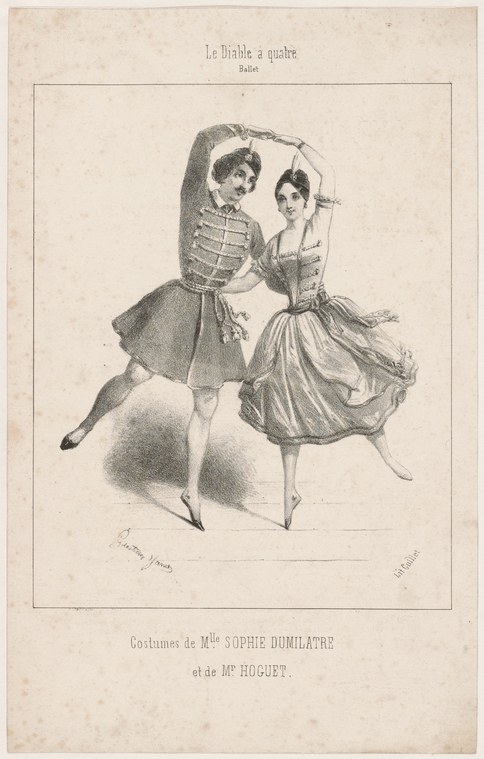
Costumes de Mlle. Sophie Dumilatre et de Mr. Hoguet.: Le diable à quatre. Ballet
Unknown artist
- Collection:
- Prints depicting dance
- Source:
- New York Public Library
- Rights:
- Public domain — free to use, share and adapt.
- Recorded as:
- Public Domain
This is a primary document of how a popular comic ballet was actually danced and costumed—not a generic dance scene, but evidence of a specific work and its performers. For historians of nineteenth-century ballet and pantomime, the image preserves physical gesture and partnering style that would otherwise be lost to time.
What you are looking at
A theatrical costume study for a male and female dancer in a romantic duet. The man wears a short tunic or jerkin with ornamental frogging or braiding across the chest, paired with fitted breeches and soft shoes; the woman wears a full-skirted dress with fitted bodice and off-shoulder neckline, her hair arranged in the period style. Both are caught mid-movement: he leans forward and to the side with one leg extended, as if in a traveling step or turn, while she moves away from him in a complementary direction, her skirt splayed in a half-circle around her. The composition captures a moment of flirtation or pursuit—his body reaches toward hers, hers recedes—typical of mid-nineteenth-century pantomime and comic ballet. The drawing is executed in lithographic crayon with fine hatching to suggest volume and shadow, and the figures are posed against a plain background with no scenery indicated.
The dancing
The male dancer is weight-forward in a dynamic lunge or traveling step, his upper body twisted toward his partner and one arm extended. The female dancer is shown in profile, her body turned away and tilted back slightly, both arms raised and extended—one reaching toward the man, one trailing behind. Their relative positions suggest a chase or playful interaction across the stage. Both figures demonstrate the crisp, controlled articulation characteristic of theatrical dance in this era, with clear line and deliberate spatial separation between the two bodies.
The dance depicted
This is a costume study for *Le Diable à quatre* (*The Devil to Pay*), a popular comic ballet-pantomime. The work was most famously performed by the dancers named in the inscription—Sophie Dumilatre and Monsieur Hoguet—likely in Paris in the 1840s–50s. The costume and gesture suggest a comedic pas de deux rather than a classical grand pas: the playful spatial relationship, the woman's tilted posture, and the man's forward-reaching energy all point to a flirtation or game of pursuit. The abbreviated male costume and full skirt suggest both the popular theatrical style and the dancers' specialized skills in demi-caractère or comic roles.
How it was made
This is a lithographic study printed from crayon drawing. The artist (unnamed in the record) used lithographic crayon to build form through careful hatching and tonal variation, a technique that allowed fine gradation and elegance suitable for costume documentation and theatrical publicity. Lithography made such prints relatively inexpensive to produce and distribute, and this work bears the marks of professional theatrical publication—a title, inscribed performers' names, and two signatures (one of which appears to be the artist's, one possibly the lithographer's or publisher's mark). The technique and format indicate this was a commercial product for theatrical audiences and collectors of dance imagery.
About this work
This is a lithographed costume study for a duet in *Le Diable à quatre*, a mid-nineteenth-century comic ballet that enjoyed sustained popularity across European stages. The image documents not only the cut and ornament of stage dress but the style of movement and partnering that defined the work: a playful, asymmetrical encounter caught in mid-motion. Costume studies of this kind served multiple purposes—they authenticated performances for patrons and critics, circulated the work to other theaters and cities, and created a permanent record of celebrated dancers' interpretations. The inscription of Sophie Dumilatre's name anchors the work to a specific historical performer and moment, making it a valuable source for the history of mid-century French theatrical dance outside the classical ballet tradition.
How to look at it
Observe the asymmetry of the composition: the man's reaching, forward-leaning posture against the woman's receding, tilted frame creates a narrative moment of pursuit or flirtation. Note that neither dancer is posed in the rigidly formal positions of neoclassical ballet; instead, both are caught in a spiraling, traveling motion that suggests wit and lightness. The costumes tell their own story—his abbreviated tunic and tight hose emphasize leg extension and attack; her full skirt, spreading in a circle, reads as the visual answer to his advance. This is not grand spectacle but rather intimate theatrical play.
The period
In the 1840s–50s, when this work was likely made, comic ballet and pantomime occupied a prestigious position in European theater alongside the Romantic ballet that is now better remembered. *Le Diable à quatre* itself dates to 1845 (choreography by Joseph Mazilier for the Paris Opéra) and was frequently revived and restaged. Sophie Dumilatre was known for her virtuosity in demi-caractère and comic roles, and the costume style—masculine and abbreviated, feminine and full—reflects the theatrical conventions of the era. Lithographic costume studies were a standard form of theatrical publicity, circulating in prints and albums and reaching audiences far beyond Paris.
Where it lives
Held in the New York Public Library's dance print collection. This is a theatrical publicity print—a lithograph intended for broad circulation among theater patrons and collectors of dance imagery.
Dance in this work
Questions about this work
What is *Le Diable à quatre*?
*Le Diable à quatre* (*The Devil to Pay*) is a comic ballet-pantomime choreographed by Joseph Mazilier in 1845. It tells the story of a peasant woman who temporarily exchanges places with a countess, creating opportunities for comedy, social satire, and display of the dancers' technical and comic skills. The work was extremely popular and was frequently revived throughout the nineteenth century across European stages.
Who were Sophie Dumilatre and Monsieur Hoguet?
Sophie Dumilatre was a French dancer known for her virtuosity in demi-caractère and comic roles, especially at the Paris Opéra. Monsieur Hoguet was her regular partner. The inscription on this print documents their joint performance in the work, likely at the Opéra.
Why was this print made and distributed?
Lithographic costume studies served as theatrical publicity: they advertised performances to potential patrons, documented celebrated dancers' interpretations, and could be sold to collectors. In the pre-photographic era, such prints were the primary way of circulating the appearance and style of star dancers and popular works to distant cities and future generations.
What does the costume tell us about how this dance was performed?
The male costume—abbreviated tunic, fitted hose, soft shoes—emphasizes leg extension and footwork typical of demi-caractère dancing. The female costume's full skirt and fitted bodice were designed to show the dancer's control and line while creating a visual counterweight to the man's forward energy. Together, the costumes reveal a style of partnering that was spiraling, traveling, and playful rather than formally vertical and static.
More dance artwork





