49 works in this view — arrow keys or swipe to move between them.
Dance in Art
Folies-Bergère, La Loïe Fuller
Unknown artist
- Collection:
- Prints depicting dance
- Source:
- New York Public Library
- Rights:
- Public domain — free to use, share and adapt.
- Recorded as:
- Public Domain
Loïe Fuller represents a crucial moment in modern dance history when the art form broke free from narrative and formal ballet conventions to explore pure movement, visual effect, and technological innovation. This poster is a primary document of how early modernist dance was sold and understood by the public—not as a technical achievement but as a total theatrical experience. For dancers and historians, it illustrates the genealogy of modern dance aesthetics and the pivotal role of women performers in avant-garde theatrical practice.
What you are looking at
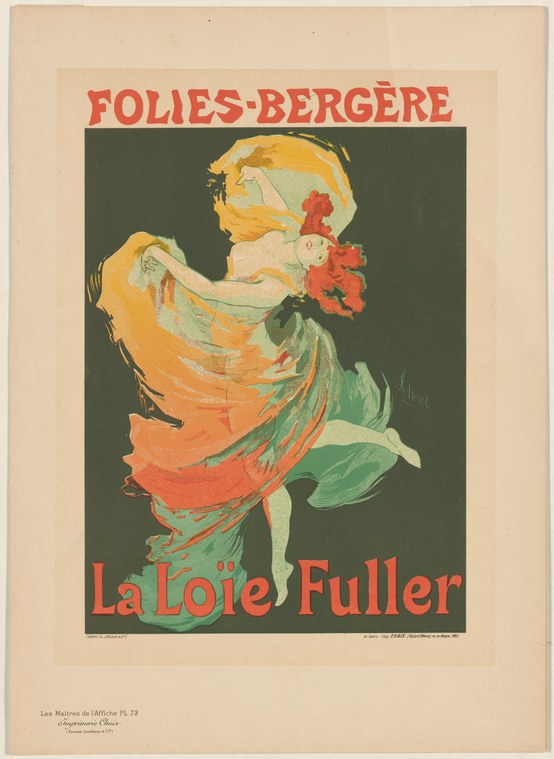
A theatrical poster for the Folies Bergère music hall, dominated by a single figure of a dancer in motion against a dark ground. The dancer, rendered in warm yellows and oranges, twists dynamically with one leg raised and the other supporting her weight in a lunging stance. She wears a flowing, draped costume in shades of orange, coral, and green that billows around her body, suggesting rapid movement. Her arms are extended and bent, cradling what appears to be a prop—possibly flowers or decorative elements—in vivid red. Her blonde hair, rendered in thick yellow strokes, streams upward and outward from her face, emphasizing the velocity of her spin. The composition is composed with expressionistic vigor: bold outlines, flattened perspective, and a limited palette that sacrifices anatomical precision for visual impact and movement.
The dancing
A single female dancer occupies the entire composition. Her weight is unevenly distributed, with one leg bearing her weight while the other extends upward or backward in a high extension. Her torso twists sharply away from the vertical, and her arms are raised and curved, suggesting the kind of upper-body articulation typical of early 20th-century theatrical dance. The extreme tilt of her frame and the streaming hair and fabric convey spinning or rapid turning movement. There is no rigid balletic line here—the body is fluid, expressionist, and emphasizes the dynamic moment rather than formal technique.
The dance depicted
This is a portrayal of Loïe Fuller, the American dancer who became famous at the Folies Bergère in Paris in the 1890s and remained a star attraction into the early 20th century. Fuller was known for her 'skirt dances'—revolutionary theatrical performances in which she manipulated vast quantities of fabric while moving, often under colored electric lighting that she helped pioneer. The poster captures the essence of her signature aesthetic: the voluminous costume, the twisting momentum, and the fusion of fabric and body as a single unified form. Fuller's work was neither ballet nor pantomime but a novel form of theatrical dance that emphasized the total visual effect—light, fabric, movement, and body as an integrated artwork.
How it was made
This is a color lithographic poster, a medium that dominated commercial theatrical advertising in France from the 1880s onward. The technique allowed bold, flat areas of color with strong linear outlines—evident here in the vivid reds, oranges, yellows, and greens that define the figure and costume against the dark green background. The expressive, sketchy quality of the line and the limited color palette are characteristic of fin-de-siècle poster design, particularly the school associated with Toulouse-Lautrec and his contemporaries. Lithography's capacity for rapid, inexpensive color reproduction made it the ideal medium for advertising entertainment venues to a broad urban audience.
About this work
This is a promotional poster for the Folies Bergère music hall in Paris, advertising a performance by Loïe Fuller, one of the most celebrated dancers of the belle époque. Created at an unknown date but stylistically consistent with 1890s–1910s French poster design, it captures Fuller's most distinctive contribution to theatrical dance: the integration of costume, light, and movement into a unified visual spectacle. The image circulated widely as advertising, reaching mass audiences and helping establish Fuller's international fame. Fuller's work fundamentally challenged what dance could be—it was neither classical ballet nor national folk form, but a modernist experiment in the possibilities of the human body moving through fabric and light. The poster preserves not just her likeness but the visual language through which she marketed her revolutionary practice.
How to look at it
Attend to the moment of maximum motion the artist has chosen: the dancer is caught mid-spin, her body compressed and torqued, her costume flying. The artist has sacrificed anatomical accuracy for the impression of speed and dynamism—the streaming hair, the billowing fabric, the unbalanced weight all signal continuous movement rather than a held pose. The expressionist drawing style, with its bold outlines and flattened forms, is not crudeness but a deliberate aesthetic choice that prioritizes visual impact over realism. This is how Fuller's art was understood: not as technical display but as a total visual event in which every element—costume, light, movement, design—worked together to create an overwhelming sensory impression.
The artist
The artist is not recorded, but the poster's style is consistent with the conventions of French art nouveau and fin-de-siècle poster design. The work belongs to the tradition of theatrical lithography that flourished in Paris from the 1880s forward, a tradition that included Toulouse-Lautrec, Jules Chéret, and many anonymous commercial artists working for printers and music halls. The poster was likely created by a studio artist or house designer for the Folies Bergère or a printing firm working on commission, a common practice for theatrical advertising of the period.
The period
The Folies Bergère, which opened in 1869, was the epicenter of Parisian entertainment during the belle époque, a venue where high technology (electric lighting), avant-garde performance, and commercial entertainment converged. Loïe Fuller arrived in Paris in 1892 and became an immediate sensation with her 'Serpentine Dance,' which used yards of silk and colored lighting to create effects that resembled abstraction. She was championed by the artistic avant-garde—Symbolist poets and painters admired her work as a form of modern art—while simultaneously achieving genuine mass popularity. Her performances at the Folies Bergère represented a unique moment when experimental art and popular entertainment were not opposed categories. In dance history, Fuller's work prefigured key concerns of modernism: the autonomy of movement from narrative, the fusion of art and technology, and the body as a vehicle for visual abstraction rather than characterization.
Where it lives
The poster is held in the New York Public Library's collection of prints depicting dance. It is a commercial lithographic advertisement, one of thousands produced for Parisian entertainment venues during the belle époque, and represents the mass-produced visual culture through which modern dance was advertised and understood by the public.
Dance in this work
Questions about this work
Who was Loïe Fuller?
Loïe Fuller (1862–1928) was an American-born dancer who became one of the most celebrated performers of the belle époque in Paris. She created a revolutionary form of theatrical dance in which she manipulated yards of silk fabric while dancing, often under colored electric lighting that she helped pioneer. Her work, sometimes called 'skirt dance' or 'serpentine dance,' was celebrated by the artistic avant-garde and achieved mass popularity at the Folies Bergère and elsewhere in Europe.
What is a lithographic poster?
A lithographic poster is an image created on stone using a chemical process that allows different areas to hold oil-based ink differentially. The stone is then used to print multiple copies on paper. Lithography was the dominant commercial printing technology for color posters in the late 19th and early 20th centuries because it was faster and cheaper than hand-coloring and allowed bold, graphic designs with strong color contrasts.
How did Loïe Fuller's work relate to ballet?
Fuller's work was a deliberate departure from ballet. While classical ballet emphasized line, turnout, and the illusion of weightlessness, Fuller emphasized the weight and dynamics of fabric in motion, the beauty of curves and spirals, and the integration of electrical lighting as part of the artwork. She was interested in pure visual effect and movement abstraction rather than narrative or technical virtuosity, making her a precursor to modernist and contemporary dance.
Why is this poster important?
This poster documents how a revolutionary dance form was advertised and consumed by the public. It preserves the visual language through which Loïe Fuller's innovations were sold—not as a display of classical technique but as a total theatrical experience. Posters like this shaped public understanding of modern dance and circulated Fuller's aesthetic ideas far beyond those who could see her perform in person.
More dance artwork





