49 works in this view — arrow keys or swipe to move between them.
Dance in Art
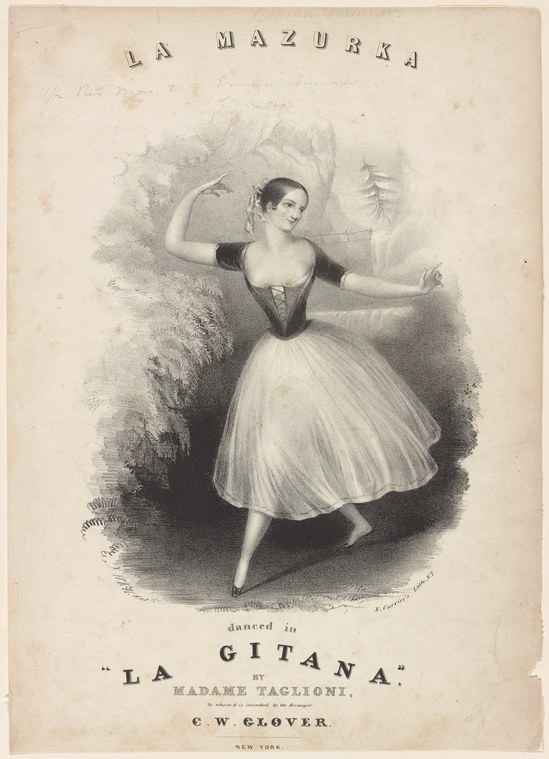
La mazurka danced in La gitana, by Madame Taglioni, to whom it is inscribed by the arranger C. W. Glover
Unknown artist
- Collection:
- Prints depicting dance
- Source:
- New York Public Library
- Rights:
- Public domain — free to use, share and adapt.
- Recorded as:
- Public Domain
This is a primary document of Romantic-era ballet technique, showing how the mazurka—a contemporary social dance—was transformed into a virtuosic solo variation for the stage's most celebrated dancer. The engraving preserves a specific moment of choreography from a performance now lost to history, and it demonstrates how commercial media shaped the public image and legacy of theatrical dance in the 19th century.
What you are looking at
A single female dancer is depicted in a moment of energetic motion against a softly rendered atmospheric background. She wears a dark corseted bodice with short puffed sleeves and a voluminous white tulle skirt that billows outward, caught mid-movement. Her left arm is raised with the elbow bent, the hand near her head in a graceful port de bras, while her right arm extends outward at roughly shoulder height. Her posture is upright and her weight appears to be on one leg with the other lifted, suggesting a turning or traveling movement. The composition is a three-quarter length portrait format, with the figure positioned slightly off-center against a hazy, sketched background that emphasizes the dancer rather than any specific theatrical setting.
The dancing
The dancer displays the classical academic posture of Romantic-era ballet: an elongated neck, lifted chest, and turned-out legs. Her arms occupy the upper frame of the composition with an openness that suggests a traveling step rather than a static pose. The raised and bent left arm shows the soft, rounded carriage typical of the period, while the extended right arm balances the composition. Her skirt, rendered in fine parallel lines that emphasize vertical movement and transparency, suggests she is captured mid-turn or mid-leap. The single figure and the way her weight is distributed indicate a traveling or turning step across the stage.
The dance depicted
This is an engraved depiction of the mazurka danced by the celebrated ballerina Marie Taglioni in the opera or ballet *La Gitana*. The inscription explicitly attributes the dance arrangement to C. W. Glover and dedicates the image to Taglioni herself. The mazurka was a Polish courtly dance that became fashionable in the Romantic ballet of the 1830s-1840s, often performed as a solo variation or character dance by principal dancers. Taglioni's performance of this mazurka in *La Gitana* would have been a virtuosic display piece showcasing both the technical vocabulary of classical ballet and the stylized character dancing popular in the era. The energetic pose and the specific costume—the fitted bodice with short sleeves typical of Romantic dress—confirm this as theatrical rather than ballroom mazurka.
How it was made
This is a steel or copper engraving, a technique evident from the fine hatching lines used to model the dancer's form and suggest depth in the background, and from the sharp, precise linear definition of the costume's edges. Engraving was the dominant medium for dance imagery in the early 19th century, particularly for circulating images of celebrated performers to a paying public. The technique's high cost and long production time meant these prints were usually commissioned as premium products: sheet music covers, souvenir portraits sold at the theatre or through print dealers, or illustrations for published memoirs of celebrated dancers. The inscription and dedication to Taglioni suggests this was a professional promotional engraving, likely produced in New York (as noted in the catalogue) or based on a European original.
About this work
This engraved portrait commemorates the celebrated ballerina Marie Taglioni performing the mazurka in *La Gitana*, a work created by dance arranger C. W. Glover. The print dates to the heyday of Romantic ballet, when such souvenir engravings of star dancers were sold to theatregoers and circulated as mementos of celebrated performances. The image captures the technical vocabulary and aesthetic ideals of the period: the elongated line, the turned-out carriage, the weight distributed into a turning or traveling step, and the characteristic costume of billowing white tulle. As both a dance document and a commercial product, the engraving represents how choreography was recorded, promoted, and consumed in early 19th-century theatrical culture.
How to look at it
Attend to the moment of the step: the artist has captured the dancer mid-turn or mid-travel, with the weight clearly shifting into the supporting leg while the free leg remains lifted or turning. The position of the arms—one raised, one extended—shows the port de bras (carriage of the arms) that was central to Romantic ballet aesthetics. The fine rendering of the tulle skirt, with its vertical lines suggesting both the fabric's transparency and its motion, shows how the engraver conveyed the kinetic quality of the performance. The soft background isolates the figure and emphasizes the dancer's line, a compositional choice that reflects both the conventions of theatrical portraiture and the aesthetic priorities of Romantic dance.
The artist
The engraver is not recorded in the catalogue, but the inscription credits C. W. Glover as the arranger of the dance itself. Glover was a known choreographer and dance composer working in the mid-19th century, particularly in New York. The actual engraving was likely produced by a commercial print house in New York, given the publication note. Dance prints of this kind were typically commissioned by theatres, dancers, or music publishers and executed by specialist engravers; attribution to the printmaker is often lost, while credit accrued to the performer and, sometimes, the arranger.
The period
This engraving dates to the Romantic ballet era (roughly 1830s–1850s), when the mazurka became a fashionable choreographic form for solo variations and character dances within longer works. Marie Taglioni, the Swedish-Italian ballerina, was the dominant figure of Romantic ballet in the 1830s-1840s, celebrated for her ethereal technique, dramatic presence, and technical innovations. The commercial circulation of engraved portraits of celebrated dancers became standard practice in this period, allowing theatre-goers to own and display images of their favorite performers. The New York publication date reflects the international traffic in European dancers and European choreographic forms to the American stage in the 19th century.
Where it lives
The image is held in the New York Public Library's print collection *Prints depicting dance*, a broad assemblage of commercial and artistic representations of dance. The publication note "New York" indicates this was printed in America, though the work may derive from a European original or may reflect a performance of a European-choreographed work in an American theatre.
Dance in this work
Questions about this work
Who was Marie Taglioni?
Taglioni (1804–1884) was a Swedish-Italian ballerina who dominated the Romantic ballet stage in the 1830s-1840s. She was celebrated for her technical virtuosity, her dramatic presence, and her innovations in pointe work and the use of the tulle skirt. Her performance in *La Sylphide* (1832) defined the aesthetic of Romantic ballet. She performed internationally, including in the United States, and her image was widely circulated in prints and engravings.
What is the mazurka in ballet?
The mazurka is a Polish country dance in triple meter that became fashionable in European ballrooms in the 19th century. Choreographers, including Taglioni's partners, adapted it for the stage as a solo variation or character dance, typically performed with virtuosic footwork and stylized, spirited movement. In ballet, the mazurka allowed dancers to show both technical brilliance and theatrical character.
What is *La Gitana*?
The catalogue provides the title of the work and the arranger's name, but *La Gitana* (The Gypsy) does not appear to be a canonical work in the Romantic ballet repertory. It may have been a lesser-known theatrical piece, an opera-ballet, or a vehicle choreographed specifically to showcase Taglioni's talents for a particular engagement, possibly in New York. More research is needed to identify the work and its historical context.
How were engravings like this used?
Engraved portraits of celebrated dancers were sold at theatres, through print dealers, and sometimes bound into published memoirs or theatrical histories. They served as souvenirs for theatre-goers, promotional materials for dancers and impresarios, and illustrations for music (particularly dances arranged for piano). The high quality and cost of engraving meant these prints were premium products, affordable mainly to middle- and upper-class audiences.
More dance artwork





