49 works in this view — arrow keys or swipe to move between them.
Dance in Art
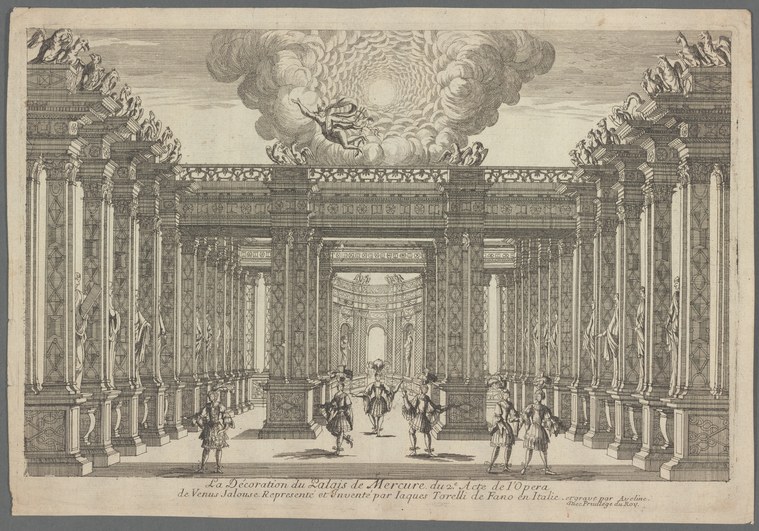
La décoration du palais de Mercure du 2e acte de l'opera de Venus jalouse
Unknown artist
- Collection:
- Prints depicting dance
- Source:
- New York Public Library
- Rights:
- Public domain — free to use, share and adapt.
- Recorded as:
- Public Domain
Opera sets of this period reveal what baroque performers—often trained dancers—actually moved through and how spatial grandeur shaped their movement and presence. This image documents the sophisticated interaction between dance, music, and architecture that defined courtly baroque entertainment, and shows that dance was only one element within a much larger theatrical apparatus.
What you are looking at
This is an engraved architectural perspective depicting an opulent palace interior, specifically designed as a stage set for opera. A monumental colonnade of fluted Corinthian columns recedes deeply into space, their shafts decorated with ornamental details and supporting an elaborate entablature. The coffered ceiling above is richly adorned, and draped fabrics hang between the columns. In the middle distance, several figures in period dress are scattered across the floor, some standing and gesturing, others in poses suggesting movement or interaction. The architectural decoration is symmetrical and precise, rendered in fine parallel lines typical of engraving. At the top of the composition, ornamental clouds and swirling baroque decorative elements frame the scene, suggesting theatrical grandeur and the supernatural realm appropriate to an opera set.
The dancing
Approximately six to eight figures are dispersed across the colonnade floor. They wear what appears to be 17th-century dress typical of operatic costumes—men in breeches and coats, women in full skirts. The figures adopt varied stances: some stand upright in conversation or observation, while others lean forward or gesture with extended arms, suggesting animated interaction or choreographed movement. Without closer detail, it is difficult to identify specific dance positions or holds, though the scattered arrangement and gestural variety suggests a theatrical scene of social encounter rather than a unified dance formation.
The dance depicted
This is almost certainly a scene from a baroque opera—specifically from the opera "Venus jalouse" (Venus Jealous), as stated in the title. The work depicts the palace of Mercury as it would have appeared on stage during Act 2. While operatic scenes frequently incorporated courtly dance and social movement, this particular composition is primarily architectural spectacle; the figures appear more as actors or courtiers navigating a magnificent space than as dancers performing a choreographed piece. The theatrical costume and operatic context indicate that this records a moment from sung drama in which movement and gesture had dramatic rather than technical dance significance.
How it was made
This is a finely detailed engraving, established from the characteristic parallel-line hatching visible throughout the composition and the precise linear perspective construction of the architecture. Engravings of this type were created by incising a design into a polished copper plate with a burin tool, then inking and printing the plate—a labor-intensive process that produced multiple impressions for circulation. The meticulous rendering of architectural ornament and the scale of the composition indicate this was a prestige publication, likely distributed among opera patrons, set designers, and educated collectors. The technique allowed for sharp detail and deep perspective effects while remaining reproducible, making it an ideal medium for documenting theatrical design to a wide audience.
About this work
This engraving documents a baroque opera set design, capturing the theatrical spectacle of Mercury's palace from the opera *Venus jalouse*. It functions as both architectural record and performance documentation, showing how operatic stage design of the period deployed classical architectural forms to create an impression of magnificence and otherworldliness. The work belongs in a dance gallery not because it depicts dance as a technical practice, but because it records the visual and spatial environment in which courtly performers moved, gestured, and sang—the theatrical ecosystem in which baroque dance existed alongside music and drama.
How to look at it
Attend to the architectural perspective and how it creates a visual pathway into illusory depth—this was the primary trick of baroque stage design, creating an impression of vast courtly space. Notice how the figures are distributed across this space at varying distances, allowing the shallow stage (in reality a very small playing area) to seem palatial. The engraver's precision in rendering the columns and ornaments demonstrates the technical sophistication of the design itself. Look at the scattered poses of the figures: their informality and the lack of any unified dance formation suggests this captures a dramatic moment of social interaction rather than a formal dance, reminding us that opera integrated many kinds of movement and gesture.
The period
This engraving dates from the era of baroque opera (likely 17th or early 18th century), when opera was the dominant form of courtly entertainment in Italy and across Europe. During this period, operatic productions were lavish affairs incorporating elaborate stage machinery, painted scenery, costumed singers, and choreographed dance. The architectural language of the set—with its classical orders and symmetrical perspective—reflected enlightenment values and the aspirations of courtly patrons to present themselves as cultivated and rational. Dance within opera was not yet ballet in the modern sense but rather the courtly forms (minuet, allemande, sarabande) adapted to stage performance, integrated with dramatic action rather than presented as autonomous spectacle.
Where it lives
This work is held in the NYPL Prints Collection under the designation "Prints depicting dance." It is catalogued as a historical document related to stage design and operatic performance rather than as a work of fine art in the traditional sense.
Dance in this work
Questions about this work
Is this actually a dance scene?
Not in the technical sense. This is a theatrical set design for an opera, documenting the architectural environment in which dancers and singers performed. The figures shown are actors or courtiers moving through the space rather than dancers executing choreography. However, it belongs in a dance collection because it documents the material and spatial context of baroque performance—the stages on which trained dancers moved.
What is the opera *Venus jalouse*?
The catalogue identifies this as depicting the palace of Mercury from Act 2 of an opera called *Venus jalouse* (Venus Jealous). The work has not been further identified in the information available, but it represents the type of courtly operatic drama popular in the 17th and 18th centuries, typically on mythological themes.
How does this help us understand baroque dance?
Baroque dance did not occur in abstract space but in actual architectural and theatrical environments like the one shown here. This engraving demonstrates the grandeur and formality of the setting in which courtly dances were performed, the way classical architecture shaped performers' movement, and how dance was one element among many (music, drama, spectacle) in courtly entertainment.
Why is this printed as an engraving rather than painted?
Engraving allowed for precise architectural detail and was reproducible, making it ideal for circulating knowledge of theatrical design among patrons, artists, and collectors. It was faster and cheaper than painting while still conveying the visual splendor and technical sophistication of the design.
More dance artwork





