49 works in this view — arrow keys or swipe to move between them.
Dance in Art
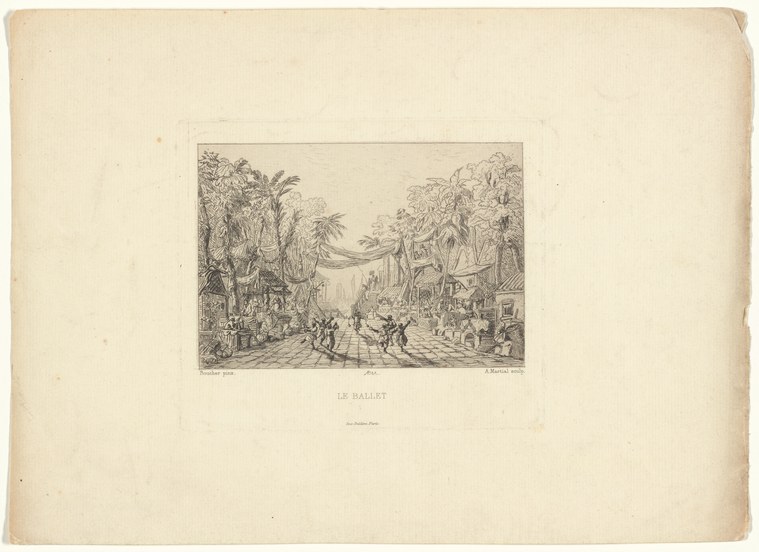
Le ballet
Unknown artist
- Collection:
- Prints depicting dance
- Source:
- New York Public Library
- Rights:
- Public domain — free to use, share and adapt.
- Recorded as:
- Public Domain
Court ballet was foundational to the development of theatrical dance in Europe and a primary vehicle through which aristocratic culture defined itself aesthetically and politically. This engraving provides a rare visual document of the actual staging, spatial design, and costume of the form—information that survives in written descriptions and dance notation but is seldom captured in visual media with such clarity and detail. Understanding how court ballet looked, how dancers moved in relation to architecture and audience, and how the form integrated multiple arts is essential to the history of dance as a discipline.
What you are looking at
This engraving depicts an elaborate outdoor ballet or theatrical dance performance set within a grand tree-lined avenue or garden colonnade. The stage space is framed by tall trees creating a natural architectural tunnel, with draped fabric swags suspended between them overhead. A large assembled crowd of onlookers—courtiers and nobility identifiable by their period dress—line both sides of the performance space, watching from what appears to be a covered loggia or gallery structure on the left. In the center, multiple dancers in light, flowing costumes execute choreography in formation, their movements suggesting coordinated ensemble work rather than solo virtuosity. The setting is richly detailed with architectural elements: columns, ornamental stonework, and manicured vegetation that suggests a royal or noble estate. The composition uses atmospheric perspective to draw the eye toward the depth of the avenue, creating a sense of processional spectacle. The sky is visible above the tree canopy, and the overall scene conveys the grand scale and formal ceremony typical of court entertainment.
The dancing
The dancers appear to move in coordinated groups rather than strict geometric patterns, their bodies oriented toward the viewers as well as toward each other. The costumes—light-colored, with apparent skirts or draped fabric—suggest female performers or a mixed ensemble in court dress. Arm positions are raised and extended rather than held close to the body, suggesting an open, expansive vocabulary. The dancers maintain upright posture throughout, consistent with the refined carriage expected of court performers. Multiple dancers are distributed across the depth of the stage space, creating a sense of three-dimensional choreography rather than a linear front-facing arrangement.
The dance depicted
This is most likely a ballet de cour (court ballet) from the seventeenth century or a retrospective artistic representation of that tradition. The setting—an aristocratic garden theater with a gathered court audience, the formal ensemble choreography, the open-air performance space, and the mixing of music, spectacle, and dance—are all hallmarks of this genre. The title *Le ballet* (The Ballet) is appropriately generic, suggesting the work may depict a generalized court ballet scene rather than a specific historical performance. Court ballet combined spoken and sung text, instrumental music, and choreographed movement in a unified theatrical experience designed to celebrate noble patrons and their courts. The outdoor setting suggests either a summer entertainment or an artistic conceit emphasizing the harmony between art and nature that these performances were meant to evoke.
How it was made
This is an engraving, identifiable by the fine parallel hatching and cross-hatching used to create tonal gradation, the precise linear articulation of architectural and figural forms, and the characteristic clarity of engraved line work. Engravings were labor-intensive to produce but yielded many impressions, making them an effective medium for disseminating images of court spectacles and theatrical events to a wider educated audience. The detailed rendering of costume, architecture, and landscape indicates substantial technical skill and likely a professional printmaker rather than an amateur artist. The technique's inherent linearity suits the formal, articulate nature of court ballet, where clarity of form and precise spatial relationships were central to the meaning of the spectacle.
About this work
This engraving documents or commemorates a ballet de cour, the dominant theatrical dance form of the European aristocracy in the sixteenth and seventeenth centuries. Court ballet integrated dance, music, poetry, and visual spectacle in performances held in royal and noble estates to celebrate patrons, mark occasions, and reinforce hierarchies of power and taste. The work captures the essential elements of the form—the formal garden setting, the assembled nobility as both audience and sometimes-participants, the ensemble choreography, and the fusion of architecture, landscape, and human movement into a unified theatrical design. As a print, the engraving served to circulate an image of courtly refinement and artistic achievement beyond the immediate occasion of performance, allowing viewers who did not attend the actual spectacle to understand its character and ambition.
How to look at it
Focus on the relationship between the dancers and their setting: the way the tree-lined avenue frames and contains the movement, the positioning of the audience relative to the performers, and the use of architectural and natural elements to create a theatrical space. Notice how the ensemble dancers are distributed across the depth of the stage rather than confined to a narrow proscenium plane—this reflects the different spatial logic of court ballet, where spectacle could unfold in three dimensions and be viewed from multiple angles. The raised arms and open postures of the dancers, the formality of their arrangement, and the clear sightlines maintained throughout the composition show an artist who understood that court ballet was fundamentally about the visibility and legibility of movement as a form of courtly etiquette and taste. The print's fine line work allows you to read the details of costume and gesture while maintaining the overall compositional unity of the scene.
The period
Court ballet flourished primarily in France and Italy during the late sixteenth and seventeenth centuries, reaching its height during the reign of Louis XIV (1643–1715), whose passion for dance and the spectacle of his own body led him to appear in numerous court ballets and to establish the first formal academies of dance and music. These performances were expensive, elaborate productions involving artists, musicians, poets, and dancers, often celebrating military victories, royal marriages, or the birth of heirs. By the early eighteenth century, when this engraving likely dates, court ballet had ceded primacy to the professional ballet emerging in the public theaters of Paris and other major cities, though the court ballet tradition remained an important reference for educated audiences. The engraving's artistic style and the formal character of the scene suggest a work made during or after the height of this tradition, possibly as a retrospective commemoration of a form that was already becoming historical.
Where it lives
This engraving is held in the NYPL Prints collection under the genre heading 'Prints depicting dance.' The bare catalogue record provides no artist attribution, date, or publication information, suggesting it may be an orphaned or partially catalogued work. As a historical print, it reflects the widespread circulation of images of court entertainment and theatrical spectacle through engraved media in the seventeenth and eighteenth centuries.
Dance in this work
Questions about this work
What is a court ballet?
Court ballet (ballet de cour) was a form of entertainment performed for European nobility, especially in France and Italy from the late 1500s through the 1600s. It combined dance, music, poetry, elaborate costumes, and scenery in performances that celebrated the patron's power and taste. Dancers were courtiers, musicians, poets, and professional performers; the form was fundamentally aristocratic in character and purpose. Court ballet was the ancestor of modern theatrical ballet and remained an important model even after professional ballet moved into public theaters.
Who danced in court ballets?
Court ballet performers included nobility—sometimes the king or queen themselves—along with courtiers trained in dance as part of their education, and professional musicians and dancers. In the French court under Louis XIV, the king was an accomplished dancer who appeared frequently in ballets, often in prominent roles. As the form evolved, professional dancers became more central, but the ideal of the courtier-dancer who combined birth, education, and physical grace remained central to the form's identity and prestige.
How is this image a reliable source for what court ballet looked like?
Engravings of court spectacles were often made to commemorate important performances and circulate images of them to a wider audience. While a print is not a photograph and contains artistic choices and conventions, the wealth of architectural, costume, and spatial detail here suggests it was made with reference to an actual performance or the conventions of court ballet staging. The artist's care in rendering the formal arrangement of dancers, the audience, and the theatrical space provides valuable visual evidence alongside written descriptions and dance notation that survive from the period.
More dance artwork





