49 works in this view — arrow keys or swipe to move between them.
Dance in Art
L'Hipermestra
Unknown artist
- Collection:
- Prints depicting dance
- Source:
- New York Public Library
- Rights:
- Public domain — free to use, share and adapt.
- Recorded as:
- Public Domain
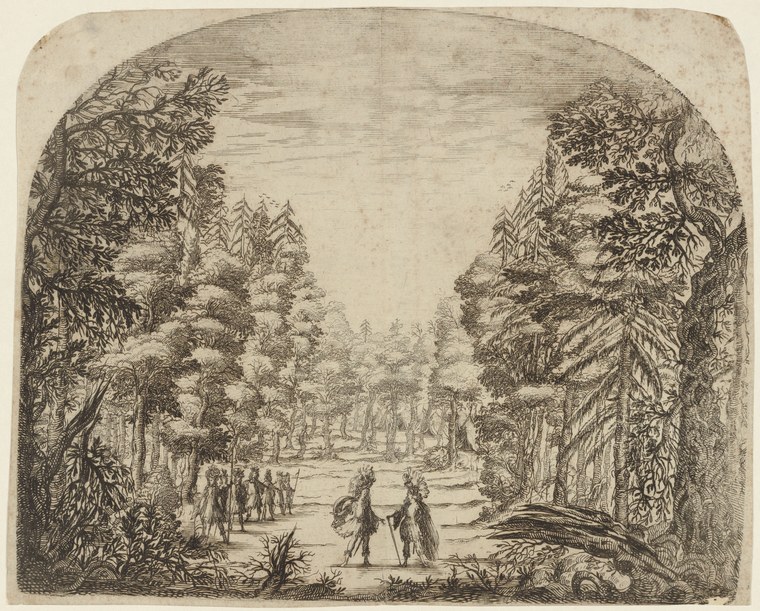
The image offers rare evidence of how the body was arranged and moved in 17th-century court spectacle, where walking, positioning, and coupled promenading were themselves genres of performance. It shows the link between theatrical ballet and the everyday courtly rituals from which such spectacles drew their aesthetic vocabulary—the stately frame, the architectural setting, the formal dress, and the visual symmetry that governed both.
What you are looking at
This engraving depicts an ordered procession through a formal garden or park, framed by tall trees that create a natural archway receding toward the horizon. In the middle distance, multiple figures in 17th-century dress walk in couples or small groups along a central path; the foreground shows three or four pairs, with men in breeches and doublets and women in full skirts. The composition uses classical perspective to draw the eye toward a vanishing point, emphasizing the processional order. The tall foliage forms a tunnel effect, and the sky is rendered with parallel lines suggesting atmosphere. The scene is rendered entirely in fine engraved lines typical of early modern printmaking, with careful cross-hatching to create depth and shadow.
The dancing
The figures are upright and formal, walking in a stately manner down the central path. The nearest couple to the viewer show the woman's full skirt clearly defined by the engraver's line, while the man walks beside her without visible physical contact. Most figures maintain a vertical posture consistent with formal, promenading movement rather than active dancing steps. The spacing between couples is deliberate and measured, suggesting processional order. No visible turning, lifting, or vigorous footwork is apparent.
The dance depicted
This appears to be a garden promenade or formal processional walk—a courtly pastime of the 17th century rather than a choreographed dance. The title *L'Hipermestra* suggests a narrative from classical legend (Hypermnestra of Ovid's Metamorphoses), and the scene may depict a moment from a ballet de cour or court entertainment in which such characters processed ceremonially. The ordered, coupled arrangement and formal dress are consistent with aristocratic social movement in baroque gardens, where walking and displaying oneself were themselves performative acts. No identifiable dance steps or holds are evident.
How it was made
This is an engraving, a printmaking technique requiring incised lines on a metal plate (almost certainly copper). The fine parallel lines and delicate cross-hatching visible throughout indicate the work of a skilled engraver, likely from the 17th century based on the style and subject. The medium allowed for wide circulation in print form, suggesting the image documented an actual court entertainment or a popular literary or mythological subject known to a cultured European audience. The precision of line and control of tone are hallmarks of northern European engraving practice.
About this work
This engraving records a formal garden procession framed by a classical architectural perspective of trees. The scene depicts aristocratic figures in 17th-century court dress moving in ordered couples through a leafy corridor—likely a moment from a ballet de cour or court spectacle associated with a classical or mythological narrative. The work belongs in the history of dance imagery because it captures how courtly movement itself was performed as display: the body's carriage, the arrangement of couples, and the processional frame were all elements of court ritual and aesthetic performance. It documents not theatrical dancing but the adjacent, equally formalized world of courtly deportment and promenade.
How to look at it
Attend to the perspective: the engraver has used the receding trees to create a sense of ordered movement and hierarchy, with the viewer positioned as if watching the procession unfold. Notice the deliberate spacing and pairing of the figures—this is not a snapshot but a composed arrangement showing how courtly bodies occupied space. The vertical postures and controlled steps, even in this walking promenade, reveal the formality and restraint expected of aristocratic performance. The garden setting itself is classical and ordered, reinforcing the idea that movement through it was as much a visual art as a physical one.
The period
The 17th century saw the flowering of the ballet de cour in France and the broader European courts, in which dance, music, poetry, and spectacle were woven together in elaborate entertainments. These spectacles often drew on classical and mythological narratives—Ovid's *Metamorphoses* was a favored source—and performed them in formal gardens or court halls. The link between courtly promenade and staged dance was fluid; formal walking and positioning in gardens were aestheticized as part of court culture. Classical perspective and formal garden design were themselves expressions of courtly order and hierarchy reflected in the body's movement and placement.
Where it lives
The work is held in the New York Public Library's collection of prints depicting dance, indicating it was catalogued for its documentary value in recording courtly movement and spectacle. It is an engraving, a medium designed for circulation and study among educated audiences across Europe.
Dance in this work
Questions about this work
Is this actually a dance, or just people walking?
In 17th-century court culture, the distinction was not sharp. Formal promenades in gardens or court chambers were choreographed and performed as displays of courtly grace and order. This image documents that performative walking as part of a court spectacle tied to a classical narrative—a genre of movement that falls between social ritual and theatrical performance.
What does the title tell us?
Hypermnestra is a figure from Ovid's *Metamorphoses*, suggesting this engraving records or commemorates a ballet de cour or other courtly entertainment based on classical narrative. The mythological frame would have been familiar to the educated audiences who purchased and collected such prints.
Why is the composition so formal?
The classical perspective, the symmetrical pairing of figures, and the architectural framing all express baroque courtly aesthetics. This visual order was not accidental but part of the performance itself—a visual language showing hierarchy, decorum, and the taming of the body through formal arrangement.
More dance artwork





