49 works in this view — arrow keys or swipe to move between them.
Dance in Art
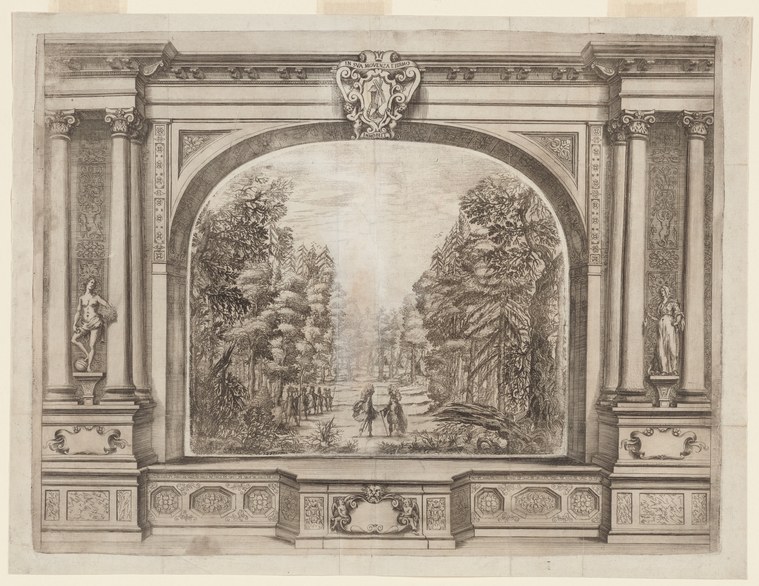
L'Hipermestra, with proscenium
Unknown artist
- Collection:
- Prints depicting dance
- Source:
- New York Public Library
- Rights:
- Public domain — free to use, share and adapt.
- Recorded as:
- Public Domain
Court dances in the 17th and early 18th centuries were inseparable from their architectural and scenic settings; this engraving preserves evidence of that integration at the moment of performance. The work also demonstrates how prints circulated designs for spectacle across Europe, making a single production visible to distant courts and musicians.
What you are looking at
This is an engraved design for a theatrical proscenium, framing a pastoral landscape deep in perspective. The architectural frame is classical and ornate: fluted columns with Corinthian capitals flank both sides, supporting a pediment with a cartouche at its apex. Below runs a decorated base with relief panels. Within the arched opening, a tree-lined avenue recedes toward a distant structure, with figures distributed along the path—some standing, some in motion—suggesting a processional or promenade through a formal garden. The engraving technique renders light effects through fine parallel lines and cross-hatching, creating atmospheric depth. Small statuary figures occupy niches in the proscenium frame itself, emphasizing the theatrical conceit of architecture as stage machine.
The dancing
The figures within the landscape are small and distant, rendered in silhouette or outline. Their poses suggest leisurely movement—some upright, others apparently in conversation or procession. No single couple or dance couple dominates; instead, the composition treats them as elements within a garden scene. The scale and distance make individual limb positions or hold unclear, but the overall distribution suggests social gathering rather than choreographed ensemble. A few figures appear to be in motion forward along the path.
The dance depicted
The image does not depict an identifiable dance in the modern sense. However, this is a proscenium design for the opera-ballet *L'Ipermestra* (a setting of the Danaids myth popular in 17th-century theatre). In that context, the pastoral landscape and processional arrangement of figures would have framed choreographed court dances—likely baroque court dances such as minuets, gavottes, or branles performed by costumed actors on the raked stage beneath this proscenium. The engraving documents the scenic apparatus, not the dancers themselves. The title and theatrical context suggest an aristocratic audience familiar with elaborate intermezzi and dance interludes within sung drama.
How it was made
This is an engraving on paper, identifiable by its linear structure, cross-hatching for tone, and the crisp edges characteristic of burin work. The technique allowed precise reproduction of architectural detail and atmospheric recession through accumulated line, suitable for circulation as a print to document or advertise theatrical productions. Engravings of proscenium designs were sent to courts, published in theatre records, and valued as evidence of court spectacle and the sophistication of stage machinery. The medium implies an educated audience of courtiers, theatre practitioners, and collectors rather than a general public.
About this work
This is an engraved design for a theatrical proscenium framing the pastoral landscape for an act or intermezzo in *L'Ipermestra*, a baroque opera-ballet or sung drama. The proscenium itself—with its classical columns, cartouche, and relief decoration—is the primary subject; the figures within the landscape are secondary, positioned to suggest courtly promenade or processional movement. The work documents the visual and spatial apparatus within which baroque court dances would have been performed, rather than depicting the dance itself. It belongs in a dance collection because it shows where and how such dances were staged, and because the composition and movement of those distant figures would have been choreographed as part of the theatrical spectacle.
How to look at it
Attend to the proscenium as a frame-within-frame, which positions the landscape as a scene to be entered and traversed. Note how the architectural elements (columns, cartouche, base reliefs) create a formal boundary between the auditorium and the stage world, a convention still in use. The small processional figures establish human scale and suggest that the foreground ground plane of the stage would have been where the principal dancers—likely in courtly dress—would perform minuets or other formal court dances, while this landscape served as backdrop or as a space for ensemble movement.
The period
In the 17th century, Italian opera and French ballet de cour converged in the form of the opera-ballet, in which sung drama alternated with or incorporated choreographed dances. *L'Ipermestra* settings appear in multiple European versions across this period. Baroque theatrical practice privileged elaborate proscenia and scene changes as marvels in themselves, often dominating the spectator's attention as much as the performers. Engravings of stage designs by artists such as the Bibiena family were widely collected and imitated, establishing a visual vocabulary for aristocratic theatricality.
Where it lives
The work is held in the New York Public Library's prints collection, catalogued under dance-related imagery. It is one of numerous engraved theatrical designs in early modern European collections, typically created to document or advertise productions for courtly circulation.
Dance in this work
Questions about this work
Is this a dance scene or a stage design?
It is a stage design—specifically, a proscenium frame. The dancers themselves are not the focus; rather, the engraving shows the architectural apparatus and scenic backdrop within which baroque court dances were performed. The small figures in the landscape represent the kind of courtly movement and processional that would have accompanied dance interludes in an opera-ballet.
What would have happened on this stage?
Actors and dancers in costume would have performed arias and choreographed dances (likely minuets, gavottes, or branles) within the frame of this proscenium. The pastoral landscape would have remained as scenery while performers moved and danced in the foreground. This particular design is for *L'Ipermestra*, based on the classical myth of Hypermnestra and the Danaids.
Why is this engraving important to dance history?
It documents the theatrical context and visual sophistication within which baroque court dances were performed and appreciated. It also shows how spectacle was designed and circulated: engravings like this were sent to other courts as evidence of a patron's taste and resources, influencing theatrical practice across Europe.
More dance artwork





