49 works in this view — arrow keys or swipe to move between them.
Dance in Art
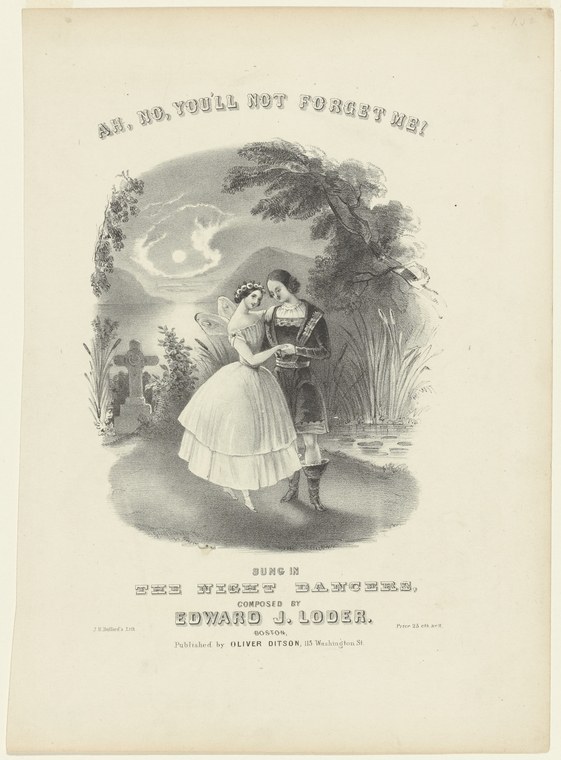
Ah, no, you'll not forget me! Sung in The night dancers, composed by Edward J. Loder
Unknown artist
- Collection:
- Prints depicting dance
- Source:
- New York Public Library
- Rights:
- Public domain — free to use, share and adapt.
- Recorded as:
- Public Domain
This work is a primary visual document of Romantic ballet costuming and theatrical staging in the mid-19th century. For historians of dance and theatre, it provides evidence of how ballet was integrated into operatic spectacle and how female dancers were posed and presented to audiences; for dancers, it shows the aesthetic vocabulary and physical ideals of the period.
What you are looking at
A young woman in a white ballet dress stands at the center of a moonlit woodland or garden scene, her body angled in a graceful pose suggesting movement or anticipation. She wears a full skirt of the Romantic era, caught mid-gesture with one arm raised. A male figure in dark clothing—possibly a soldier or officer in military dress—stands nearby, and additional figures are visible in the shadowed background among trees. The scene is lit by moonlight, creating dramatic contrasts between light and shadow across the composition. The overall mood is one of romantic encounter or drama, with the setting suggesting a forest rendezvous at night.
The dancing
The central female dancer is captured in a balletic pose with her weight appearing to be on one leg, the other leg extended or lifted, and her arms in a position suggesting either preparation for movement or a moment of emotional suspension. Her posture shows the characteristic verticality and turnout of classical ballet training. The male figure stands in a more grounded, less trained stance, his attention directed toward the woman. The body language between the two suggests a narrative moment of courtship, hesitation, or romantic encounter rather than partner dancing in a technical sense.
The dance depicted
This is a theatrical or operatic scene rather than a depiction of ballroom or social dance. The woman's costume and port de bras are consistent with Romantic-era ballet (early-to-mid 19th century), and the image illustrates a moment from *The Night Dancers* opera or theatrical work, of which this appears to be a song illustration. The pose suggests the vocabulary of classical ballet as performed in the European theatre, though the scene is narrative and dramatic rather than a representation of a specific technical dance form. The work belongs to the tradition of illustrated theatrical song sheets.
How it was made
This is a lithograph or engraving on paper, characteristic of 19th-century theatrical song sheet illustration. The technique employs fine line work and tonal shading to create atmospheric depth, particularly in the rendering of moonlight and foliage. Such prints were mass-produced and bound into sheet music or sold separately, making them the primary visual record of theatrical costume and staging for audiences who could not attend performances. The quality of execution and the use of light and shadow suggest professional theatrical illustration work.
About this work
This is a song sheet illustration from the mid-19th century operatic work *The Night Dancers*, composed by Edward J. Loder. It preserves a moment from a Romantic-era theatrical production, depicting a female dancer in classical ballet dress in a moonlit encounter. The image documents both the visual conventions of romantic ballet spectacle and the popular theatrical repertoire of the period, serving as a record of how dancers were costumed and posed for dramatic effect in opera houses of the time. Song sheet illustrations like this one were widely circulated and represent an accessible form of theatrical publicity and documentation.
How to look at it
Notice the moment chosen: not a moment of vigorous movement, but one of stillness, gesture, and emotional expression. The woman's pose is both ballet vocabulary and theatrical acting—her raised arm and extended line communicate both technical training and romantic longing or uncertainty. The moonlit setting, the isolated figures, and the narrative framing signal that this is not a social dance but a dramatic scene. Observe how the male figure is rendered less gracefully, more grounded, positioning the woman as the trained artist and focus of aesthetic attention.
The artist
Edward J. Loder was a 19th-century English composer known for operas and theatrical works. The illustrator of this particular sheet is not recorded, but the quality and style suggest a professional theatrical illustrator working in London during the period of the composition. Such illustrations were collaborative products: the composer's name appears prominently while the visual artist's identity was often anonymous in this period.
The period
This work dates to the era of Romantic ballet, when theatrical dance had become a major attraction in European opera houses. The female dancer in ethereal dress performing narrative roles—often ghostly, magical, or emotionally heightened characters—was the dominant aesthetic. Ballet was being integrated into opera and longer theatrical works rather than presented as isolated social dances. The 1840s-1860s saw the peak of this romantic aesthetic in ballet, with works featuring supernatural or exotic themes and elaborate scenic effects. Song sheet illustrations were a standard form of theatrical publicity and entertainment, distributed to audiences and sold in music shops.
Where it lives
This work is held in the New York Public Library's *Prints depicting dance* collection, indicating it was catalogued as a significant visual record of dance history. The publication information identifies Oliver Ditson of Boston as the publisher, confirming it as a commercial theatrical song sheet.
Dance in this work
Questions about this work
What is The Night Dancers?
*The Night Dancers* was an operatic or theatrical work with music composed by Edward J. Loder. This song sheet illustrates a moment from that production. Details about the full work and its narrative are not established from the image alone, but the composition and setting suggest a Romantic-era theatrical work with supernatural or magical themes.
Is this actually a dance scene or just a theatrical picture?
It is primarily a theatrical scene with a dance-trained performer, rather than a representation of a dance form or technique. The woman's classical ballet training is visible in her posture and deportment, but the image documents a narrative moment from an opera or theatrical work, not a social dance or balletic technique.
Who is the artist?
The illustrator is not recorded in the catalogue. Edward J. Loder is credited as the composer of the music, but the visual artist remains anonymous, which was common practice in 19th-century theatrical song sheet production.
Why was this printed and sold?
Song sheet illustrations were mass-produced ephemeral objects—affordable, portable, and popular. They served as publicity for theatrical works, souvenirs for audiences, and standalone entertainment. This object represents how theatrical dance and music reached the public through commercial print culture.
More dance artwork





