49 works in this view — arrow keys or swipe to move between them.
Dance in Art
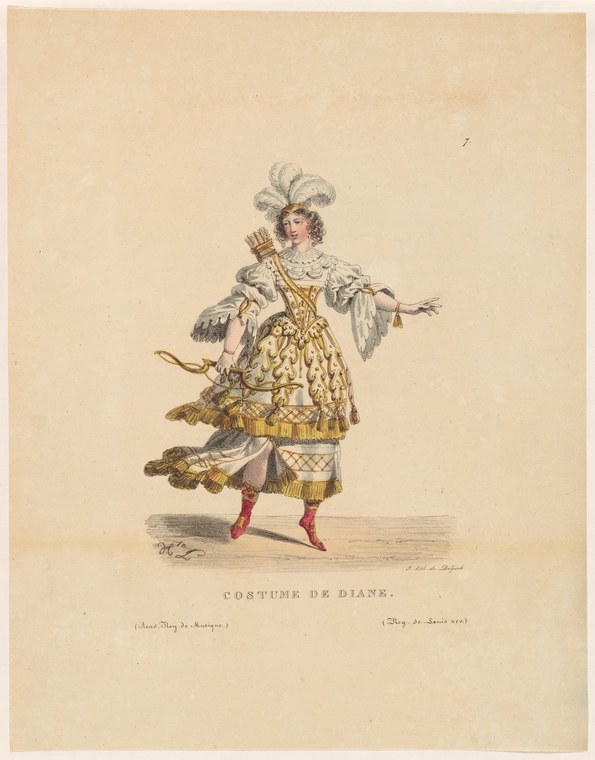
Costume de Diane
Unknown artist
- Collection:
- Prints depicting dance
- Source:
- New York Public Library
- Rights:
- Public domain — free to use, share and adapt.
- Recorded as:
- Public Domain
This print documents a foundational figure in Baroque and 18th-century court dance: the mythological female character (nymph, huntress, goddess) who appeared in court ballets, operas, and theatrical spectacles across France and Europe. Understanding how Diana was dressed, posed, and presented—as an aristocratic figure embodying virtue and grace—tells us what the period valued in female dancing bodies and what movement was meant to express. Without access to the actual choreography or notation, such costume studies are among the only reliable records of how these roles were performed and how they were understood by their audiences.
What you are looking at
A single figure stands center stage against a plain, neutral background—a theatrical pose rather than a narrative scene. She is dressed as Diana, the Roman goddess of the hunt, in an elaborate costume of the 18th century. A plumed headdress crowns her curled hair. She wears a short yellow-gold tunic or skirt decorated with intricate scrollwork and scalloped edges, layered over white silk drapery at the hips. A white fur or feathered mantle drapes from her shoulders. Her legs are bare or in flesh-colored hose, ending in red heeled shoes. She holds a bow in her left hand and gestures outward with her right arm in an open, aristocratic pose—the studied elegance of a court dancer or actress. Her weight appears to rest on her back leg, her torso angled toward the viewer, her expression composed and theatrical. The print has hand-coloring in gouache or watercolor, with careful attention to the gilded details of her costume.
The dancing
The dancer's weight is shifted onto her right leg, with the left leg relaxed and slightly forward, suggesting a moment between steps rather than active movement. Her arms are held away from her body in an open frame—the bow held at waist height in her left hand, her right arm extended at shoulder height in a gesture of presentation or benediction. Her torso is upright and formal, her gaze direct toward the viewer. The pose reads as a position rather than a transition, characteristic of theatrical portraiture of the period where the dancer 'holds' a flattering attitude for representation.
The dance depicted
This is a costume study for the role of Diana, likely created for a French court ballet, opera-ballet, or theatrical production of the 18th century. Diana was a stock character in court and theatrical dance of the Baroque and early 18th-century periods, typically danced by a trained court dancer or actress-singer in spectacles that combined dance, music, and elaborate staging. The open, presentational pose and the formal composition tell us nothing about active choreography; this is a record of costume and character rather than of technique. The image documents the theatrical apparatus in which dance occurred—the mythological costume, the aristocratic bearing, the constructed elegance—rather than the dance itself.
How it was made
This is a hand-colored engraving or etching, as confirmed by the fine linear detail in the background and the controlled parallel hatching visible in the drapery and feathers. The coloring has been applied in opaque gouache or watercolor over the print, with gold leaf or gold paint highlighting the decorative embroidery on the tunic and the ornamental details of the costume. The technique—combining precise engraved line with applied color—was standard for theatrical costume documentation in 18th-century France and England, allowing wide circulation of designs to theater companies, costume makers, and artists across Europe. The notation at the foot (partially legible in the original) suggests this was part of a published series documenting theatrical roles and dances.
About this work
This is a theatrical costume print recording the role of Diana for an 18th-century court or stage production. The image sits at the intersection of dance documentation and fashion: it preserves not choreography but the visual apparatus through which dance was experienced—the mythological character type, the elaborate costume, the aristocratic deportment. As a hand-colored engraving, it belongs to a large European genre of theatrical documentation that recorded roles and performers rather than movements. For a dance historian, it raises the essential problem of pre-cinematic dance history: what survives are costumes, roles, and poses, not movement itself.
How to look at it
Look first at the pose itself: the weight distribution, the open arms, the way the body is presented to the viewer rather than captured mid-gesture. This is a 'standing' moment—a theatrical attitude—chosen specifically because it shows off the costume and allows the viewer to see the full figure and all the ornamental detail. The artist has frozen a moment of aristocratic repose rather than dynamic action. Notice how the printed line defines the edges of the drapery and feathers, while the hand-coloring adds richness and depth that the engraving alone could not convey. The combination of precise black line and warm flesh tones, gold details, and soft blue drapery creates the illusion of a three-dimensional figure on a stage.
The artist
The artist is not recorded in the catalogue, which is common for theatrical prints of this era. The print bears a signature or mark in the lower left corner, but it is not legible in reproduction. The style and execution are consistent with the work of French engravers and printmakers active in theatrical documentation in the mid-to-late 18th century, many of whom remained anonymous or are known only through their prints. The inscriptions suggest publication in France, and the hand-coloring technique indicates a work made for a cultivated market—theater companies, dancers, collectors of costume designs, and wealthy patrons interested in theatrical spectacle.
The period
In the 18th century, court ballets and theatrical spectacles remained central to European aristocratic culture. Dancers—often trained in the vocabulary of ballet d'action—performed mythological and allegorical roles in productions that combined music, dance, scenery, and costume in elaborate unified spectacles. The role of Diana, connected to the hunt and to virtuous femininity, was a standard character type. Theatrical prints like this one served multiple functions: they documented roles for performers and theaters, circulated designs among costume makers, and offered the public a record of sumptuous productions they might not have seen. By the late 18th century, such prints had become a thriving commercial genre, particularly in Paris.
Where it lives
The print is housed in the New York Public Library's collection of prints depicting dance and theatrical scenes. It is one of many such costume studies surviving from 18th-century French and European theatrical practice, indicating it was part of a published or circulated series documenting theatrical roles.
Dance in this work
Questions about this work
Was Diana an actual dance, or just a costume character?
Diana was a character type—a role danced in court ballets, opera-ballets, and theatrical spectacles, but not a named choreographic work. A dancer trained in the vocabulary of Baroque and early 18th-century dance would have danced this role, but we don't know the specific choreography. The costume print preserves the character and the theatrical presentation, not the steps or movement vocabulary.
Why was Diana such a popular character in Baroque dance?
Diana, the Roman goddess of the hunt, symbolized independence, virtue, and martial prowess—qualities valued in court culture but expressed in a feminine figure. Mythological characters allowed choreographers and dancers to explore a range of movement qualities and dramatic situations while remaining within the framework of classical allegory. Diana's association with hunting also allowed for dynamic and varied movement in a way that purely courtly roles might not.
How do we know what 18th-century dancers actually did if we only have costume prints?
We piece together evidence from multiple sources: notation systems like Feuillet notation, written descriptions of performances, costume and visual documentation like this print, musical scores, and surviving dance treatises. No single source tells the complete story. Costume prints like this one show us the aesthetic values of the period—the kind of grace, elegance, and presence the audience expected to see.
More dance artwork





