49 works in this view — arrow keys or swipe to move between them.
Dance in Art
Le spectre de la rose
Unknown artist
- Collection:
- Prints depicting dance
- Source:
- New York Public Library
- Rights:
- Public domain — free to use, share and adapt.
- Recorded as:
- Public Domain
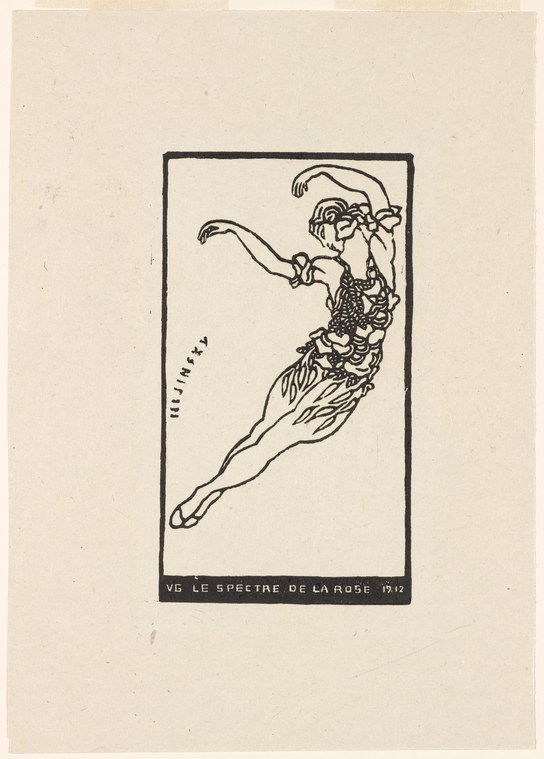
Nijinsky's *Spectre* became the benchmark for male ethereal technique in the 20th century, influencing generations of male dancers and redefining what elevation and weightlessness could mean. This engraving is among the primary visual records of that performance and its revolutionary impact on how the body was perceived in dance.
What you are looking at
A single dancer floats diagonally across the composition in a linear engraving, their body extended in an ethereal arabesque or soaring leap. The figure wears a fitted tunic decorated with elaborate scrollwork or jeweled ornamentation at the bodice, paired with tights; the costume suggests theatricality and luxury. Two long, curved appendages or ribbons stream upward from the figure's head or upper body, creating an impression of weightlessness and supernatural motion. The composition is severely cropped and frameless except for a thin border, focusing all attention on the ascending figure against bare paper. The inscription at the base reads "VG LE SPECTRE DE LA ROSE 1912", anchoring the work to a specific ballet and date.
The dancing
The dancer's body is arranged in a vertical or steeply diagonal lift, with legs extended and torso reaching upward in a posture associated with Romantic-era elevation and fantasy. The arms frame the head, which tilts back, and the overall line suggests weightlessness rather than grounded technique. The figure appears alone, isolated in space, creating an impression of supernatural or dream-like solitude. The costume is close-fitting and decorative, consistent with early 20th-century theatrical ballet dress.
The dance depicted
This image documents the ballet *Le Spectre de la rose* (*The Haunted Rose*), choreographed by Michel Fokine for the Ballets Russes and premiered in 1911 with Vaslav Nijinsky as the Rose Spirit. The engraving captures the essence of that role: a supernatural male dancer embodying the spirit of a rose that haunts a young woman's dreams. Nijinsky's interpretation of the role became legendary for its apparent defiance of gravity, and this image freezes that iconic quality—a moment of ascent or hovering in mid-air. The vertical thrust and weightlessness visible in the pose reflect what contemporary audiences described as Nijinsky's revolutionary technique.
How it was made
This is a line engraving, likely a wood engraving or copper engraving given the fine linear detail and the date. The technique employs hatching and a bold outline to suggest volume and movement; the spare use of line allows the ghostly, ethereal quality of the subject to emerge through restraint rather than tonal rendering. Engravings of this period were relatively affordable and widely circulated, making ballet imagery accessible to a broad public and serving as both artistic documentation and theatrical publicity.
About this work
This engraving documents one of the most iconic roles in early 20th-century ballet: Vaslav Nijinsky's portrayal of the Rose Spirit in Michel Fokine's *Le Spectre de la rose* (1911). The image crystallizes the role's defining quality—an impossible, weightless elevation that seemed to defy gravity and human limitation. It is a record of both a specific performance and a revolutionary moment in dance history, when Russian Imperial dancers and choreographers reimagined what ballet could express and how high the body could rise. The work belongs in a dance gallery not merely as documentation but as visual evidence of the Ballets Russes' transformation of theatrical dance.
How to look at it
Attend to the diagonal thrust of the figure and the upward reach of the ribbon or appendages. The artist has chosen the instant of maximum lift or suspension, the moment when gravity appears momentarily suspended. Notice how the engraver uses line economy—the absence of background detail, the thin border, the sparse hatching—to create an impression of weightlessness and dream logic rather than naturalism. The costume detail grounds the image in theatrical specificity while the posture transcends it.
The artist
The artist is not recorded in the catalogue. The engraving's style, date, and subject suggest it was made by a Paris-based printmaker associated with theatrical or artistic circles in the years following the Ballets Russes' arrival in 1909. The signature "VG" may identify the engraver, though it has not been confirmed.
The period
The Ballets Russes, founded by Sergei Diaghilev in 1909, revolutionized dance in Paris and Europe by importing Russian Imperial technique, avant-garde choreography, and exotic visual spectacle. *Le Spectre de la rose* (1911) epitomized this moment: a short, dreamlike narrative ballet with a male dancer as the supernatural protagonist, defying the 19th-century convention of the ballerina as the sole focus. Nijinsky's performance caused a sensation; critics struggled to describe the height and fluidity of his jumps. Printmakers and illustrators documented the Ballets Russes intensively, both as artistic documentation and as publicity for a phenomenon that redefined European culture.
Where it lives
The work is held in the New York Public Library's Prints collection, a repository devoted to theatrical, artistic, and documentary prints. As a theatrical print from the early 20th century, it served both as a souvenir and as documentation of the Ballets Russes' performances.
Dance in this work
Questions about this work
Why is the Rose Spirit male?
In Fokine's 1911 ballet, the Rose Spirit was danced by a male soloist (Nijinsky), who embodied a supernatural or dreamlike presence in a young woman's reverie. This was revolutionary: prior to the Ballets Russes, male dancers in European ballet had become increasingly marginal, relegated to supporting roles. Fokine and Nijinsky reclaimed the male dancer as a vehicle for poetry and ethereal expression.
What is the curved shape above the dancer's head?
The curved lines may represent ribbons, tendrils, or a stylized indication of the dancer's upward momentum and the supernatural aura surrounding the figure. They reinforce the dreamlike and weightless quality of the image. They may also be a formal element of the artist's composition rather than a literal costume element.
Who was Vaslav Nijinsky?
Nijinsky (1890–1950) was a Russian dancer trained in the Imperial Ballet and the greatest male star of the Ballets Russes. He was celebrated for his technical virtuosity (particularly his elevation and jumps), his interpretive range, and his work with choreographers Michel Fokine and Sergei Diaghilev. He also choreographed avant-garde ballets, including *L'Après-midi d'un faune* (1912).
More dance artwork





