49 works in this view — arrow keys or swipe to move between them.
Dance in Art
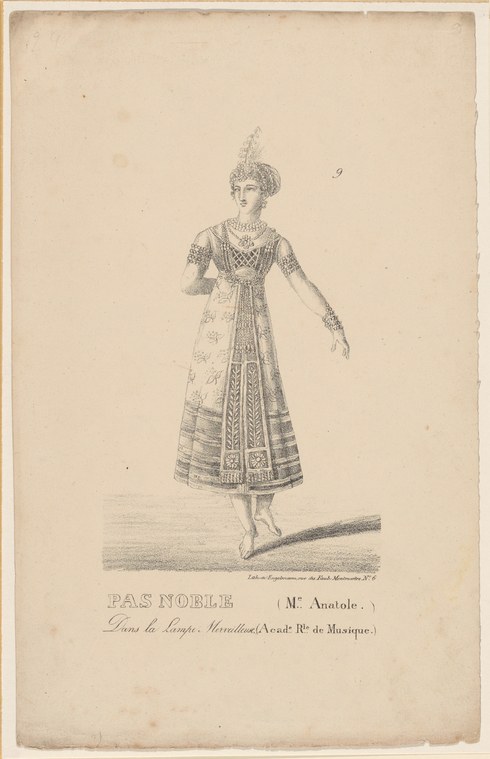
Pas noble (Mme Anatole) dans La lampe merveilleuse (Acade. Rle. de musique)
Unknown artist
- Collection:
- Prints depicting dance
- Source:
- New York Public Library
- Rights:
- Public domain — free to use, share and adapt.
- Recorded as:
- Public Domain
This image documents a precise moment in the genealogy of ballet—the transition from Baroque court dance to the codified technique of the early Romantic period. The *pas noble* was the DNA of all subsequent ballet vocabulary, and seeing how a professional performer of this era embodied it, in the actual costume she wore, gives historians direct access to practice that otherwise survives only in written notation and description. The engraving's clarity also demonstrates how the 18th-century dance world used printmaking for documentation and training, a visual technology that preceded and shaped the later development of dance notation itself.
What you are looking at
A single female dancer stands in three-quarter view against a plain background, posed in a formal, upright stance characteristic of 18th-century court dance. She wears an ornate long dress with a fitted bodice featuring an open, latticed front panel, short sleeves, and a skirt falling to mid-calf with horizontal bands of decorative patterning and embellishment. Her posture is formal and composed: one arm hangs at her side while the other is gently extended outward at shoulder height, palm open. A tall feathered headdress crowns her head, and she wears what appear to be jewelry or ornamental accessories at her neck and wrists. The entire figure is rendered as a fine line engraving on a cream-colored paper, with minimal shading and no architectural or spatial context—the dancer floats against white space as if presented for study or instruction.
The dancing
The dancer's weight appears centered and evenly distributed, with no pronounced shift of weight or rotation of the torso. The extended arm is raised only slightly above shoulder level, with the hand open in a gentle, refined gesture rather than any active movement position. The opposite arm remains relaxed at the side. The posture is upright and dignified, the legs appear straight though the engaving's linear style obscures fine detail of foot position and weight placement. There is no suggestion of active motion or elevation—this is a posed presentation rather than a captured moment of movement.
The dance depicted
The title identifies this as a *pas noble* (noble step), a foundational movement in 18th-century court dance and early ballet. This was an unhurried, dignified walking step with turned-out legs and an elongated, graceful carriage—the basic vocabulary of aristocratic dance from the Baroque through Romantic periods. The French caption attributes this to Mme Anatole and associates it with *La lampe merveilleuse* (The Marvelous Lamp), performed at the Académie Royale de Musique (the Paris Opera). The image appears to be a costume or movement study for the performer, documenting the dress and formal deportment required for the role rather than capturing a moment of active choreography.
How it was made
This is a line engraving, likely made from a copper plate, printed on laid paper. The medium is characteristic of 18th-century theatrical documentation—precise, repeatable, portable, and suited to circulation among dance masters, performers, and patrons. The use of pure line with minimal cross-hatching and no tonal shading gives the figure clarity and emphasis on contour and detail of costume. This technique was standard for costume studies and dance instruction materials of the period, allowing fine rendering of ornamental detail in the dress while keeping the image legible at small scale.
About this work
This is a documentary engraving of a female dancer in formal 18th-century court dress, identified by inscription as Mme Anatole performing in *La lampe merveilleuse* at the Paris Opera. It records the *pas noble*, one of the essential steps of aristocratic dance and early ballet—not in motion, but as a formal position for study. The work belongs to a tradition of theatrical costume and movement notation that predates modern dance photography, serving both as a record of a specific performer and as a visual reference for how this foundational technique was understood and executed during the late 18th century. Such engravings circulated among the dance world as both commercial prints and instructional documents.
How to look at it
Attend to the absolute stillness and formality of the pose: this is not a fleeting moment but a held position for inspection. The *pas noble* is not about elevation or turning—it is about carriage, the management of weight and elongation of the body while moving slowly across the floor with turned legs. The ornate costume is integral to the dance, not decorative; the pose demonstrates how a performer carries such elaborate dress with unstudied grace. The engraving's precision in rendering the dress and jewelry is not incidental—it records what a dancer's body was required to animate, and how.
The period
This engraving dates to the late 18th century, a period of intense codification and systematization of dance technique. The Académie Royale de Musique (founded 1661) was the apex of French dance training and performance, and prints of its dancers and roles circulated throughout Europe as models of taste and technique. The *pas noble* and its variants were being distilled into precise physical definitions during this era—the foundation that would become the vocabulary of Romantic ballet. *La lampe merveilleuse* itself appears to have been a pantomime-ballet of the period, and the costume and pose shown here reflect the blend of ornamental display and technical refinement that characterized late-18th-century operatic dance.
Where it lives
This engraving is held in the New York Public Library's collection of prints depicting dance, a major archive of theatrical imagery from the 17th through 20th centuries. It is an example of the commercial theatrical prints that were produced and sold throughout Europe during the height of the European opera-ballet tradition, serving both as souvenirs of celebrated performances and as reference materials for dance instruction.
Dance in this work
Questions about this work
What is a pas noble?
The *pas noble* (noble step) is an unhurried, dignified walking movement with turned-out legs that was fundamental to Baroque court dance and carried forward into early ballet. It was performed with an elongated carriage, lifted spine, and quiet grace—the opposite of any vigorous or showy movement. It remained part of ballet vocabulary through the Romantic era and beyond, as the basic pattern for how a dancer moves across the stage.
Who was Mme Anatole?
The engraving credits this pose to Mme Anatole as a performer of a role in *La lampe merveilleuse* at the Paris Opera. Beyond this inscription, little is known from the image alone. She was one of many professional dancers of the late 18th century whose careers are now documented only through such prints and occasional written references in theater records.
Why is she dressed so elaborately?
Late-18th-century operatic and court ballet demanded spectacular costume as part of the spectacle. The ornament was not applied after the dance was choreographed; the choreography was designed to display the costume and jewels. The performer's skill included the ability to move with grace and technique while wearing heavy, constricting dress—an integral part of the art.
What was the Académie Royale de Musique?
The Académie Royale de Musique (Royal Academy of Music), founded in 1661 and based in Paris, was the premier institution for opera and ballet in France and by extension in Europe. Performing there was the height of a dancer's career. The institution's standards of technique and aesthetics were exported throughout Europe via prints, notation, and the migration of French-trained dancers.
More dance artwork





