49 works in this view — arrow keys or swipe to move between them.
Dance in Art
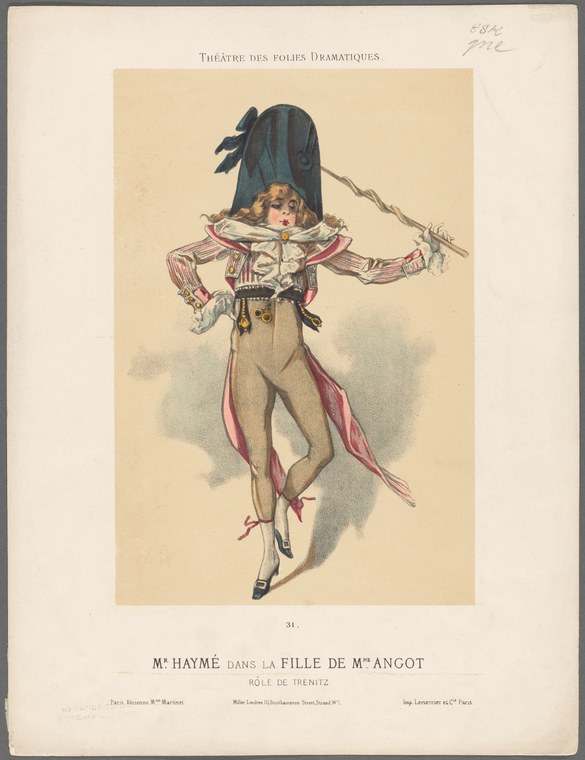
31. Mr. Haymé dans La fille de Mme. Angot, rôle de Trenitz, Théâtre des Folies Dramatiques
Unknown artist
- Collection:
- Prints depicting dance
- Source:
- New York Public Library
- Rights:
- Public domain — free to use, share and adapt.
- Recorded as:
- Public Domain
For a dancer or historian, this print offers a rare direct view of how a nineteenth-century comic opera performer actually moved and dressed—not an idealized stage scene, but a study of a specific body in a specific role. The costume detail, the prop, and the particular cant of the pose all carry information about the movement practices, comic timing, and social satire that defined opéra comique as a dance form. This work also documents the *travesti* tradition in European theater—a convention with real consequences for how gender, movement, and comedy were staged.
What you are looking at
A single female dancer dominates the composition, shown in a three-quarter pose against a pale ochre background. She wears an elaborate costume of the mid-nineteenth century: a black cylindrical hat topped with a large bow, a white chemise with voluminous puffed sleeves trimmed in red, and a beige skirt with red ribbon detail cascading asymmetrically. Her right arm is raised and extended outward in an expressive gesture; her left holds what appears to be a decorative stick or wand. Her posture is upright and proud, with her weight seemingly on one leg, creating a sense of movement and buoyancy. The figure is rendered in soft watercolor or similar medium, with subtle shading that gives dimension to the fabric and face. The spare setting—just the figure and background—suggests this is a theatrical portrait documenting a specific role or character rather than a scene from performance.
The dancing
The dancer is shown in profile-to-frontal view, her body arranged to display the costume fully while suggesting forward momentum. The raised arm creates an open, expansive upper frame; the opposite arm holds a prop—possibly a fan or bâton—close to the body. Her legs are not fully visible, but the tilt of her torso and the asymmetrical placement of weight hint at a demi-plié or similar suspension of weight mid-movement. The overall posture conveys elegance and a certain theatrical swagger rather than the formal verticality of academic ballet.
The dance depicted
This is a costume study for a character role in the opéra comique *La Fille de Mme Angot*, a popular French stage work of the mid-1800s. The inscription names the character as Trenitz and the performer as Mlle. Haymé. Trenitz appears to be a male role, likely played by a woman (a *travesti* or trouser role, common in comic opera). The costume—the hat, the bows, the stick—reads as character dress designed for theatrical comedy and social satire rather than as formal dance wear. The figure's pose and bearing suggest the movement vocabulary of opéra comique, which blends spoken dialogue, sung passages, and stylized social dancing. The image documents how this particular actress inhabited the role: poised, playful, and ready to move through the staged action.
How it was made
This is a hand-colored lithographic print, identifiable by its soft chromatic rendering and the way color sits on the surface. The base image was likely drawn on stone and printed in black line, then finished with watercolor or colored inks applied by hand or in separate passes. The technique allowed for rapid production of multiple copies—essential for theatrical documentation and promotion—while maintaining the delicacy of the drawn line and the specificity of the actress's likeness. The page carries publication marks at the bottom, indicating it was issued as part of a series documenting the performers and roles of the Théâtre des Folies Dramatiques.
About this work
This is a mid-nineteenth-century theatrical costume portrait: a hand-colored lithograph documenting the actress Mlle. Haymé in the character of Trenitz from the opéra comique *La Fille de Mme Angot*. It belongs to a category of popular prints that served simultaneously as playbills, souvenirs, and records of celebrated performers and celebrated roles. The work sits at the intersection of theatrical documentation and fashion illustration, preserving not just a dance vocabulary but the specificity of comic stagecraft as it was performed in Paris during the heyday of opéra comique. These prints were affordable, collectible, and circulated widely, making them primary evidence for how nineteenth-century audiences understood character, movement, and theatrical fashion.
How to look at it
Notice the composite pose: the raised arm and forward tilt create the illusion of movement frozen mid-stride, but the full-frontal display of the costume is carefully arranged for clarity. The artist has chosen the moment just before action—a theatrical pause that lets the audience absorb the character. The prop (stick or fan) is key: it marks this as a character who acts and moves through space, not a formal dancer in an attitude. The face, turned slightly toward the viewer with a hint of expression, reinforces that this is a portrait of a personality performing a role, not a abstracted study of movement.
The artist
The print is part of a series issued by the Théâtre des Folies Dramatiques. The artist is not recorded, but the lithographic technique and styling are consistent with commercial theatrical printing of the 1840s–1860s. These works were typically created by in-house theatrical printers or contract lithographers who worked quickly from costume sketches or live observation, prioritizing likeness and detail of dress over artistic signature.
The period
This image dates to the golden age of opéra comique in France, when works like *La Fille de Mme Angot* (first performed in 1872) drew enormous audiences and spawned waves of souvenir prints. Theatrical lithography was at its commercial peak; colored prints of singers and dancers in costume were cheap, desirable, and widely collected. The 1860s–1870s were also the period when ballet was gradually ceding dominance in French theater to opéra comique and *vaudeville*, forms that demanded more acting, more contemporary satire, and a different kind of physicality—less vertical, more mobile, more rooted in social dance and gesture. The costume here—modern dress, comic props, theatrical exaggeration—reflects that shift.
Where it lives
This print is held by the New York Public Library in its collection of prints depicting dance. It is numbered 31, suggesting it is one item in a numbered series, likely a complete or partial documentation of a season's performers at the Théâtre des Folies Dramatiques.
Dance in this work
Questions about this work
What is a travesti role?
A travesti (or trouser role) is a part written for a female singer or actor to play a male or masculine character, common in opéra comique and nineteenth-century comic theater. The convention allowed for comic business, satire of male behavior, and a different kind of movement vocabulary than traditional female roles. The costume here—the hat, the breeches, the swagger—signals that Trenitz is a travesti part.
What was opéra comique?
Opéra comique was a French theatrical form combining spoken dialogue, sung passages, and stylized movement—not necessarily comic, but lighter and more socially rooted than grand opera. Works like *La Fille de Mme Angot* were immensely popular in the nineteenth century, especially among middle-class audiences. The form demanded actors who could sing, speak, and move with fluidity through both social and theatrical spaces.
Why are costume prints like this historically important?
These prints are among the few direct records of how nineteenth-century performers actually looked and moved on stage. They document costume detail, prop use, and bodily posture with precision that written descriptions cannot match. For historians of dance, theater, and fashion, they are primary sources—evidence of what was actually performed, not what critics thought should have been performed.
More dance artwork





