49 works in this view — arrow keys or swipe to move between them.
Dance in Art
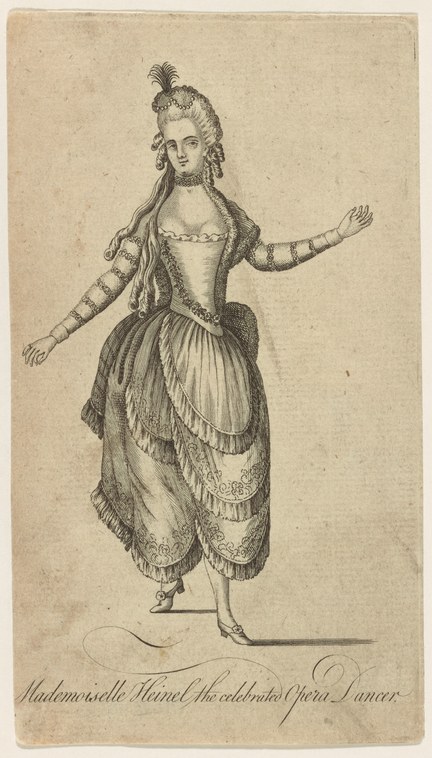
Mademoiselle Heinel, the celebrated opera dancer
Unknown artist
- Collection:
- Prints depicting dance
- Source:
- New York Public Library
- Rights:
- Public domain — free to use, share and adapt.
- Recorded as:
- Public Domain
This image is rare documentary evidence of how an celebrated 18th-century dancer actually presented herself on stage: the exact cut of the costume, the posture, the gesture, the objects of adornment. For dance historians, it is a visual archive of the balletic body before Romantic pointe work, showing the turned-out classical frame and the aristocratic port de bras that defined the noble style. It also records a woman named as a performer and professional, commodified and celebrated for her skill, in an era when women's agency in the public sphere was narrowly constrained.
What you are looking at
A single female dancer is shown in a three-quarter standing pose against a plain background, her weight lifted and balanced on one leg in an attitude of performance. She wears an elaborate costume of the mid-18th century: a fitted bodice with a plunging neckline and decorative trim, the torso partially exposed, paired with a voluminous skirt constructed in multiple layers of looped and draped fabric that creates a pronounced bustle silhouette. The skirt fabric appears gathered and caught up in swoops, a hallmark of the gallant dress of the period. Her left arm is raised and extended outward in an open, generous gesture; her right arm hangs at her side. Her hair is arranged high on her head with a distinctive feathered plume or ornament rising from the crown. She wears shoes with heels, appropriate to the dance of her era. The engraving technique renders her figure with fine parallel lines and cross-hatching that define musculature, drapery, and shadow.
The dancing
The dancer stands in a lifted, balletic frame with her working leg bent and raised, weight carried on the supporting leg in what appears to be a relevé or heel position. Her torso is upright and elegant, her shoulders held back. The raised left arm describes a graceful curve from shoulder to wrist, palm open and fingers extended—a gesture of display and invitation typical of the theatrical vocabulary of her moment. Her head is held at a slight angle, turned toward her raised arm, lending an air of coquetry and engagement with an imagined partner or audience.
The dance depicted
Mademoiselle Heinel was one of the most celebrated dancers of the late 18th century and is known to have performed across European stages. This engraving depicts her in the idiom of the serious or theatrical dance of the period, likely a movement from a ballet or opéra-comique in which she specialized. The costume and pose are consistent with the French noble style that dominated theatrical dance before the Romantic ballet revolution; the hiked skirt, the turned-out positions, and the arms' generous port all announce classical training in the balletic vocabulary of the ancien régime. The specific dance cannot be determined from the image alone, but the title's reference to her as 'the celebrated opera dancer' anchors this as a record of a real performer's professional identity.
How it was made
This is a line engraving, identifiable by the fine parallel hatching lines that model form and light. The technique allowed for precise rendering of decorative detail—the trimmed bodice, the pleats and gathers of the skirt, the feathered headdress—making it ideal for circulation as a souvenir or advertisement of a celebrated performer. Engravings of dancers were collected and distributed widely in the 18th century as prints, reaching a market of enthusiasts who could not attend the theatre; this format established the dancer as a public figure and the image as a commodity.
About this work
This is an 18th-century engraved portrait of a named professional dancer in her stage costume, frozen in a moment of balletic display. Mademoiselle Heinel appears in an attitude of easy command—poised, lifted, and dressed in the ornate theatrical style of the period just before Romantic ballet reformed the genre. The work is a print designed for distribution and collection, part of a visual economy that made star dancers into recognizable public figures and recorded the aesthetic conventions of their training and performance. It belongs in a history of dance portraiture and of the visual cultures surrounding professional theatre in the 18th century.
How to look at it
Attend to the dancer's posture and the direction of her gaze and gesture: she is not captured mid-movement but posed in a moment of stillness and presence, as if presenting herself to a viewer or courtier. Notice the costume's architecture—the way the skirt is constructed to frame and display the body, the exposed bodice that signals theatrical rather than court propriety. The engraver has chosen to render her in a three-quarter view that shows off both the gesture of the arm and the profile of the raised leg, a compositional choice that maximizes legibility of the dancing body. Her lifted weight and the turned-out position of her legs mark her as trained in the noble style, a visual grammar that an 18th-century viewer would have instantly recognized.
The period
In the mid-to-late 18th century, theatrical dance in France was dominated by the noble style—a dance descended from court manners and performed by trained professionals in operas, ballets, and comédies-ballets. Dancers like Heinel were among the first to achieve celebrity status and to have their images mass-produced and circulated as engravings. The 1760s–1780s saw the emergence of the balletmaster as author and the female dancer as a public star whose body was subject to critical description and visual representation. This image sits at the threshold of Romantic ballet; within a generation, the pointe shoe, the ethereal tutu, and the vocabulary of supernatural femininity would transform the dancer's body and its aesthetic presentation. Heinel's costume—the generous skirt, the exposed bodice, the heeled shoe—represents an earlier regime of theatricality in which the dancer's body was framed within the artifice of baroque ornamentation rather than the illusion of weightlessness.
Where it lives
This engraving is held in the New York Public Library's collection of prints depicting dance. It is an ephemeral object—a souvenir, advertisement, or record designed for collection and circulation, part of a broader visual economy of celebrity and theatrical culture in the late 18th century.
Dance in this work
Questions about this work
Who was Mademoiselle Heinel?
Mademoiselle Heinel was a celebrated professional dancer of the late 18th century, known for performing in operas and ballets across European stages. She was among the first generation of female dancers to achieve international celebrity and to have her image widely reproduced in prints. The title 'celebrated opera dancer' signals her status as a star performer of her era.
What style of dance is she performing?
She is posed in the noble or serious style that dominated theatrical dance in the mid-to-late 18th century before the Romantic era. The turned-out positions, the lifted carriage, and the port de bras (arm position) are all hallmarks of classical training in this vocabulary. Without additional context, the specific ballet or opera cannot be identified, but her costume and posture mark her as a professional trained in the aristocratic balletic tradition.
Why does her costume look so different from a ballet dancer's costume today?
This engraving predates the Romantic ballet revolution of the 1830s, which introduced the pointe shoe, the ethereal tutu, and an aesthetics of weightlessness. Heinel's costume—with its ornate bodice, voluminous looped skirt, and heeled shoe—belongs to the baroque theatrical tradition in which the dancer's body was framed within elaborate artifice rather than the illusion of supernatural ease. The hiked skirt was a practical choice that allowed her leg to be visible and admired, a convention of 18th-century theatre.
What does it mean that this is an engraving?
Engravings were the primary way that images of celebrities, including dancers, were circulated in the 18th century. This print was designed to be affordable, reproducible, and collectable—a souvenir for theatre enthusiasts and a form of advertisement for the dancer's fame. The medium allowed for precise rendering of costume detail and made the performer into a recognizable public figure across a broad geographic area.
More dance artwork





