49 works in this view — arrow keys or swipe to move between them.
Dance in Art
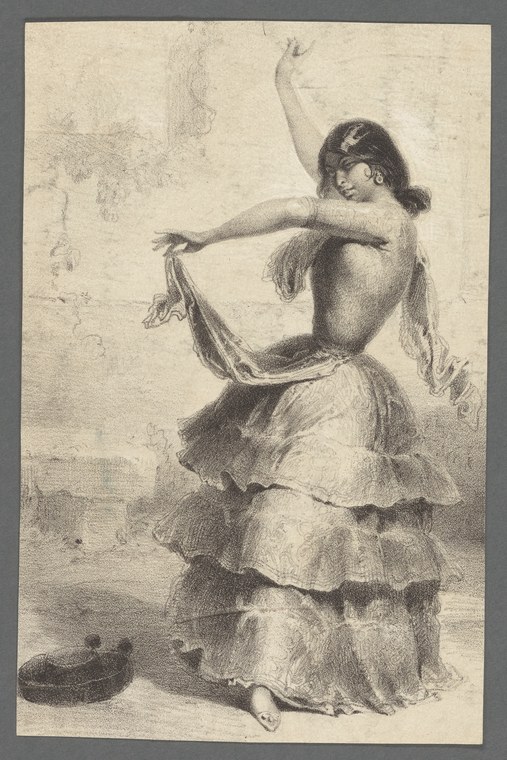
Female dancer, facing left, right arm raised
Unknown artist
- Collection:
- Prints depicting dance
- Source:
- New York Public Library
- Rights:
- Public domain — free to use, share and adapt.
- Recorded as:
- Public Domain
This engraving captures the neoclassical ideal of the female body in dance at a pivotal moment in ballet's history, when the form was being formalized and idealized. For dancers and historians, it demonstrates how the conventions of classical training—the quiet strength, the control of drapery, the expressive arm—were codified and disseminated through prints before photography made documentation instantaneous. The image also raises questions about attribution, gender, and the circulation of dance imagery in the print trade: countless dancers performed these roles, yet few names survive, while the prints themselves endured.
What you are looking at
A single female dancer is shown in profile, facing left, captured mid-movement in what appears to be a moment of lyrical expression. She wears a classical draped garment—a lightweight skirt or chiton—that falls from the hips and is gathered or belted at the waist, leaving her upper torso bare. Her dark hair is pulled back, and her body is angled in a graceful contrapposto stance. Her right arm is raised in an extended arc above her head, while her left arm hangs at her side, the hand holding or gesturing with a piece of fabric or drapery. The composition is spare: a neutral background with only subtle tonal variation suggests depth, and a small dark object—possibly a vessel or musical instrument—sits on the ground at her feet. The overall effect is one of classical restraint and refined movement, suggesting a moment of introspection or expressive pose rather than vigorous action.
The dancing
The dancer's weight is poised on one leg in a grounded stance; the other leg is visible but not bearing weight, suggesting a shift in balance or preparation for continued movement. The raised right arm traces an elegant arc overhead, with the hand open and fingers extended in a relaxed but purposeful gesture. The left arm, hanging lower, holds or releases drapery that echoes the folds of her skirt. The body's alignment and the ease of the pose suggest training in classical forms—the torso is controlled, the line from hip through the raised arm flows unbroken, and the head follows the direction of the gaze rather than twisting awkwardly.
The dance depicted
This appears to depict a classical or neoclassical female dancer, likely from the late 18th or 19th century, in a style influenced by ancient Greek or Roman imagery. The sparse costume, the expressive arm gesture, and the introspective quality suggest a romantic-era ballet aesthetic, possibly representing a soloist in a character role or a classical study. The barefoot stance and the drapery are consistent with the aesthetic vocabulary of early theatrical ballet, though the image could equally represent the classical revival styles popular in the 18th-century prints and engravings that emulated antique art. Without further documentation, a precise identification of the work or the dancer is not possible, but the iconography—the classical drape, the solitary figure, the raised arm—places it squarely within the tradition of idealized classical female dance.
How it was made
This is a black-and-white engraving or etching, rendered in fine lines and careful cross-hatching to model form and suggest texture. The technique creates a delicate balance between the figure and the background, with the tonal work concentrating attention on the dancer's body. Engravings of this type circulated widely in the 18th and 19th centuries, reaching educated audiences interested in the theatrical arts, classical aesthetics, and prints after paintings. The refined execution and the contemplative pose suggest this was created as a work of some standing—not a hasty sketch but a considered study intended for collection or reproduction. The medium also allowed for multiple impressions, making such works accessible beyond the wealthy patrons of unique paintings.
About this work
This engraving documents a moment in the visual culture of classical and romantic-era dance—a period when ballet was increasingly influenced by neoclassical aesthetics and the figure of the female dancer became an emblem of grace and refinement. The image belongs to a substantial tradition of dance engravings and prints, many produced without attribution, that served to circulate images of celebrated dancers and codify the ideals of the period's movement vocabulary. Such prints were often made after paintings or in response to celebrated performances, and they shaped how dance was understood and remembered by audiences who could not attend the theatre. The work's lack of attribution—common for engravings of this era—does not diminish its value as evidence of how the body in motion was conceptualized and rendered for public consumption.
How to look at it
Attend to the moment the artist chose to freeze: not a leap or a turn, but a moment of balance and repose, where the dancer's grace lies in the control of stillness and the eloquence of a single extended arm. This is a work about line and posture, not action. The engraver's use of line to suggest the fall of drapery and the ease of the body shows an understanding of how fabric and flesh move together. Notice how the raised arm and the pendant drapery echo each other—this visual rhyme is characteristic of neoclassical composition and suggests how the dancer's whole body, even the garment, was orchestrated as a unified statement of grace.
The period
This work belongs to the long tradition of dance engravings that flourished from the late 17th century onward, reaching a peak of popularity in the 18th and 19th centuries. In this period, theatrical dance—especially ballet—was increasingly viewed as a serious art form worthy of commemoration through high-quality prints. Engravings after paintings by celebrated dancers of the day, or studies of celebrated roles, were collected and circulated widely. The aesthetic of this particular image—the classical drape, the idealized pose, the introspective mood—aligns with the romantic ballet era (roughly 1830–1870) and its fascination with the ethereal, the classical, and the female body as a vehicle for expressing emotion and grace. The barefoot stance was still somewhat remarkable in the 18th century and became canonical for ballet only gradually; its presence here signals classical or neoclassical revival rather than contemporary fashion.
Where it lives
The work is held in the New York Public Library's collection of prints depicting dance. No artist is recorded in the catalogue; this reflects both the common practice of not crediting engravers and the loss of information over time for many prints in institutional collections.
Dance in this work
Questions about this work
How do I know this is an engraving and not a drawing?
The regular, fine parallel lines used to build tone and shadow are characteristic of line engraving or etching, techniques in which an image is incised into a metal plate and printed. A drawing would show more varied, loose linework and would be unique; an engraving could be printed many times. The precision and the formal finish also point to engraving rather than a sketch or study.
Is this dancer performing in a play or a ballet?
The image does not show enough context to say definitively. The classical costume and bare feet suggest ballet or a classical dance role, but engravers often drew on theatrical imagery broadly. What is clear is that this represents an idealized version of movement, not a realistic depiction of a specific performance.
Why is the dancer barefoot?
Bare feet were associated with classical and neoclassical aesthetics, evoking ancient Greek sculpture and the idealized human form. Dancers in the 18th and early 19th centuries performed in heeled shoes; the barefoot ideal was partly a fantasy of the prints and partly a visual code meaning 'classical' or 'noble.'
What is the object on the ground?
It is unclear from the image alone. It could be a vessel, a musical instrument (perhaps a lyre), or a theatrical prop. Its small scale and dark tone suggest it is meant as an attribute or symbol rather than a literal element of the scene.
More dance artwork





