49 works in this view — arrow keys or swipe to move between them.
Dance in Art
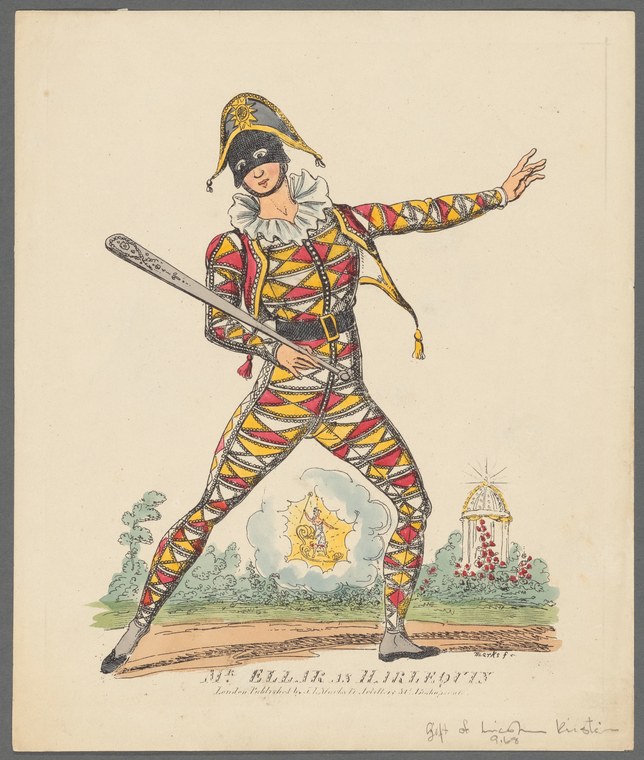
Mr. Ellar as Harlequin, London, published by J.L. Marks
Unknown artist
- Collection:
- Prints depicting dance
- Source:
- New York Public Library
- Rights:
- Public domain — free to use, share and adapt.
- Recorded as:
- Public Domain
This is direct evidence of how the Harlequin character was physically performed in the Georgian theatre—not a later romantic reconstruction or written description, but an image made to capture and sell the actual body language and athletic presentation of a named performer. Commedia dell'arte techniques shaped the development of theatrical dance across Europe, and prints like this are among the only visual records of how these characters actually moved.
What you are looking at
A theatrical figure in full Harlequin costume dominates the composition, posed in a dramatic lunging stance against a stylised theatrical backdrop. The performer wears the characteristic diamond-patterned suit in red, yellow, and black, with a white ruffled collar and a jester's cap topped with a golden star and trailing ribbons. One arm extends outward in an expansive gesture while the other holds a wooden bat or sceptre; the legs are splayed wide in a deep forward lunge that conveys both acrobatic capability and comic exaggeration. Behind the figure, a painted stage set shows a classical garden with a gazebo or pavilion on the right, stylised clouds, and distant architectural elements, establishing this as a theatrical scene. The colouring is hand-applied to what appears to be a printed base, with careful attention to the costume's striking pattern and the figure's animated pose.
The dancing
The single figure demonstrates exceptional physical control and extension. The forward leg is fully extended in a deep lunge while the back leg remains straight, suggesting significant flexibility and strength. The torso is upright and rotated, with the extended arm held at shoulder height in an open, welcoming gesture; the other arm grasps a wooden prop at roughly waist height. The pose is fundamentally asymmetrical and dynamic—frozen mid-movement rather than in repose. This is the body language of a trained performer comfortable with acrobatic display and exaggerated theatrical gesture.
The dance depicted
This depicts Harlequin (Arlecchino), the acrobatic servant character from the commedia dell'arte tradition that dominated European theatrical dance from the 16th through 18th centuries. The figure is identified by the catalogue as "Mr. Ellar as Harlequin," suggesting this is a portrait of a specific celebrated performer. Harlequin was danced and performed with considerable physical virtuosity—the character demanded acrobatic skill, wit, and physical comedy, often including tumbling, rapid footwork, and exaggerated gestural vocabulary. The pose shown here—a wide, controlled lunge with extended arm—captures the character's characteristic combination of athletic prowess and theatrical self-presentation.
How it was made
This is a hand-coloured engraving or aquatint, a reproductive print technique that allowed multiple copies to be produced and distributed. The fine line work defining the costume pattern, the figure's musculature, and the stage architecture is characteristic of engraving; the subtle tonal gradations in the clothing and background suggest aquatint or hand-applied watercolour wash. The publisher J. L. Marks was a London print publisher active in the 18th and early 19th centuries, indicating this was a commercial theatrical print—the kind distributed to audiences and collectors to commemorate celebrated performances and performers. Such prints were affordable and collectable, giving them wide circulation among theatergoers and dance enthusiasts.
About this work
This hand-coloured theatrical print documents a celebrated performance of the Harlequin character, likely from the late 18th or early 19th century, showing the acrobatic and gestural vocabulary that defined this crucial figure in European dance and theatre history. Harlequin prints were among the most popular theatrical imagery of their era, and this work preserves both the physical style of the character and the specific performance of an identifiable dancer. The print's commercial origin—a London publisher's product for a general theatrical audience—reflects Harlequin's position as popular entertainment, not yet codified as 'art' in the academic sense, but central to how theatre-going crowds understood physicality, comedy, and performance skill.
How to look at it
The artist has chosen the moment of greatest physical extension and theatrical display—the lunge catches the character mid-movement, at the point of maximum reach and openness, which reads as both vulnerable and triumphant. Notice how the pose is asymmetrical in every direction: the legs, the arms, the direction the face is turned. This is not a resting position but a frozen instant of athletic performance. The exaggerated width of the lunge and the precision of the line work in the costume pattern emphasise both the character's physicality and his theatrical self-consciousness—Harlequin is always performing, always aware of the audience's gaze.
The artist
The artist is not recorded in the catalogue. The print was published by J. L. Marks, a London print publisher and seller active during the 18th and early 19th centuries, whose business produced theatrical prints, portraits, and satirical engravings for the London market. The quality of the engraving and colouring suggests a skilled commercial workshop rather than a notable named artist; such theatrical prints were products of a collaborative trade rather than signed individual works.
The period
Harlequin was at the height of his theatrical popularity in Britain during the 18th century, when pantomime—a form that combined commedia dell'arte characters, music, acrobatics, and spectacular stage machinery—became the dominant form of theatrical entertainment. The character had migrated from the Italian travelling companies of earlier centuries into English pantomime, where he retained his mask, costume, and acrobatic vocabulary but acquired new narrative contexts and English comedic sensibilities. By the time this print was made, 'Harlequin' was so familiar to London audiences that individual celebrated performers could become stars in the role; prints depicting named actors in the costume were standard merchandise, sold at theatres and print shops alongside portraits of actors in dramatic roles.
Where it lives
Published by J. L. Marks, a London print merchant active in the late 18th and early 19th centuries. This is a commercial theatrical print, the kind sold to audiences and collectors as a souvenir of performance and as a portrait of a celebrated actor. It belongs to the NYPL's collection of prints depicting dance, a category that includes theatrical imagery, social dance documentation, and performance records.
Dance in this work
Questions about this work
Who was Mr. Ellar?
Ellar (also spelled Ellario or similar variants) was a celebrated Harlequin performer in London theatres during the late 18th or early 19th century. He was prominent enough that a commercial print publisher commissioned a portrait of him in the role. Beyond what this print tells us, specific biographical information about individual performers in this period is often sparse, as actors were not always documented in detail by theatrical historians of the time.
What is commedia dell'arte and why did it matter to dance?
Commedia dell'arte was a form of improvisational European theatre that developed in 16th-century Italy, using stock characters with codified costumes, masks, and physical vocabularies. Harlequin was one of these stock characters—a witty, acrobatic servant figure. The form spread across Europe and became foundational to pantomime and theatrical dance, introducing audiences to rapid footwork, exaggerated gesture, physical comedy, and acrobatic display as elements of performance. Many techniques in modern theatrical dance descend from commedia traditions.
Why is this figure wearing a mask?
Harlequin traditionally wore a half-mask (domino), which is visible here. The mask was part of the character's identity in commedia dell'arte tradition, allowing the performer to transform into the role while maintaining the character's visual recognisability across performances. By the 18th-century English pantomime, the mask was sometimes omitted or worn loosely, as this print suggests—the character was by then so well-known that the costume pattern and behaviour conveyed the identity more than the mask itself.
What is the wooden object the figure is holding?
This is likely a slapstick or wooden bat—a prop weapon that was part of Harlequin's standard equipment. It was used in physical comedy and mock combat with other characters, and could also serve as a cane or walking stick. The slapstick was both a literal prop and a symbolic attribute of the character's role as a mischievous, combative figure.
More dance artwork





