49 works in this view — arrow keys or swipe to move between them.
Dance in Art
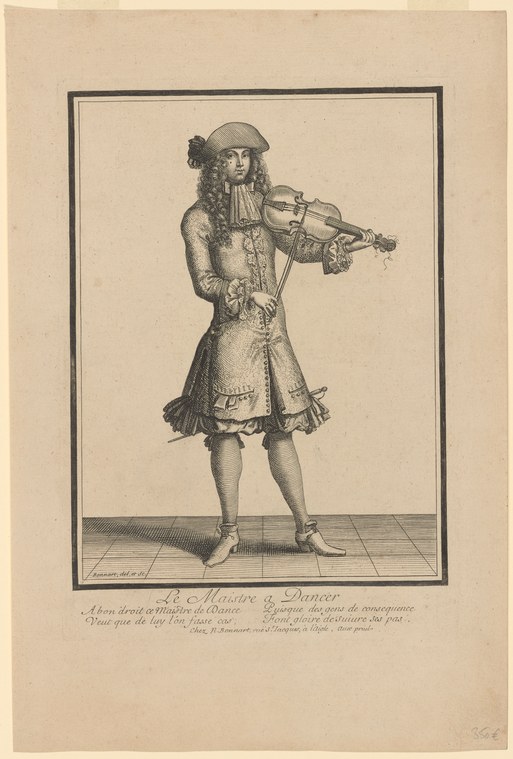
Le maistre a danser
Unknown artist
- Collection:
- Prints depicting dance
- Source:
- New York Public Library
- Rights:
- Public domain — free to use, share and adapt.
- Recorded as:
- Public Domain
The print preserves documentary evidence of the French dance master tradition at its height—a moment when dance instruction was a prestigious profession intimately linked to music and courtly authority. For dancers and historians, it shows how the ideal dance professional was represented and how printed images functioned as teaching tools, establishing physical and social norms that influenced dancing across Europe for generations.
What you are looking at
A single male dancer is portrayed in three-quarter stance against a plain background, holding a violin at playing position. He wears early 18th-century court dress: a long-skirted coat with ornate buttons and decorative trim, a white shirt with ruffled cravat, breeches, and heeled shoes. His hair is long and curled, topped with a small cap. The figure is centrally placed within a simple rectangular frame, posed as if captured mid-performance. The engraving employs fine parallel lines and cross-hatching to model the figure's form and fabric textures, creating a polished, formal presentation typical of instructional or documentary prints.
The dancing
The dancer stands in a composed, upright posture with weight distributed evenly. His right arm is raised to playing position, the violin held at chin height in the manner of a professional musician-dancer. The left arm hangs naturally at his side. His stance is open and frontal, with feet positioned in an easy, natural spread—not a turned-out balletic position. The overall bearing is that of a courtier or professional performer demonstrating mastery and refinement rather than executing a specific choreographed step.
The dance depicted
This is a master of dance (maître à danser) or dance instructor of the French court tradition, shown as both musician and teacher. The title and the figure's dual competence—violin in hand, formal dress, commanding posture—suggest this depicts someone of high rank in the 18th-century entertainment hierarchy. The inscription indicates this is didactic material, likely from a manual on courtly deportment or dance instruction. The style is consistent with the French baroque and early rococo periods, when dancing masters were often also musicians, and when published engravings of titled teachers served as authoritative references for the proper execution of genteel movement.
How it was made
This is a line engraving, identified by its clean, precise marks and the use of parallel hatching to build tone and shadow. The technique allowed for mass production and circulation as instructional material, making this type of print valuable for disseminating standards of courtly behavior and dance technique across Europe. Engravings of dance masters and their techniques were common teaching aids in the 17th and 18th centuries, distributed to aristocratic households and used by aspiring dancers and nobility learning proper deportment.
About this work
This engraving documents a French dance master of the early 18th century in formal court dress, combining the roles of instructor and musician. It represents a moment in European dance history when the teaching and performance of aristocratic dance required mastery of both movement and music, and when printed images were the primary medium for standardizing and transmitting technique. The work belongs to a substantial tradition of instructional dance prints that shaped the practice of ballroom and court dance across the continent.
How to look at it
Notice the dancer's composed stillness: he is not captured in violent motion but in a moment of readiness and authority. The engraver has chosen to show him as a teacher might present himself to students—frontal, clear, unambiguous. The violin in hand is not incidental; it declares his double competence. Pay attention to the precision of the costume details and the careful modeling of the body beneath the coat, which would have signaled to contemporary viewers the disciplined physical control expected of a man of his station.
The period
This work dates to the era when France dominated European taste in dance, music, and courtly behavior. The early 18th century saw the formalization and codification of baroque dance technique through published manuals and instructional engravings. Masters like Feuillet, Beauchamp, and Raoul-Auger Feuillet had recently systematized dance notation and published treatises that relied on engravings to illustrate proper stance, arm positions, and courtly decorum. The professional status of the dance master was at its height, bridging the roles of athlete, artist, musician, and social arbiter.
Where it lives
The work is held in the Prints collection at the New York Public Library as part of a broader series of dance-related engravings documenting European practice from the 16th through 18th centuries. Such prints were often bound into instructional volumes, pasted into albums, or distributed as individual sheets for reference.
Dance in this work
Questions about this work
What is a maître à danser and why are they shown with a violin?
A French dance master was a professional instructor in aristocratic dance and deportment, often of high social rank. Many were also accomplished musicians who played during lessons and performances. The violin shown here was a common instrument for dance accompaniment. Depicting the master with his instrument emphasized his dual mastery and the inseparability of dance and music in this tradition.
How was this print used?
Instructional engravings like this served multiple purposes: they were collected in printed manuals on dance and courtesy; pasted into private albums and pattern books; distributed to students as reference materials; and circulated among the nobility as authoritative representations of proper deportment. They functioned as the 18th-century equivalent of instructional photographs or videos.
What does the inscription tell us?
The inscription identifies this as a titled figure ('Le Maistre à Danser') and provides a brief poem or descriptive text in French. Such inscriptions were standard on instructional engravings and typically reinforced the authority and status of the figure depicted, or offered moral or practical advice to the reader.
More dance artwork





