49 works in this view — arrow keys or swipe to move between them.
Dance in Art
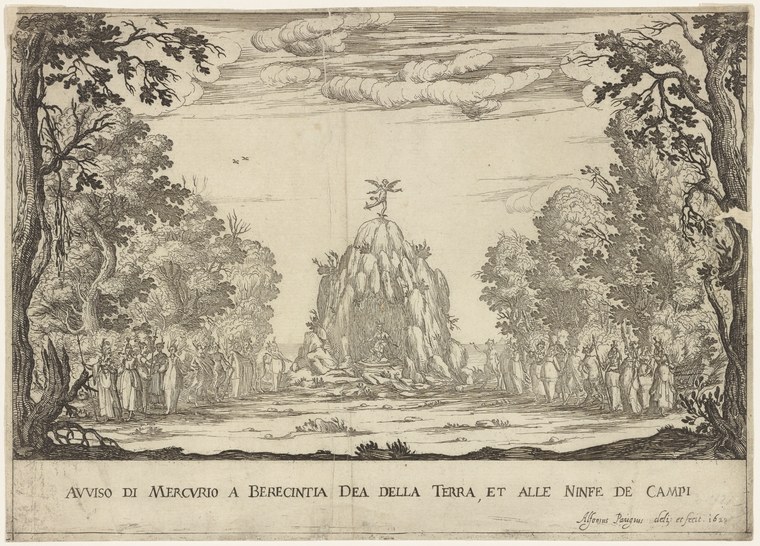
Avviso di Mercurio a Berecintia, dea della terra, et alle ninfe de campi
Unknown artist
- Collection:
- Prints depicting dance
- Source:
- New York Public Library
- Rights:
- Public domain — free to use, share and adapt.
- Recorded as:
- Public Domain
Early modern court spectacles integrated dance as a foundational element of power, ceremony, and political meaning. This engraving preserves evidence of how such events were conceived and circulated—as designed theatrical environments in which the formal arrangement of noble and allegorical figures created meaning through spatial composition. A historian of court dance will recognize here the conventions of the ballet de cour and the masque traditions in which dancing was inseparable from costume, landscape, and myth.
What you are looking at
A theatrical garden scene unfolds within a classical engraved frame. A rocky pinnacle or temple structure rises at center, crowned with spindly vegetation and occupied by standing figures. The landscape is densely wooded on both sides—tall trees with intricate foliage flank the scene—while the foreground opens into a broad plaza or meadow where a gathering of figures stands in loose formation. The sky above is rendered with parallel hatching to suggest cloud cover. The entire composition is bounded by a decorative border of trees and foliage, creating the effect of a garden theater or sacred grove. The engraving is dated 1633 in the cartouche at bottom.
The dancing
Approximately thirty to forty figures populate the scene, mostly arranged as standing or slowly moving forms distributed across the foreground plaza. Their stances are upright and formal rather than actively dancing; they appear to be in procession or ceremonial gathering. The figures nearest the viewer are rendered in some anatomical detail, though most at middle distance become schematic silhouettes. Dress appears classical or allegorical—long robes and simple drapery. There is no evidence of partnered dance hold, rapid footwork, or the dynamic spatial tension of active choreography.
The dance depicted
The title identifies this as an "Avviso" (notice or announcement) from Mercury to Berecintia, goddess of the earth, and to the nymphs of the fields. The scene appears to depict an allegorical or mythological gathering rather than a specific named dance. The formal arrangement of figures and the sacred setting suggest a ceremonial procession or an assembly of deities and attendants, which aligns with late Renaissance and early Baroque court spectacle traditions where dance, pageantry, and allegorical narrative were fused. Whether actual dance occurs is unclear from the image alone—the figures may be stationary or moving only ceremonially.
How it was made
This is an engraving, identifiable by the fine parallel hatching (cross-hatching and directional lines) used to model form, shadow, and texture throughout. The technique allows for fine detail in costume and landscape while maintaining a uniform tonal surface across the print, suitable for wide circulation. The date cartouche and formal border treatment suggest this was a published print, likely illustrative of a theatrical or literary work. Engravings of this type were often created to document or publicize court entertainments, pageants, or festival designs.
About this work
This is an engraved illustration of an allegorical assembly, dated 1633, in which mythological figures gather in a sacred landscape. Mercury delivers a message to Berecintia and the nymphs of the earth—a scene that sits at the intersection of theatrical design, court spectacle, and allegorical narrative. Though ostensibly about a divine communication, the densely populated and formally arranged composition suggests the visual language of Baroque court ballet and masque, where dance, pageantry, costume, and mythological narrative were interwoven into elaborate productions. The work belongs in a gallery of dance imagery because it documents how dance existed not as an isolated technique but as one element within a total theatrical vision.
How to look at it
Attend to the formal geometry of the composition: the way figures are distributed across the plaza, the centrality of the temple-like structure, and the framing wilderness. This is not a snapshot of active movement but a designed spatial arrangement. Notice the scale and dress of the central figures versus the distant crowd—a hierarchy of importance rendered through size. The engraver has chosen a stillness that nonetheless suggests procession and ceremony, capturing the theatrical moment before or after the climax of action rather than the action itself. The decorative border of trees positions the viewer as looking into a bounded stage.
The period
The date 1633 places this work in the mature phase of the Baroque court ballet tradition, particularly strong in France and Italy. The ballet de cour and its Italian equivalent reached their height in the early to mid-seventeenth century, combining intricate choreography, elaborate costumes, mythological narrative, and spectacular design. Engravings and etchings were primary means of documenting and promoting such events—they circulated among nobles, artists, and performers across Europe, spreading the aesthetic and conventions of court dance. The allegorical vocabulary here (Mercury as messenger, Berecintia as earth goddess, nymphs as attendants) was standard in these productions, which drew on classical texts and Renaissance neoclassical learning.
Where it lives
The work is held in the New York Public Library's Prints collection as a historical example of dance imagery. It is a published engraving, likely from a series documenting court entertainments or illustrating a literary or allegorical work. The cartouche attribution to Roma [?] and the date 1633 are inscribed on the print itself.
Dance in this work
Questions about this work
Is anyone actually dancing in this image?
Not visibly. The figures appear to be standing or moving in ceremonial procession rather than performing choreographed dance. However, this does not mean dance was absent from the event this engraving documents. Court spectacles of this era used engravings to show the designed space and allegorical narrative, not always to capture dynamic movement. The still arrangement may represent the moment of gathering before the dances began.
What is Berecintia?
Berecintia (also called Cybele or Magna Mater) was a classical goddess of the earth and fertility. Using her and Mercury together in an allegorical assembly was typical of Renaissance and Baroque court spectacle, which drew heavily on classical mythology to create elaborate narratives celebrating the ruling court or commemorating important events.
Why does this look like a stage set?
Because it probably is one. Many early prints of this kind were created from designs for court ballets, masques, or theatrical festivities. The rocky central structure, the framing trees, and the formal open plaza all suggest a theatrical stage or garden theater designed for a courtly entertainment. Engravings preserved and publicized these designs among the aristocratic and artistic circles who patronized such events.
More dance artwork





