28 works in this view — arrow keys or swipe to move between them.
Dance in Art · 2019
Dancers bowing before the minuet?
Unknown artist
- Medium:
- Engraving
- Dance:
- Minuet
- Era:
- 1700s (Enlightenment/Minuet Era)
- Source:
- New York Public Library
- Rights:
- Public domain — free to use, share and adapt.
- Recorded as:
- public_domain
This image is direct documentary evidence of how the minuet was actually positioned, framed, and socially deployed in the 1700s—not as described in text but as visualized by a printmaker working in the period. The presence of the musician, the attentive onlookers, and the formality of the spatial arrangement all illustrate that the minuet was a social performance, not merely a private exercise, and that its proper execution required both technical skill and embodied propriety.
What you are looking at
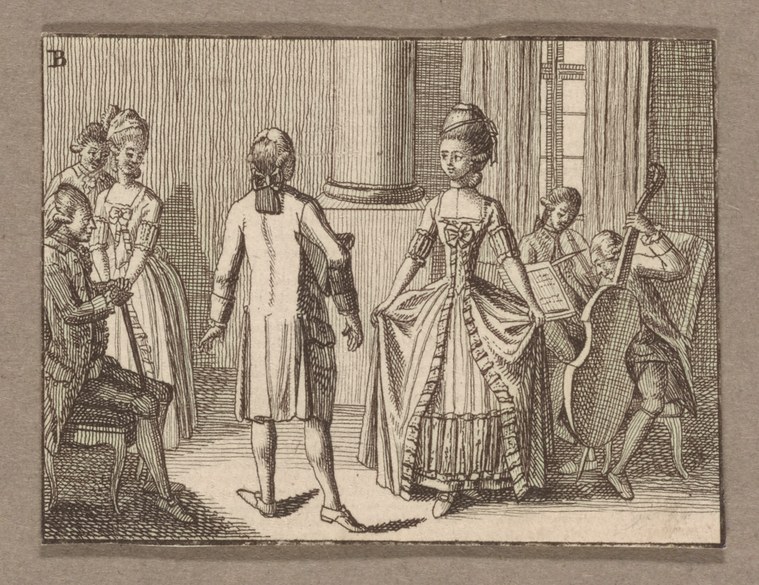
An engraving depicts an aristocratic interior scene of formal social dance instruction or performance in the 18th century. A gentleman in a pale coat stands in the center, viewed from behind, while a woman in an elaborate gown with voluminous skirts trimmed in ornate detail faces him in a poised stance. To the left, two women in court dress observe or wait their turn, one holding a small child. On the right, a musician plays a stringed instrument (likely a violin or cello) while a second figure, possibly another musician or attendant, stands nearby. The interior is defined by vertical paneling and architectural detail suggesting a aristocratic chamber or drawing room. The engraving employs fine hatching and linear mark-making typical of 18th-century reproductive printmaking, creating subtle gradations of light across fabrics and faces. The composition emphasizes formal posture and dignified distance between the figures, with the dancing pair positioned as the focal point of the gathered assembly.
The dancing
The male dancer stands in a formal upright posture, weight balanced, one arm extended in a gesture of address or invitation toward his partner. The female dancer faces him with her body held erect, one arm correspondingly positioned, her elaborate skirts arranged to display the fashionable silhouette. Both figures maintain an open frame with considerable space between them—characteristic of Baroque-era courtly dance. Neither figure displays the turned-out positions or the dynamic weight shifts that would characterize later balletic idiom. The stillness of both bodies suggests a moment of formal acknowledgment or the opening phrase of a movement sequence, rather than active traveling or turning.
The dance depicted
This engraving almost certainly depicts the minuet, the dominant social and courtly dance of the 18th century, most probably in a domestic instruction or formal reception setting. The minuet was performed by couples in succession, often as a display of grace and social accomplishment. The formal dress, the presence of a musician, the attentive onlookers, and the careful spatial relationship between the partners all conform to documented practice of minuet performance in aristocratic circles. The moment captured—a formal stance with arms positioned in address—represents the opening or a key structural moment of the dance, not its traveling or turning phrases. The engraving documents the dance as a vehicle for courtship, rank display, and the embodiment of Enlightenment ideals of refinement and bodily control.
How it was made
This is an engraving, a technique that involves incising lines into a metal plate (typically copper) which are then inked and printed. The fine parallel hatching visible throughout—defining shadow, fabric texture, and architectural space—is characteristic of engraving rather than etching. The technique permitted high-quality reproduction and wide circulation, making such prints valuable documents of dance practice and fashion for scholars and the fashionable public alike. The precision and finish of the line work suggests this is a finished reproductive print, likely published as part of a series or instructional manual on courtly deportment and dance.
About this work
This 18th-century engraving documents the minuet at the moment of formal greeting between two aristocratic dancers. It is a visual record of how the minuet was understood and performed in polite society—not as a vigorous traveling dance but as a structured sequence of formal addresses and measured movements, performed under observation and accompanied by a live musician. The print preserves the aesthetics, dress codes, spatial relationships, and social choreography of a dance that was central to Enlightenment courtly life and that structured interaction between men and women of rank. As a reproductive engraving, it also documents 18th-century print culture and the appetite for images of fashionable behavior among an educated, affluent audience.
How to look at it
Observe the stillness and formality of both bodies. Neither figure is captured in mid-motion; instead, the printmaker has chosen a moment of formal address and acknowledgment. Notice how space is maintained between the partners—this is not a close hold but rather an open, frontal relationship mediated by gesture and the extension of the arm. The presence of the musician on the right is crucial: the minuet was always accompanied, always performed for an audience, and always embedded in social ritual. Look at the dress, particularly the woman's gown: the elaborate trim and voluminous skirts were themselves part of the dance, requiring skill to manage and move gracefully. The composed, almost tableau-like quality of the image reflects the minuet's character as a dance of formal display rather than improvisation or virtuosity.
The period
The minuet dominated European aristocratic social dance from the early 18th century through the 1780s. It originated in the French court and spread across Europe as the primary dance of formal social occasions and private assemblies. During the Enlightenment, dance was understood as a physical expression of refinement, emotional restraint, and social order. Treatises on dancing—by Raoul-Auger Feuillet, Pierre Rameau, and others—codified minuet technique into precise, repeatable sequences that could be transmitted and taught. Engravings like this one served both as records of fashionable practice and as instructional aids, circulating among the aristocracy and the aspiring bourgeoisie. The minuet was also the backdrop for courtship and marriage negotiation; its formal structure and required proximity between man and woman made it a socially sanctioned context for intimate encounter.
Where it lives
The work is held in the New York Public Library collection. It is catalogued as an 18th-century engraving, consistent with the style and technique visible in the print itself. No artist, publisher, or specific date is currently recorded.
Dance in this work
Questions about this work
What is happening in this image?
Two aristocratic figures are performing or demonstrating the minuet, the most prestigious social dance of the 18th century. A musician plays to accompany them, while other members of the household observe. The moment captured is likely the formal opening of the dance, in which the partners acknowledge each other with gesture and posture before traveling into the measured phrases and turns that constitute the full minuet.
How do I know this is a minuet and not another 18th-century dance?
The catalogue record identifies it as such, and the visual evidence supports this: the formal dress, the careful distance between partners, the open frame, the presence of an attending musician, and the moment of formal address all conform to documented minuet practice. The minuet was the dominant courtly dance of this era, and any formal dance scene of this period in an aristocratic interior most likely depicts it.
Why are there other people watching?
The minuet was always a social spectacle, not a private activity. In aristocratic households, dance was a public performance within a semi-public domestic space. Servants, family members, musicians, and guests would gather to watch skilled dancers perform. This was how courtship proceeded, how rank was displayed, and how refined behavior was learned and evaluated.
Is this an instructional document?
Very likely. Engravings of dance were produced both as fashionable prints for display and as instructional aids. They circulated among aristocratic and bourgeois households as references for how to perform correctly. The clarity of the figures and the didactic composition—showing posture, arm position, and the spatial relationship between partners—all suggest an instructional purpose.
More Minuet artwork