49 works in this view — arrow keys or swipe to move between them.
Dance in Art
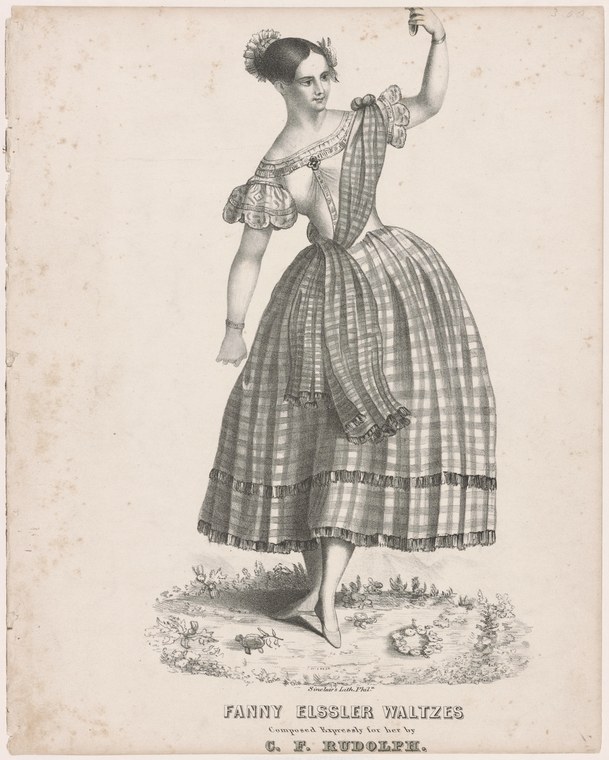
Fanny Elssler waltzes composed expressly for her by C. F. Rudolph
Unknown artist
- Collection:
- Prints depicting dance
- Source:
- New York Public Library
- Rights:
- Public domain — free to use, share and adapt.
- Recorded as:
- Public Domain
Fanny Elssler was one of the defining figures of Romantic ballet, and images of her are primary historical evidence for how the era's finest technique and most celebrated roles were actually performed. This print captures her in a pose and costume that became iconic, offering visual proof of the aesthetic and technical values of her era.
What you are looking at
A young woman stands alone against a plain background, posed in a moment of balletic grace. She wears a checkered plaid dress in two tones—the bodice fitted and off-shoulder, the skirt voluminous and gathered to mid-calf, with decorative pleating at the hem. Her left arm is raised overhead in an elegant line, her right arm extended at shoulder height, and she stands en demi-pointe or with weight lifted through her feet. Her posture is upright and composed, her gaze directed away from the viewer. Below her feet is a thin scenic line suggesting stage ground, scattered with what may be flowers or decorative elements. The engraving is finely detailed, with careful attention to the play of light across the fabric and the delicate proportions of the figure. The woman's hair is styled in the fashion of the mid-nineteenth century, gathered up with decorative combs or feathers.
The dancing
A single female dancer is depicted in an extended balletic pose with weight balanced high and centered. Her raised left arm and extended right arm frame an open, lifted frame typical of Romantic-era ballet technique. The body shows the elongation and verticality valued in theatrical ballet of this period. No male partner is present; the figure is isolated and self-contained. The positioning suggests a moment of suspension or between-phrase balance rather than dynamic traveling or turning.
The dance depicted
This is a Romantic-era theatrical ballet image, almost certainly depicting a stylized portrait of the celebrated dancer Fanny Elssler, who was one of the most famous ballerinas of the 1830s and 1840s. The title refers to waltzes composed for her by C. F. Rudolph, suggesting this may document a specific choreographic work or series. Elssler was known for both classical ballet technique and the inclusion of character dances and national idioms in her performances. The checkered plaid dress points toward her celebrated roles in works with folk or character themes, such as *La Cachucha* or other divertissements that became her signature. The pose itself is balletic but unhurried—a moment for the dancer to be admired, not a captured split-second of action.
How it was made
This is a wood or steel engraving, likely hand-colored or tinted after printing, evidenced by the fine line work, the subtle gradation of tone, and the crisp detail in the dress pattern and facial features. The technique allows for precise rendering of the fabric's texture and the dancer's delicate proportions. Such prints were produced in considerable numbers for a middle-class audience and circulated as sheet music covers, souvenirs of performances, or standalone fashion and theatrical prints. The inscription at the bottom indicates this served a dual purpose as a commercial music cover.
About this work
This is a mid-nineteenth-century theatrical print commemorating Fanny Elssler, one of Romantic ballet's most celebrated performers. The engraving documents her costume and pose in works composed for her by the musician Rudolph—likely the waltzes named in the title. As a commercial print, it reveals how Romantic-era dancers were marketed to the public: isolated, elegantly posed, and presented in the spectacular costumes that were central to their fame. The work sits at the intersection of theatre history, dance practice, and popular print culture of the 1830s–1840s.
How to look at it
Look at the pose: this is not a moment of dynamic action but an attitude or extended pose that displays the line of the body and the ornament of the dress. The dancer's weight is lifted, not pressing into the ground—a key principle of Romantic-era technique. Notice how the checkered plaid dress is rendered: the pattern creates a sense of volume and movement even though the figure is still. The engraving technique's fine lines allow the viewer to read both the geometry of the pose and the softness of the fabric. This is a portrait of a star in her moment of professional display.
The artist
The engraver is not recorded in the catalogue. The print was published in the context of mid-nineteenth-century European theatrical print production, when celebrated dancers' images were mass-produced and sold to fans. The style and execution suggest a professional theatrical printmaker, likely working in Paris or London, the centers of Romantic ballet culture.
The period
This print dates to the height of the Romantic ballet era (c. 1830–1850), when ballet underwent a profound transformation toward ethereal, supernatural themes and a new emphasis on the ballerina as the central figure. Fanny Elssler rose to fame in this context and was rivals with Marie Taglioni as the era's two supreme dancers. While Taglioni embodied the aerial, otherworldly aesthetic associated with works like *La Sylphide*, Elssler brought dramatic presence, technical brilliance, and a celebrated ability to perform character dances—Spanish, Italian, Hungarian forms—within the classical ballet vocabulary. The waltz itself was one of the most fashionable dances of the period, danced in ballrooms and increasingly incorporated into theatrical works. This print reflects both the cult of celebrity surrounding major dancers and the theatrical interest in national and character dances that gave Romantic ballet much of its appeal.
Where it lives
The print is held in the Prints depicting dance collection at the New York Public Library. It is a commercial theatrical print, likely sold at the time of performances or as a souvenir to admirers of the dancer.
Dance in this work
Questions about this work
Who was Fanny Elssler?
Fanny Elssler (1810–1884) was an Austrian prima ballerina who dominated the European stage in the 1830s and 1840s. She was known for her technical facility, dramatic presence, and especially for her performance of character dances—Spanish, Italian, and Hungarian forms—which she incorporated into classical ballet. She was one of the two most celebrated dancers of the Romantic era, rivaling Marie Taglioni.
What is the checkered dress?
The plaid or checkered dress reflects Elssler's famous roles in character ballets and divertissements, particularly her signature role in *La Cachucha*, a Spanish-themed dance. Such folk or national costumes were central to her repertoire and her fame, distinguishing her from other ballerinas who focused on purely classical roles.
What does the title mean—'composed expressly for her by C. F. Rudolph'?
The title indicates that these waltzes were created as vehicles for Elssler, likely as part of a ballet or as standalone pieces performed during her career. C. F. Rudolph was a composer-musician of the period. Such custom compositions were a mark of a star dancer's status.
Why was this print made?
During the Romantic era, prints of celebrated dancers were produced and sold widely to the public as souvenirs and works of art. Often they served as covers for sheet music or were bought independently by admirers. This one appears to be a music cover, documenting both Elssler's image and the works composed for her.
More dance artwork





