49 works in this view — arrow keys or swipe to move between them.
Dance in Art · 2023
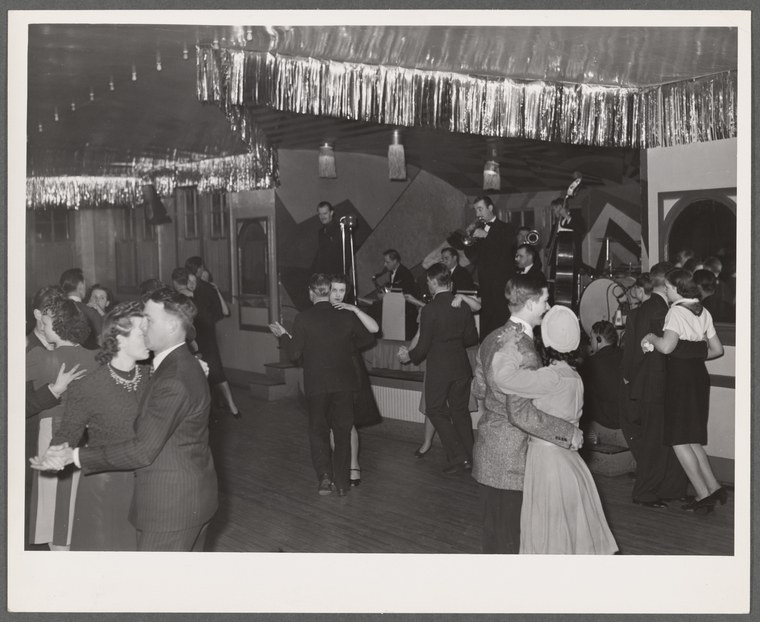
Dance hall, Saturday night. Marshalltown, Iowa
Unknown artist
- Medium:
- Source:
- New York Public Library
- Rights:
- Public domain — free to use, share and adapt.
- Recorded as:
- public_domain
This photograph preserves evidence of social ballroom dancing at a moment when it was the dominant form of public entertainment and courtship ritual in small-town America. It shows dance not as performance or technique but as lived social practice, offering historians and dancers alike a rare visual record of how ordinary people moved together. The specificity of place and time makes it valuable documentation of a cultural world that has been largely replaced by other forms of entertainment and courtship.
What you are looking at
A crowded dance hall filled with couples and groups moving across a wooden floor. The space is decorated overhead with what appears to be streamers or garland strung in long vertical lines, creating a festive atmosphere. The lighting is relatively even, likely from overhead sources typical of a public dance venue. Men in dark suits and women in dresses and coats occupy the floor; some couples are clearly dancing while others stand conversing or watching. The photograph captures a moment of social animation—the kind of Saturday night public dance that was central to small-town American social life in the mid-twentieth century. The composition is crowded and naturalistic, with no formal arrangement of the dancers; they occupy the space as they would have in real time, creating an authentic snapshot of the event.
The dancing
The bodies are in varied attitudes: some couples hold each other in closed dance position, though the exact frame is difficult to determine from this distance and angle; others stand separately or in loose groupings. The women wear coats, dresses, and hats; the men wear suits and ties. No pointe shoes, no obvious theatrical costume, no formal ballroom frame is clearly visible. The dancers appear relaxed and social rather than performing or executing formal technique. Weight is distributed naturally, and the overall impression is of social rather than competitive or staged dancing.
The dance depicted
This is social ballroom dancing—the kind of partner dancing that filled American dance halls, particularly in small towns like Marshalltown, Iowa. The specific style cannot be determined with certainty from the image; it could be a waltz, fox trot, two-step, or another standard ballroom form of the era. The setting and dress suggest mid-twentieth-century American social dance culture. What matters is not the refinement of technique but the democratic social function: men and women of the community gathering on Saturday night for music, movement, and courtship or companionship. The photograph documents a cultural practice that has largely vanished.
How it was made
This is a black-and-white photograph, likely taken with a handheld or semi-portable camera given the naturalistic framing and slight graininess. The print quality and composition suggest documentary or journalistic photography rather than posed studio work. The even exposure and ability to capture detail across a crowded interior space indicates film stock and lighting suitable for public indoor venues, a technology well-established by the mid-twentieth century. The photograph was likely made during the event itself rather than staged afterward, capturing spontaneous movement and genuine social interaction.
About this work
This is documentary evidence of American social dance as a community ritual. The photograph preserves a specific moment and place—a Saturday night in Marshalltown, Iowa—but it represents a widespread practice that defined social life for millions of Americans. The image shows ballroom dancing not as an art form or competitive sport but as the ordinary language through which strangers became acquainted, couples courted, and communities gathered. It belongs in a dance gallery because it documents a major form of human movement that shaped American culture and identity, and because the photograph itself is a primary source for understanding how people actually danced in their daily lives rather than on stage.
How to look at it
Observe the mixed energy of the hall: some couples are actively dancing, others talking, others watching. Notice the formal dress—suits, ties, coats, hats—which marks this as respectable public entertainment rather than informal recreation. The overhead decoration signals the intentional creation of a special space for the event. Look at how the couples relate to each other: some are in close hold, others at arm's length, reflecting both the formality of the era and individual preference. The photograph's distance and crowd composition prevent clear analysis of footwork or frame, which is itself significant—it shows us the social context of dance rather than the dance technique itself.
The period
The photograph dates from the early-to-mid twentieth century, when public dance halls were central institutions in American social life. The Saturday night dance hall was a standard feature of small towns and cities across the country, offering affordable, respectable public entertainment and a space where young people could meet under community supervision. Ballroom dancing was not yet professionalized or media-driven; it was a participatory social practice that required no special training or expense beyond the price of entry. By the time this photograph was taken, jazz and swing influences were beginning to transform American social dance, though the formal ballroom frame remained dominant. The photograph documents this culture on the eve of major changes brought by postwar suburban development, the rise of automobile culture, and eventually television and recorded music as primary entertainment.
Where it lives
This print is housed in the New York Public Library's collections and was contributed to LODance from their holdings. It appears to be part of documentary or local history photography collections, though the specific series, photographer, and accession details are not recorded in the available catalogue information.
Dance in this work
Questions about this work
What kind of dancing is this?
This is social ballroom dancing—partner dancing in closed or semi-closed hold, likely a waltz, foxtrot, or two-step. The specific style cannot be determined from the photograph, and that ambiguity is itself historically accurate: most dancers learned these forms informally and danced multiple styles in a single evening. What matters is that it was the standard social dance of mid-twentieth-century America.
Why is everyone dressed so formally?
In the early-to-mid twentieth century, public dance halls were respectable venues that required formal dress as a condition of entry. This was not casual recreation but a sanctioned community social event. The formality of dress reflected and reinforced the formality of the dancing itself and signaled that behavior would be orderly and moral.
What are the decorations overhead?
The vertical streamers or garland strung across the ceiling are festive decoration, typical of dance hall decoration of the era. They marked the space as set apart for celebration and special social occasion, distinguishing the dance hall from ordinary public buildings.
Would people have taken lessons to dance like this?
Some would have; dance schools existed and offered instruction in ballroom forms. But many learned informally from family, friends, or simply by participating in dance halls regularly. The forms were sufficiently standardized that people could pick them up through imitation and practice, making social dancing accessible across class lines.
More dance artwork