49 works in this view — arrow keys or swipe to move between them.
Dance in Art
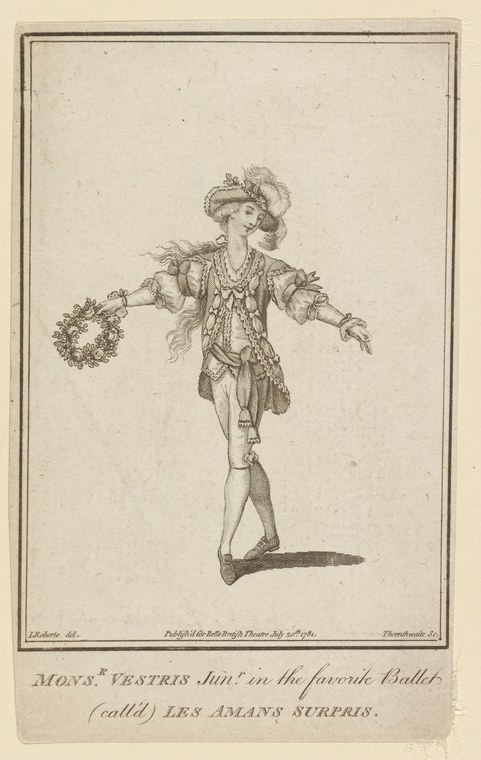
Monsr. Vestris Junr. in the favorite ballet (call'd) Les amans surpris
Unknown artist
- Collection:
- Prints depicting dance
- Source:
- New York Public Library
- Rights:
- Public domain — free to use, share and adapt.
- Recorded as:
- Public Domain
The Vestris family were the superstars of 18th-century dance, and Gaëtan Vestris in particular was celebrated across Europe as a dancer of extraordinary technical facility and presence. This print is evidence of how dance was circulated and remembered in the pre-photographic era—through prints that commemorated celebrated performers in signature roles. For historians of dance, such prints are among the few detailed visual records of how professional dancers actually looked and moved during this period.
What you are looking at
A single male dancer in elegant 18th-century court dress occupies the center of the composition, posed in a moment of animated performance. He wears a richly decorated coat with ornate embroidery, knee breeches, and heeled shoes appropriate to the period. His left arm extends outward holding what appears to be a wreath or garland of flowers; his right arm gestures expressively across his body. His posture is buoyant and elevated, with his weight appearing to lift through the torso and legs in a way that suggests he has either just left the ground or is poised to do so. The figure is set against a plain background within a simple rectangular border, rendered in a fine engraved line. The artist has captured a moment of theatrical display rather than a static pose—the dancer's body angles slightly forward and his legs are positioned to suggest movement or a jump, while the wreath-bearing gesture suggests he is presenting or displaying something to an unseen audience. The print is finely detailed, with careful attention to the textures of fabric and the articulation of the limbs.
The dancing
A single dancer positioned in an attitude of elevation and display. His weight is lifted through a well-articulated frame; the left leg appears to extend or lift while the right provides support, creating an impression of airiness and control. Both arms are active and gesturing—the left held high and extended with the wreath, the right crossing his body at approximately chest height with an open, expressive hand. His torso is lifted and slightly angled, suggesting the kind of épaulement (rotation from the shoulders) characteristic of trained court dancers. The head is held up and turned toward the raised arm, following the line of the gesture. Everything in the carriage suggests training and technical facility.
The dance depicted
This is almost certainly a dancer from the Parisian stage in the mid-to-late 18th century, identified by the caption as 'Monsr. Vestris Junr.' (most likely Gaëtan Vestris or a member of the Vestris family, who dominated European dance of this period). The print documents his appearance in a ballet titled 'Les Amans Surpris' (The Surprised Lovers). The pose and costume are consistent with theatrical ballet as practiced in the French court and opera house tradition—a style emphasizing turned-out legs, lifted carriage, graceful arm positions, and the display of technical accomplishment. The wreath he carries is a common attribute in 18th-century ballet, often associated with celebratory or romantic scenes. The extreme refinement of his dress and the formal presentation suggest this was a principal dancer role in a significant theatrical production, likely a divertissement or independent ballet piece performed at the Opéra.
How it was made
This is an engraving, likely produced by reproductive engraving from a drawn or painted design. The fine, consistent line work and the careful use of parallel lines (hatching) to create tone and modeling are characteristic of 18th-century printmaking. The inscription at the base—giving the dancer's name, the ballet title, and what appear to be artist's or publisher's marks—indicates this was a commercial print produced for a theater-going public. The skill of the engraver in rendering the textures of embroidered fabric, the anatomical articulation of the figure, and the subtle modeling of the face and limbs suggests this was a work intended for a cultivated audience. As a print, this object would have circulated among dancers, patrons, and the theater-literate public, functioning as documentation of a celebrated performer and as a souvenir or advertisement for the ballet.
About this work
This engraving documents a celebrated moment in 18th-century theatrical dance: a principal male dancer from the Parisian stage, identified as a member of the Vestris family (the most prestigious dance dynasty of the era), captured mid-performance in the ballet 'Les Amans Surpris.' The work is a primary document of the appearance, costume, and physical technique of late Baroque theatrical ballet, showing the refined, turned-out aesthetic and the emphasis on graceful arm movement and lifted carriage that defined the genre. The print represents both the art of dance itself and the art of engraving used to publicize and memorialize celebrated dancers and their roles.
How to look at it
Pay attention to the dancer's relationship to the ground: his weight is clearly lifted, and the positioning of his legs suggests the moment after a jump or the height of an elevation. Notice how his arms work expressively—the raised arm holding the wreath creates a diagonal line that draws the eye upward, while the lower arm provides balance and counterpoint. The fineness of the line work in the engraving is itself worth studying; the artist has rendered every fold of fabric and every articulation of the figure with care, suggesting this was a work meant to celebrate not just the dancer's fame but the skill of both performer and printmaker. The formal border and the inscription below anchor this image firmly in the tradition of commemorative theatrical prints.
The period
This engraving dates to the mid-to-late 18th century, when theatrical ballet was consolidating as an independent art form, distinct from opera and court entertainment. The Vestris family dominated European dance during this period; Gaëtan Vestris (1729–1808), known as 'le dieu de la danse' (the god of dance), was the most celebrated male dancer of his age and worked for decades at the Paris Opéra and other major European theaters. The aesthetic shown here—the elevated carriage, the turned-out legs, the emphasis on graceful arm movement, the rich theatrical costume—represents the height of the Baroque and emerging Classical style in dance. Prints like this one served both as souvenirs for theater patrons and as documentation of celebrated performers and roles, circulating among dancers and aficionados.
Where it lives
This is a print from the New York Public Library's collection of dance-related prints, part of their broader holdings documenting the history of performance. The print is catalogued under 'Prints depicting dance,' a section that includes theatrical ephemera and documentation of celebrated performers and productions from the 17th century onward.
Dance in this work
Questions about this work
Who was Vestris Junr.?
Vestris Junr. (the younger) likely refers to Gaëtan Vestris (1729–1808), a member of the legendary Vestris family and the most celebrated male dancer of the 18th century. The Vestris family was virtually synonymous with excellence in European dance for much of the 1700s and early 1800s. Gaëtan was known for his extraordinary technical facility, his elevation, and his powerful stage presence; he was celebrated across Europe and commanded enormous fees.
What is 'Les Amans Surpris'?
This ballet (The Surprised Lovers) is not well documented in surviving records, but such works were typically short divertissements or independent ballets performed as part of an evening's entertainment at the opera house. The title suggests a comedic or romantic scenario—a common theme in 18th-century ballet. The wreath Vestris carries is consistent with celebratory or romantic themes of the period.
What do the clothes tell us about 18th-century dance?
The elaborate embroidered coat, knee breeches, heeled shoes, and careful grooming show that male dancers in this era were gentlemen performers—or at least dressed and presented as such. The heeled shoes provided both aesthetic line and practical support for the specific technique of the period. The overall richness of costume indicates this was a high-status role and that dancers of this caliber were celebrities commanding significant resources.
How do we know this is really Vestris?
The inscription on the print states 'Monsr. Vestris Junr. in the favorite Ballet (call'd) Les Amans Surpris,' identifying the dancer and the ballet. Without additional archival sources, we cannot independently verify that this print accurately depicts him, but it was clearly sold or distributed as a representation of a celebrated performer in a known role.
More dance artwork





