49 works in this view — arrow keys or swipe to move between them.
Dance in Art
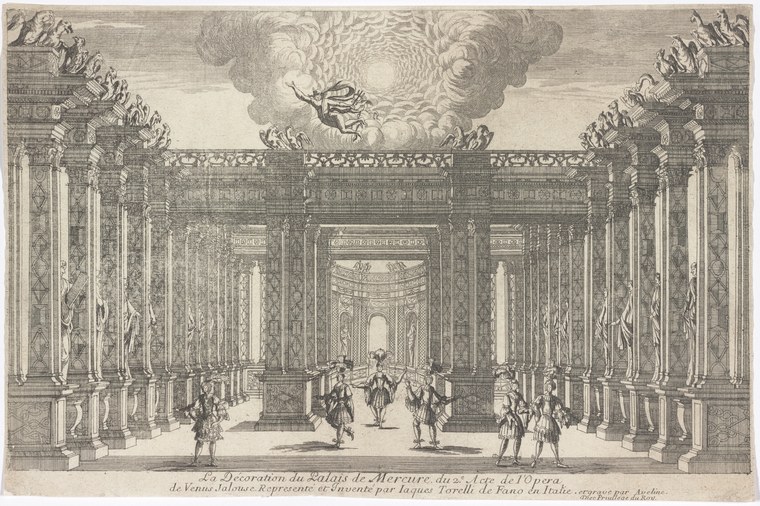
La Décoration du Palais de Mercure du 2e Acte de l'Opera de Venus Jalouse
Unknown artist
- Collection:
- Prints depicting dance
- Source:
- New York Public Library
- Rights:
- Public domain — free to use, share and adapt.
- Recorded as:
- Public Domain
This is a rare documented record of a specific baroque opera scene, preserving not only the costume and setting of court dance but also the compositional logic of theatrical spectacle at the height of the baroque period. For historians of stage design, opera, and courtly dance practice, such prints are primary evidence of how productions were conceived and marketed. The engraving demonstrates the symbiotic relationship between architecture, decoration, and choreography in baroque theater.
What you are looking at
This is an engraved design for a grand palatial interior, identified in the French inscription as the decoration of the Palace of Mercury from Act II of the opera *Venus Jalouse*. The space is a vast hall defined by paired columns in classical orders, receding in perspective toward a distant doorway. The columns are fluted and rise to ornate capitals supporting an elaborate entablature. Between the columns hang rich draperies or tapestries. The floor is a geometric pattern of stone or marble. In the foreground and middle distance, seven figures in 17th-century court dress are scattered across the floor—men in breeches, coats, and feathered hats, and at least one figure in a full skirt. They are positioned as if in movement or interaction, though the print's distance and small scale make specific gestures difficult to discern with certainty. Above, in the sky beyond the colonnade, billowing clouds part to frame a dramatic heraldic or allegorical emblem. The entire composition is rendered in fine line engraving, with careful attention to architectural perspective and decorative detail.
The dancing
The figures are dispersed across the space rather than grouped tightly, suggesting either processional movement or a formal ensemble arrangement typical of court spectacle. The postures appear upright and formal, with what seems to be minimal dramatic gesture—this is a scene of courtly presentation rather than virtuosic movement. The distance of the viewpoint and scale of the engraving make it difficult to discern footwork, arm positions, or the precise nature of any hold between figures. The dress is exclusively aristocratic court costume of the period, suggesting these are courtiers or professional performers in an elite context rather than folk or vernacular dancers.
The dance depicted
This appears to depict a scene from a baroque court opera or ballet spectacle, likely involving processional movement, formal groupings, or the kind of courtly dances (menuet, courante, or similar) that would have been integrated into operatic interludes. The title references an operatic scene, suggesting this is a design record of theatrical dance rather than a depiction of dance in a social setting. The engraving's function—to document and disseminate an ephemeral stage spectacle—implies this was a notable production worthy of publication. Without more context on *Venus Jalouse*, the specific dance style cannot be securely identified, but the setting, costume, and compositional formality all point to baroque court dance traditions.
How it was made
This is an engraving, executed in fine line technique with careful cross-hatching to model architectural form and create tonal depth. The inscription is in French and appears to be printed as part of the plate. The technique allowed precise rendering of architectural detail and enabled mass reproduction, which suggests this print was made to circulate beyond a single court—either as a record of a celebrated spectacle or as a design template for other productions. The quality of execution and the care taken with perspective and ornament indicate this was the work of a skilled professional engraver, likely based on a design or drawing by another artist.
About this work
This engraving documents a scene from a baroque opera, presenting both the architectural magnificence of the stage set and the formal arrangement of costumed figures within it. It is a record of theatrical dance spectacle as it was performed in the 17th century—not a capture of movement itself, but an architectural and compositional arrangement designed to convey grandeur and courtly order. The work belongs in a dance archive as evidence of how opera integrated dance, how spectacle was designed and disseminated, and how the stage itself—its proportions, décor, and symbolic elements—shaped the movement and presentation of the dancers within it.
How to look at it
Attend first to the architectural frame: the engraver's choice to show the entire colonnade in perspective emphasizes the vastness and geometric order of the space, which would have been the dominant visual experience for an audience. The figures, though small in scale, are positioned to activate this space—not clustered in the foreground but distributed to suggest movement through and across the stage. Notice the inscription at bottom, which names the scene and opera, indicating this was meant to be an identifiable record. The clouds and heraldic elements above locate this scene within a divine or allegorical register typical of baroque spectacle.
The period
This print dates to an era when French court spectacle—ballet de cour and operatic performances—were at the apex of European prestige. The baroque opera was an Italian invention, but France rapidly adopted and transformed it into a distinctly courtly form under Louis XIV. Operas often included dance scenes (divertissements) as integral structural elements, blurring the boundaries between opera and ballet. Engravings of celebrated scenes were published both as records of productions and as designs for circulation to other courts and theaters. The classical architectural vocabulary and formal symmetry seen here reflect baroque ideals of order and magnificence.
Where it lives
This print is held in the New York Public Library's collection of prints depicting dance. It is identified in the institutional catalogue only by title and collection designation, with no artist, date, or medium recorded in the metadata.
Dance in this work
Questions about this work
Who created this engraving?
The artist is not identified in the catalogue record. The print is signed or inscribed only with the French title and description of the scene. Attribution would require additional research into baroque opera documentation and engraving practices.
What was *Venus Jalouse*?
The title translates as *Venus Jealous* or *Jealous Venus*. This appears to be a baroque opera or ballet spectacle, but the print record itself contains no further information about the work, its composer, date of performance, or the theater where it was staged.
Why would someone engrave a stage design?
Engravings of celebrated stage scenes served multiple purposes: they documented ephemeral performances, they were sold as artworks and souvenirs for audiences and collectors, they circulated designs to other courts and theaters, and they enhanced the prestige of the original production by extending its fame through print culture.
Can you see what dance is being performed?
The small scale of the figures and the distance of the viewpoint make specific dance movements difficult to identify. The formal dress and courtly setting suggest baroque court dances like the minuet or courante, but the engraving is primarily concerned with documenting the architectural spectacle rather than the choreography.
More dance artwork





